Rick Lagina CONFIRMS the $150 Million Templar Vault Beneath Oak Island Is REAL…
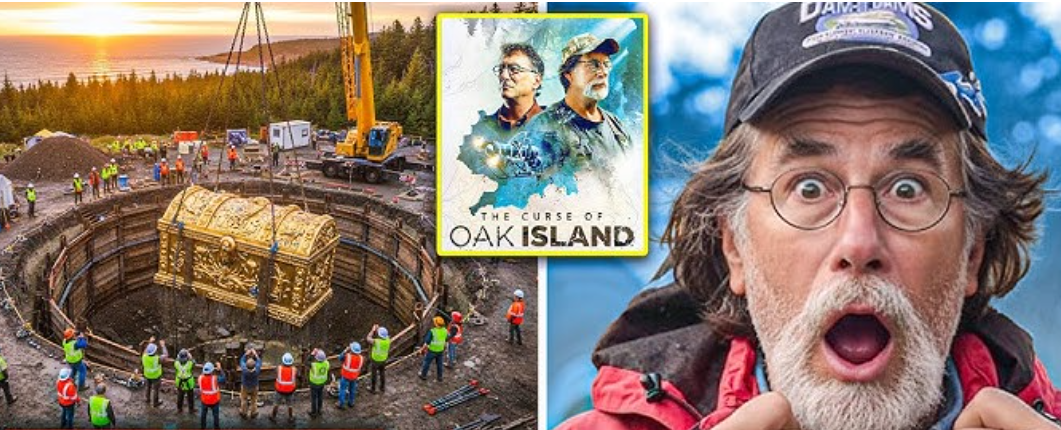
OAK ISLAND, NOVA SCOTIA — What began as a quiet update on a small excavation forum has now escalated into one of the most extraordinary archaeological developments in modern history. According to project lead Rick Lagginina, his team has uncovered a sealed subterranean chamber beneath Oak Island at a depth of roughly 180 feet—far deeper than any known colonial excavation. The structure, its artifacts, and its engineering are raising questions that may challenge centuries of accepted history.
Lagginina’s statement was brief but chilling: “We found something that shouldn’t exist.”
At first, few understood what he meant. But those watching the team’s swamp-zone drilling suspected something was coming. Sensors had repeatedly detected a geometric anomaly underground—an impossibly symmetrical void that defied geological models. When the borehole finally broke through, cameras revealed a clear cavity, its walls too smooth and deliberate to be natural.
“This wasn’t fractured stone,” Lagginina said. “It was architecture.”
An Engineered Void Deep Below the Island
Initial scans showed a chamber reinforced with layered materials—dense bands alternating with pockets of open air. Archaeologists describe such engineering as “impossibly advanced” for any group known to have reached Nova Scotia before the 17th century. As probes reached the chamber floor, a carved limestone slab emerged, sealed with marine clay and etched with a distinctive cross patty.
Experts recognized it immediately: the mark of the medieval Knights Templar.
The carving’s erosion pattern indicated enormous age. Subsequent testing confirmed the stone predated European colonial settlement by more than a century. The find electrified the team.
“This is the first physical proof,” Lagginina whispered when the Templar cross appeared on the monitors.
Ancient Gold and Ceremonial Relics Discovered
The discoveries did not end with the stone tablet. Beneath layers of sediment, the team recovered refined gold unlike any known colonial artifact. Metallurgical analysis showed purity levels and forging methods consistent with medieval Europe—centuries older than anything previously unearthed on Oak Island.
Then came an even more shocking artifact: a brass ceremonial chain, its links engraved with Templar iconography. Testing matched its alloy composition to known relics found in Poitiers, France, one of the order’s strongholds before its fall in 1312.
The chain’s discovery shifted the tone of the excavation. What had long been dismissed as legend suddenly had physical, datable evidence behind it.
“This changes everything,” Lagginina said.
A Trap Mechanism Hidden in the Bedrock
But the most unexpected revelation came next. Beneath the relics, cameras captured an intricate network of wooden beams, brass pulleys, and water valves embedded directly into the bedrock. Maritime engineers immediately recognized the design as a sophisticated counterweight system—similar to mechanisms used aboard medieval ships.
It was no accident. It was a defensive structure.
“This vault wasn’t meant to be found,” Lagginina explained. “It was meant to collapse if tampered with.”
The discovery suggested that whoever built the chamber understood geology, engineering, and long-term preservation at an astonishing level for the era.
A Celestial Blueprint Hidden Across the Island
To determine how the vault’s builders designed such a complex system, Lagginina enlisted specialists in lidar scanning and astronomical mapping. Their findings stunned the team.
Across Oak Island’s landscape, hidden beneath centuries of soil, lay a network of stone markers. Individually they seemed random, but when digitally plotted, they formed a perfect symmetrical cross. When overlaid with astronomical software, the alignment matched Orion’s Belt—one of the most sacred constellations in Templar tradition.
The realization reframed the entire excavation.
“They weren’t just hiding something,” said Marty Lagginina. “They were encoding knowledge.”
The major dig sites—Smith’s Cove, the Money Pit, the swamp—corresponded precisely to the constellation’s key stars. It was a map written in both earth and sky, implying that only those who understood the pattern could locate the vault.

The Final Chamber and a Medieval Chalice
Guided by the celestial layout, the team drilled into the constellation’s central intersection. The borehole camera descended into a polished limestone corridor leading to a sealed arched gate. Carved on its surface was the rosy cross—an ancient emblem associated with secrecy and preservation.
Behind the gate, scanners detected structured metallic forms. When the team inserted a fiber-optic lens through a narrow crack, the chamber shimmered with golden reflections. At its center stood a chalice.
The artifact was recovered days later. Its alloy was a precise blend of Byzantine gold and Frankish silver—a combination used in medieval reliquaries but lost for centuries. Around its rim was a Latin inscription: “Veritas sub rosa” — Truth under the rose.
Soon after, a letter from Vatican historians confirmed the chalice matched a relic listed as missing since the early 14th century.
Then, the final revelation: hidden coordinates on the first limestone tablet indicated that the Oak Island chamber was only “the lesser vault.” The greater vault—its purpose unknown—was marked on a remote location deep in the North Atlantic.
Lagginina stood before the sealed gate, chalice in hand.
“If this is the lesser vault,” he said quietly, “then what lies in the greater one?”
For now, Oak Island’s greatest secret may not be what rested beneath its soil, but what it was pointing toward.