OAK ISLAND MONSTER: Rick Lagina and Gary Drayton unearthed the giant skeleton of a prehistoric creature.
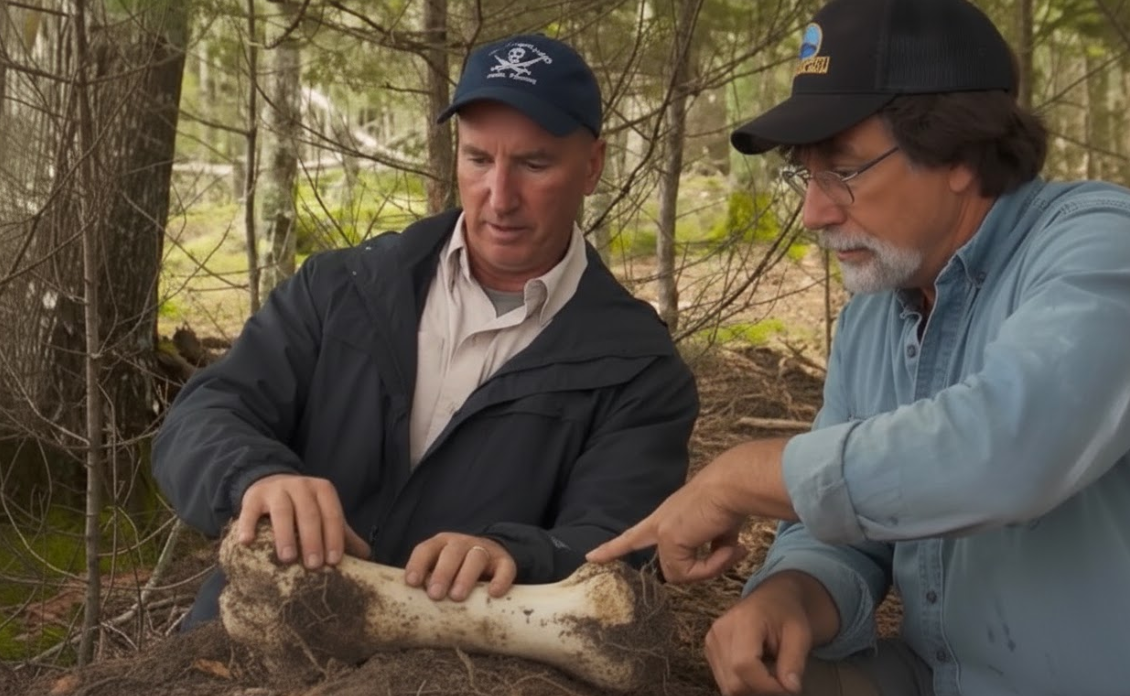
During a tactical sweep of a newly excavated section near the Swamp, lead treasure hunter Rick Lagina and metal detection expert Gary Drayton have unearthed a biological anomaly that defies conventional zoology. What began as a routine search for Templar artifacts has resulted in the recovery of a “large-scale” bone fragment so massive it has left experts speechless. Early assessments suggest the bone is neither human nor belonging to any known modern North American wildlife.
A “Top-Pocket” Find of Titanic Proportions
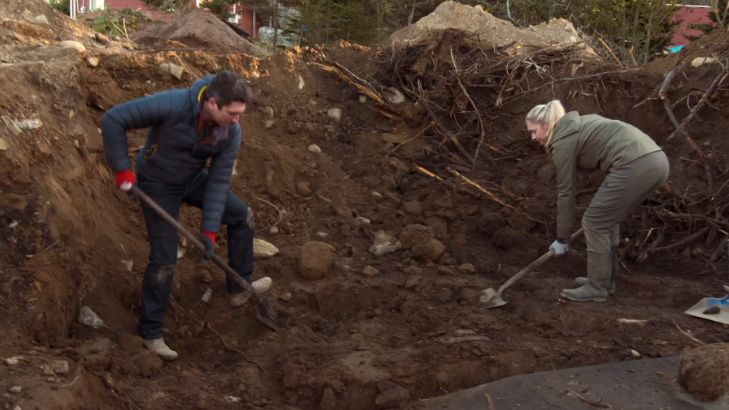
The discovery occurred late Thursday afternoon. Gary Drayton, known for his “top-pocket” finds of gold and silver, received a deep, booming signal from his Minelab detector. Expecting a heavy iron chest or a discarded ship’s anchor, the duo began a careful hand-dig.
“I thought it was a piece of an old galleon at first,” Drayton remarked, still visibly shaken by the find. “But as Rick brushed away the clay, we realized it wasn’t wood. It was ivory-white and porous. When we saw the joint socket, the scale of it hit us. It’s absolutely massive—far too big for a moose, a bear, or even a whale to be buried this deep inland.”
Defying the Laws of Nature
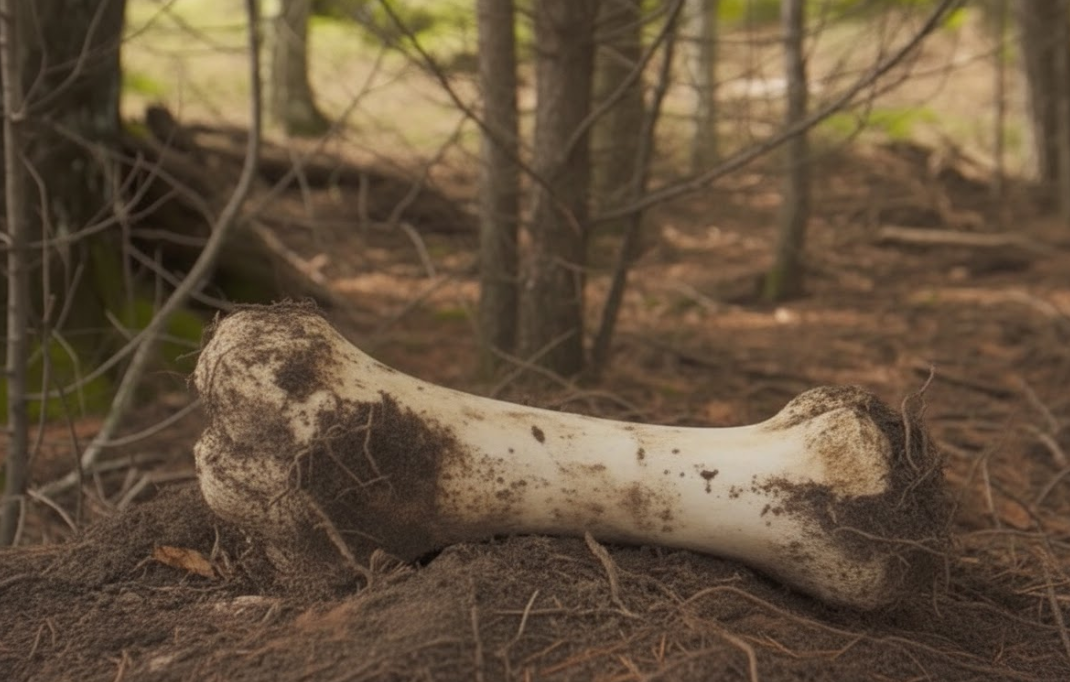
The specimen, currently being held under 24-hour armed guard following the recent Roman coin theft, measures several feet in length. Preliminary visual inspections by local biologists have sparked a firestorm of controversy.
-
The Size Factor: The bone’s density and circumference suggest a creature of immense weight and height, far exceeding the dimensions of any animal recorded in Nova Scotia’s history.
-
Non-Human Origin: While the team has found human remains in the Money Pit before (dating back to the Middle East and Europe), this fragment is purely “mega-faunal.”
-
Unknown Species: The structure of the bone does not match the skeletal maps of elephants, mammoths, or even prehistoric mastodons known to have roamed the continent during the Ice Age.
A Mythological Connection?
Speculation is already mounting among the crew and the “Oak Island” community. Could this be the remains of a legendary creature? Some are pointing to the Mi’kmaq legends of the Chenoo—giant, ice-hearted beings—while others suggest the bone belongs to a species of “giant” previously thought to be a work of fiction.
“We’ve always said this island is a place where history and myth collide,” Rick Lagina said during a briefing at the site. “If this bone belongs to a creature that shouldn’t exist, it changes the entire narrative of why this island was chosen. Was the treasure here to be hidden, or was it here to guard something… or someone?”
The Scientific Dilemma
The fellowship is now in a race against time to conduct DNA sequencing and radiocarbon dating. If the bone dates back to the 14th century—the same era as the recently stolen Roman coins—it would suggest a terrifying possibility: that the people who built the Money Pit were interacting with, or perhaps transporting, creatures of “mythic” proportions.
“It’s a monster-sized discovery,” Gary Drayton added. “In all my years of digging, I’ve never seen nature produce something this terrifyingly large.”
Security and Secrecy
In light of the recent War Room breach, the “Giant Bone” has been moved to an undisclosed high-security facility. The team is taking no chances, fearing that whatever forces targeted the Roman coins might now be after this biological “smoking gun.”
As Season 13 reaches its fever pitch, the mystery of Oak Island has shifted from “what is buried there” to “what lived there.”