Tony Beets Pushes for a 1,000-Ounce Week as Parker Schnabel and Rick Ness Face Their Own Final-Season Battles

With only a few weeks left in the mining season, the race for gold has reached its most demanding stage. Tony Beets, Parker Schnabel, and Rick Ness are all fighting different battles, but the pressure is the same across the Klondike: every hour matters, every breakdown costs money, and every ounce could decide how the season ends.
For Tony Beets, the goal is simple. He wants to finish strong, protect his reputation, and remind everyone why he is still considered one of the most powerful miners in the Yukon. Tony has already passed his 6,500-ounce target and stacked more than $30 million in gold, but that has not slowed him down. With the price of gold rising, the veteran miner sees a chance to push even harder.
Tony’s latest plan is ambitious: get four wash plants running and chase a possible 1,000-ounce week. To make that happen, he needs fresh pay from the Hester cut and a fast setup for his fourth wash plant, Harold. The operation begins with building a pad for the 100-yard-an-hour plant, installing a 30-foot hopper feeder, connecting the water system, and firing up the pump.
But as always in gold mining, the plan quickly runs into trouble.
The pump refuses to start after showing a coolant issue. Mechanic Lucas Lots discovers that the problem may be connected to the coolant sensor or the electronic control module, the computer system that prevents the pump from running if it cannot confirm the correct coolant reading. Without that pump, Harold cannot run. Without Harold, Tony’s four-plant push could fall apart before it even begins.
Lucas turns to a field repair using a potentiometer, a variable resistor that can imitate the signal from a working sensor. It is the kind of practical fix that defines Yukon mining: part mechanical skill, part improvisation, and part nerve. After careful adjustment, the code clears, the pump comes back to life, and Tony’s fourth wash plant remains in play.

The repair matters because Tony is not simply chasing another good cleanup. He is trying to overwhelm the competition in the final stretch. His operation has enough pay, enough equipment, and enough ambition to make a major finish possible. But with multiple plants running, every new machine adds more demand on the crew. More pumps, more hoses, more feeders, and more moving parts mean more chances for something to fail.
While Tony pushes for maximum output, Parker Schnabel is already looking beyond the current season. Parker has built momentum with several weeks above 500 ounces and is nearly 700 ounces ahead of Tony in the race toward 10,000 ounces. His current position is strong, but his attention is also fixed on next year.
For Parker, autumn is not just the end of one season. It is one of the most important preparation periods for the next. His crew has begun stripping new ground on the Indian River, opening the next pit while still trying to keep active wash plants running. Parker understands that the scale of his company now depends on constant forward planning. If the next season’s ground is not ready early, the entire operation risks losing valuable time when spring arrives.
That responsibility falls heavily on key team members like Mitch Blaschke, who must keep current production alive while helping prepare future ground. Parker’s operation has become a massive machine, and the final weeks of the season show how difficult it is to balance immediate gold production with long-term strategy.
Rick Ness, meanwhile, is facing a much more personal and urgent fight.
After two months with no gold coming in, Rick’s season finally began to turn around when he fired up Monster Red at Vegas Valley and pulled more than 200 ounces. For a seven-man crew, the result was impressive and gave Rick a badly needed boost. But the celebration did not last long.
Rick is still far from his 1,800-ounce target. To reach it and pay his crew their bonus, he needs approximately 400 ounces every week for the rest of the season. That is a huge demand for any crew, especially one that has already been worn down by months of setbacks, long hours, and uncertainty.
The situation becomes more difficult when Bailey discovers that Vegas Valley is nearly out of pay dirt much sooner than expected. There is only about a week’s worth of pay left in the cut. To keep Monster Red running, Rick wants to chase the pay streak upstream. The problem is that Bailey would have to dig down another 40 feet to reach the richer material, all before winter closes in.
Bailey is cautious, and for good reason. Moving that much material at the end of the season is a major task. The crew is tired, time is short, and the payoff is not guaranteed. Rick, however, sees no other choice. If the deeper pay can produce a 400-ounce week, it may be worth the effort. His focus is clear: he wants his crew to go home with gold in their pockets.
That emotional weight becomes even clearer through Z’s return to the site. Rick’s longtime friend jumps back into the loader to help feed Monster Red, while mechanic Ryan Kent works nearby clearing tailings. Z’s presence brings humor and familiarity, but also a reminder of what the crew sacrifices to be there.
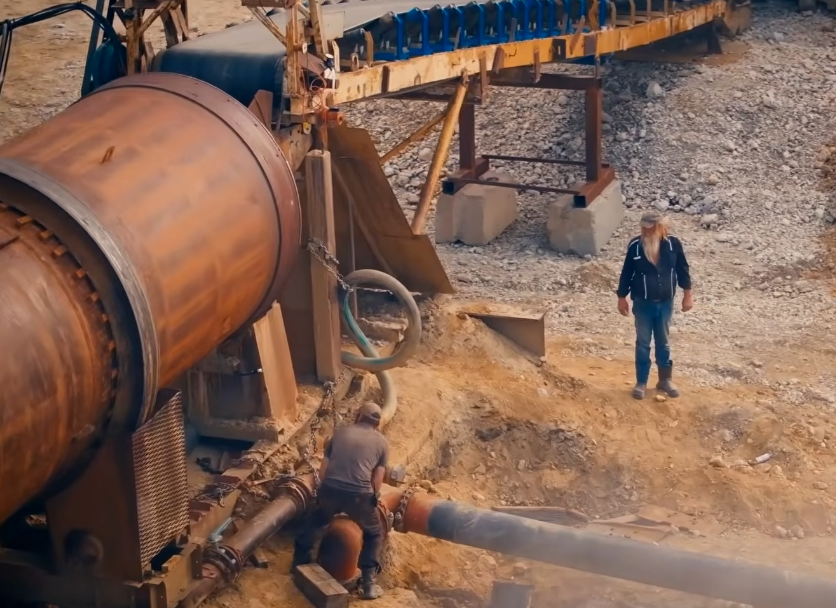
When a pin breaks on the grizzly bar hinge, the team faces another interruption. It is not a catastrophic breakdown, but at this stage of the season, even two hours of downtime matters. Ryan and Z search for a replacement pin, remove one from another feeder, and get Monster Red running again. It is a small repair, but it carries a larger meaning: Rick’s season is being held together by persistence, loyalty, and quick thinking.
Behind the machinery, the human cost is becoming harder to ignore. Z admits that spending six months away from home is difficult, especially when the gold is uncertain. He speaks about family, responsibility, and the possibility of staying home next year. His comments reveal one of the quieter truths of Gold Rush: the fight for gold is not only measured in ounces. It is measured in time away from loved ones, pressure on families, and the emotional strain of chasing a goal that may not pay off.
As the season enters its final stretch, Tony, Parker, and Rick represent three different versions of mining pressure. Tony is chasing dominance. Parker is balancing current success with future growth. Rick is fighting to save his season and reward the people who stood by him.
The Klondike may be rich with gold, but in these final weeks, nothing is guaranteed. The crews are tired, machines are fragile, and winter is closing in. For every miner, the message is the same: run hard now, or leave the gold behind.