Jeremy Clarkson caused a stir with his statement that he “will run for Congress and oust Ed Miliband.”
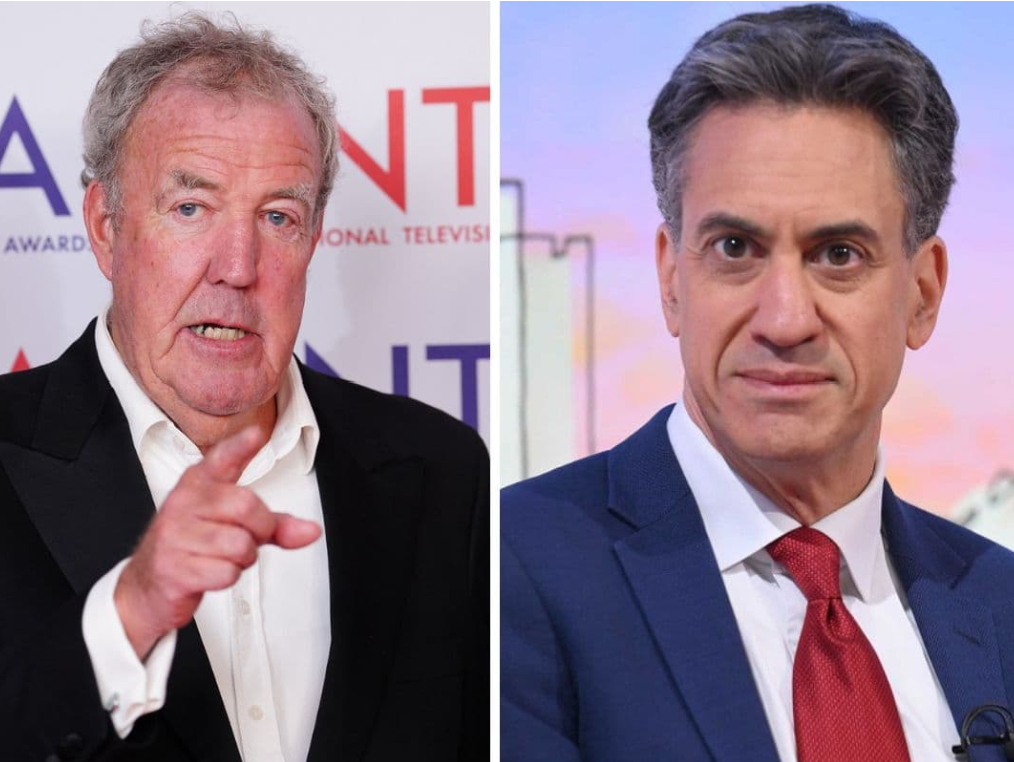
The recent statement attributed to Jeremy Clarkson—claiming he “will run for Congress and oust Ed Miliband”—has triggered an immediate wave of speculation across media circles, political commentary spaces, and fan communities of Clarkson’s Farm. While the remark appears to sit somewhere between satire, provocation, and performance commentary, its impact is already measurable in terms of public discourse and brand amplification.
From an analytical standpoint, the key question is not whether Clarkson intends to pursue political office in the United States—a claim that is structurally implausible given constitutional eligibility requirements—but rather why such a statement resonates so effectively in the current media ecosystem.
Clarkson’s Established Pattern: Provocation as Brand Infrastructure
Jeremy Clarkson has built a multi-decade career on calibrated controversy. From Top Gear to Clarkson’s Farm, his public persona operates within a consistent framework: blunt commentary, ideological exaggeration, and a deliberate tension between authenticity and theatricality.
Within the Clarkson’s Farm universe, this persona has been reframed into a rural-business narrative: the “outsider farmer” battling regulatory systems, market inefficiencies, and bureaucratic friction. The Congress statement, therefore, fits a recognizable pattern—it extends his established identity of institutional challenger into a political fantasy space.
In media theory terms, Clarkson is not merely speaking; he is continuously performing a meta-character whose value increases with reaction intensity. The “Congress run” claim should be interpreted through that lens: not as policy intent, but as narrative acceleration.

Why Ed Miliband Became the Target
The mention of Ed Miliband is not incidental. As a public figure associated with UK energy and climate policy debates, Miliband represents a symbolic node in the broader conversation around regulation, sustainability, and rural policy pressure—topics frequently explored in Clarkson’s Farm.
Clarkson’s brand has repeatedly positioned itself in contrast to policy frameworks perceived as detached from agricultural realities. Whether discussing fertilizer restrictions, taxation concerns, or environmental compliance burdens, the show often frames rural producers as operating under increasingly complex regulatory constraints.
By invoking Miliband in a transatlantic political fantasy, Clarkson effectively compresses multiple policy tensions into a single rhetorical target. This is less about electoral logic and more about symbolic opposition: the farmer versus the regulator, the producer versus the policymaker.
The Implausibility Factor: Political Reality vs Media Fiction
From a structural standpoint, the claim collapses under basic institutional analysis. A British media figure cannot simply “run for Congress” without constitutional eligibility (citizenship requirements alone eliminate feasibility). However, this implausibility is precisely what gives the statement its viral elasticity.
Modern media ecosystems increasingly reward content that is instantly interpretable yet obviously exaggerated. Clarkson’s statement functions in this space: it is not meant to be verified, but to be circulated.
In Clarkson’s Farm terms, this reflects a broader shift in how rural narratives are consumed. The audience is no longer only engaged with farming logistics or agricultural education; they are also consuming personality-driven commentary that intersects with politics, economics, and cultural identity.
The Clarkson’s Farm Ecosystem Response
Within the Clarkson’s Farm analytical framework, this event can be interpreted as a “brand pressure amplifier.” Clarkson’s public identity is no longer confined to television production cycles; it now operates as a continuous media entity across interviews, social platforms, and derivative commentary.
Three immediate response patterns typically emerge in such situations:
- Audience Polarization
Supporters interpret the statement as humorous exaggeration or anti-establishment satire. Critics frame it as attention-seeking or politically irresponsible rhetoric. - Media Recycling Loop
News outlets repackage the statement into opinion cycles, debates, and reaction pieces, extending its lifespan far beyond the original context. - Narrative Integration into Clarkson’s Farm
The show itself may indirectly reference or capitalize on the publicity through thematic reinforcement—particularly around bureaucracy, governance, or rural policy friction.
Strategic Implications for Clarkson’s Brand
If analyzed as a media strategy rather than a literal political announcement, the statement reinforces three key brand dynamics:
- Cross-domain relevance: Clarkson remains relevant beyond agriculture, spanning entertainment, politics, and cultural commentary.
- Conflict-driven engagement: Controversy continues to be a primary driver of audience attention.
- Institutional tension narrative: The recurring theme of “individual vs system” remains central to his storytelling ecosystem.
From a production standpoint, this type of publicity indirectly benefits Clarkson’s Farm by sustaining attention between seasonal releases and reinforcing Clarkson’s role as a culturally reactive figure.
Predicted Developments
Looking forward, several plausible trajectories emerge from this media moment:
1. Clarification or Retraction Statement
It is likely that Clarkson or his representatives will frame the comment as humorous exaggeration or contextual banter, reducing political interpretation while preserving comedic ambiguity.
2. Integration into Clarkson’s Farm Narrative Tone
Future episodes or promotional material may subtly incorporate themes of governance frustration, regulatory critique, or “system inefficiency,” aligning with the public discourse triggered by the statement.
3. Escalation of Satirical Political Commentary
Clarkson may further lean into exaggerated political rhetoric as a tool for audience engagement, especially if media coverage amplifies the initial remark.
4. Temporary Media Cycle Dissipation
As with many Clarkson-related controversies, the discourse will likely peak rapidly before being replaced by the next attention cycle, unless deliberately reignited.
Conclusion
The claim that Jeremy Clarkson intends to “run for Congress and oust Ed Miliband” should be understood not as a literal political declaration, but as a high-impact media artifact operating within Clarkson’s established brand logic.
Within the Clarkson’s Farm analytical framework, it represents another iteration of his enduring formula: provocative simplicity layered over complex institutional critique. Whether interpreted as satire, commentary, or strategic performance, the statement ultimately reinforces Clarkson’s position as one of the most effective attention-engineered personalities in contemporary British media culture.
In that sense, the real story is not about Congress, nor about Miliband—but about how easily modern audiences convert personality-driven rhetoric into global discourse.