Ancient Clues Deepen the Mystery: Roman Coin and 15th-Century Horseshoe Found on Oak Island
As Season 13 of The Curse of Oak Island progresses, the investigation has taken a remarkable leap forward with discoveries that could connect the island to civilizations far older and far more widespread than previously imagined. From a possible Roman artifact examined in Halifax to a 15th-century horseshoe unearthed in the swamp, the Oak Island team now faces one of its most intriguing seasons yet.
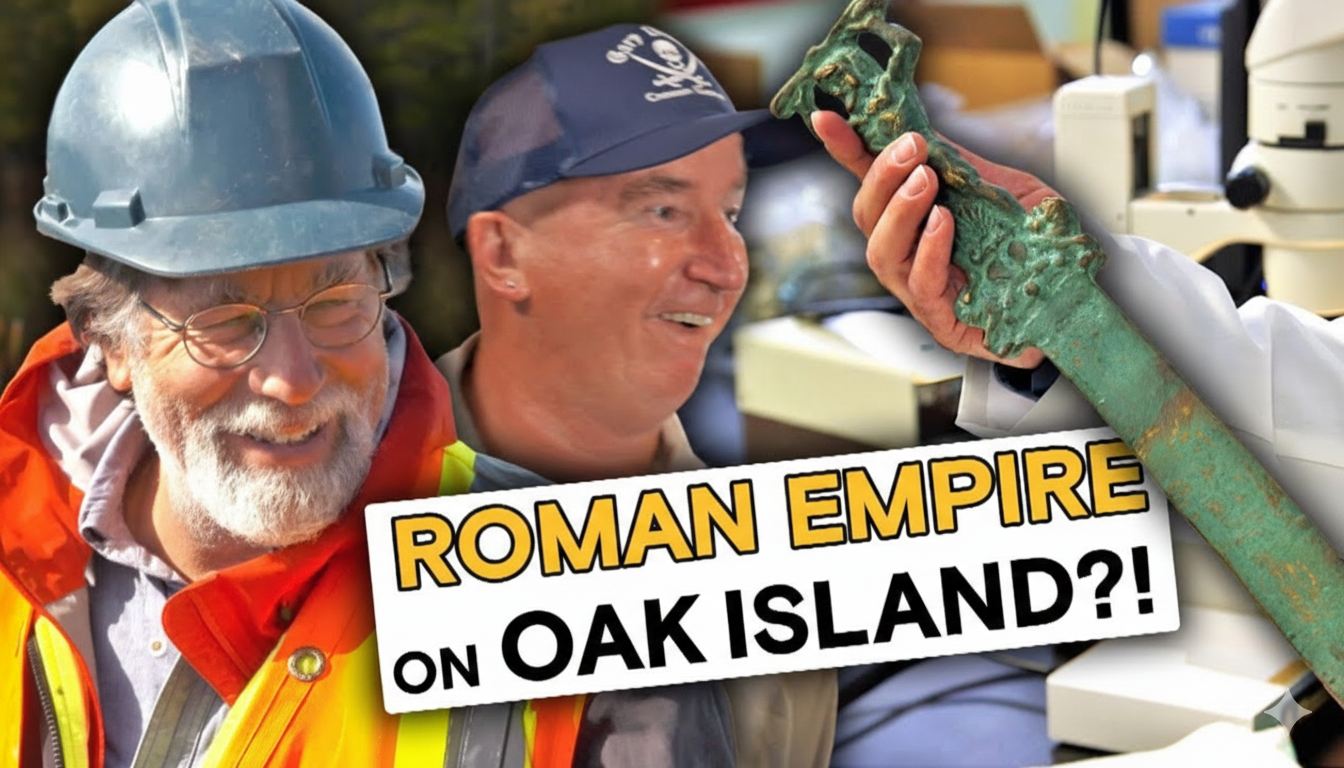
This week’s search began not on the island itself, but 50 miles away at St. Mary’s University in Halifax, where Rick and Marty Lagina, their nephew Alex, Craig Tester, and longtime partner Dave Blankenship arrived carrying an object that has ignited heated debate among theorists. The item — a bronze sword reportedly recovered from waters near Oak Island — has long been rumoured to resemble a Roman weapon dating back nearly 1,800 years.
The team presented the artifact to Professor Myles McCallum, a specialist in Roman archaeology. One look at the sword captivated the group; its ornate design included a depiction of Hercules, a significant figure in Roman mythology. Still, Professor McCallum urged caution. While acknowledging that the piece was stylistically Roman, he noted that its construction seemed unusual for a functional ancient weapon. Lines along the casting suggested a bivalve mould rather than the lost-wax method typically used during the Roman era.
“It may not be ancient,” McCallum explained, “but it could be a copy produced centuries later.” A reproduction from the 18th or 19th century, rather than a modern counterfeit, would in itself carry historical weight — possibly linking the object to early explorers or private collectors who travelled the North Atlantic long before Oak Island’s modern treasure hunt began.
For Rick and the team, the verdict was neither a confirmation nor a dismissal. McCallum’s assessment kept the door open to the possibility that the artifact had legitimate historical significance, leaving the team determined to investigate further.

Back on Oak Island, attention turned to another find — a cut copper coin discovered on Lot 5 during a metal-detecting sweep by Rick Lagina and Gary Drayton. To evaluate the piece, numismatist Sandy Campbell joined Alex Lagina, Jack Begley, and archaeometallurgist Emma Culligan at the island’s Interpretive Center.
Campbell examined the coin fragment while Culligan displayed X-ray fluorescence results showing high copper, tin, lead, small traces of silver, and notably, arsenic. The presence of arsenic, combined with the metallurgy, strongly suggested a pre-1500 origin. Campbell estimated that the coin might have originally weighed around three grams — meaning the recovered piece represented roughly one-third of a larger whole. Cutting coins for partial payments was common practice in ancient economies.
Then came the remarkable assessment: the engraving style and lettering suggested a Roman or possibly Byzantine coin dating from 300 BC to as late as 600 AD.
The team was stunned. A Roman-era coin on Oak Island introduced possibilities far beyond the typical narratives of 17th- or 18th-century visitors. Rick and the others immediately considered parallels with their 2023 research trip to Portugal, where they studied Templar roads, architecture, and stonework. Remarkably, the swamp’s stone path — discovered in 2020 — resembled Roman cobblestone roads still visible in parts of central Portugal.
The implications raised a tantalizing question: could Roman or Roman-influenced artifacts have reached the island through medieval travellers such as the Knights Templar, whose maritime networks extended across Europe?
While the coin may not provide definitive proof, it is undeniably inconsistent with known Nova Scotian history. As archaeologist Laird Niven noted, no Roman coins have been recorded in the region. Yet evidence from archaeological sites along the eastern United States suggests rare instances of ancient items transported across the Atlantic by later populations.
The following day brought yet another significant clue. At the triangular swamp — long suspected of concealing a concealed structure or roadway — Rick, Gary Drayton, and heavy-equipment operator Billy Gerhardt located a small horseshoe while clearing earth along the suspected stone ramp. Though heavily corroded, the shoe appeared unusually small, suggesting it belonged not to a draft horse but a riding or cavalry horse.
To learn more, they consulted blacksmithing expert Carmen Legge. His reaction was immediate: the shoe’s thickness, curvature, and handmade construction indicated an age potentially stretching back to the 1400s. Such a date predates recorded European presence in Nova Scotia by more than two centuries.
Even more compelling was the type of horse the shoe would fit. Legge explained that the design suited a high-prestige riding horse — the kind a military leader or engineer might use while overseeing construction projects. If this object did originate from the 1400s, its presence in the swamp is difficult to explain within known North American timelines.

The context deepens the mystery. Over recent years, the team has uncovered ship components, cargo barrel fragments, wooden structures, and evidence of controlled water systems around the swamp. Combined with the stone road and the newly classified Roman-era coin, the horseshoe could point to a far earlier — and far more sophisticated — presence on the island than previously documented.
Rick Lagina reflected on the discovery with characteristic caution and curiosity. “If this truly dates to the 1400s,” he said, “then we may be looking at something that rewrites part of Nova Scotia’s history.”
As the team returns to Lot 5, energized by new evidence, Oak Island once again demonstrates why its mystery continues to captivate audiences year after year. With each find — whether a coin, a sword, or a centuries-old horseshoe — the island whispers a little more of its elusive story. And Season 13 is shaping up to be one of the most revealing chapters yet.