A buried structure changes everything: why Oak Island’s latest discovery could redefine the mystery
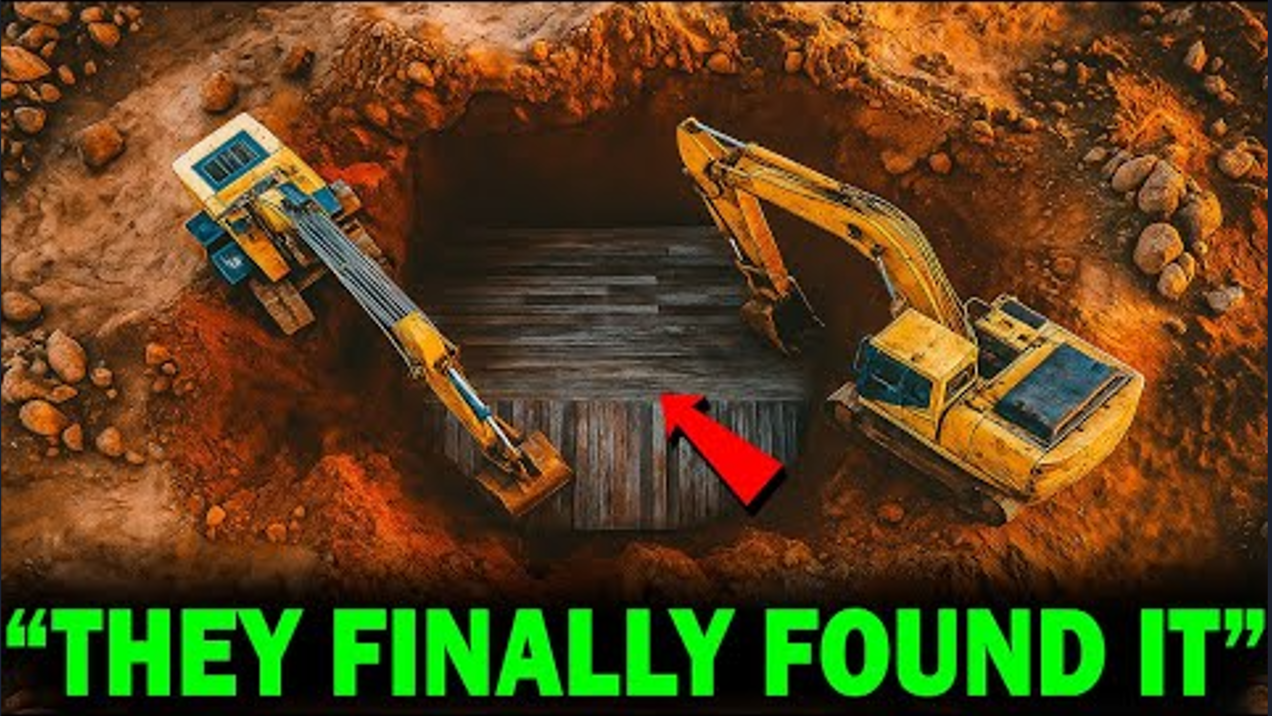
From the perspective of a long-time analyst of The Curse of Oak Island, few moments stand out as genuine turning points. Many discoveries over the years have added texture to the legend—artifacts, wood, traces of human activity—but rarely has the island offered something that forces a complete reassessment of intent. The newly revealed underground structure, uncovered during the 2026 investigation, appears to be one of those rare moments.
What separates this discovery from earlier finds is not just its scale, but its precision. Advanced scans pointed to a perfectly flat, linear surface buried deep between Lots 5 and 9—an area previously dismissed as unremarkable. When excavation confirmed sharp angles, straight edges, and a clearly defined wall, the team was confronted with evidence that went beyond coincidence or geology. This was not erosion. It was design.
Why this location matters
The decision by Rick Lagina and Marty Lagina to shift focus away from the traditional Money Pit zone was significant. For years, effort clustered around known problem areas where flooding and collapse repeatedly halted progress. By moving into an overlooked corridor, the team effectively tested a new hypothesis: that Oak Island’s creators built laterally, not just vertically.
The data supported that idea. Ground-penetrating radar, LiDAR mapping, magnetometer surveys, and sonic drilling all converged on the same coordinates. In analytical terms, this alignment across independent systems dramatically reduces the likelihood of error. When multiple technologies “agree,” the signal is usually real.
A structure, not a coincidence
As soil was removed layer by layer, the excavation tool struck something solid, producing a sound unmistakably different from rock or compacted earth. What emerged was a flat surface resembling cut stone or engineered material. As more of it was exposed, a corner came into view—clean, angular, unmistakably shaped.
For analysts, this detail is crucial. Natural formations rarely produce right angles at scale. When they do appear, they lack consistency. Here, the surface showed uniformity, symmetry, and apparent tool marks. Even more compelling was the discovery of what looked like a threshold or sealed opening within the wall.
Marty Lagina’s response—measured and cautious—signalled the importance of the moment. Rather than accelerating the dig, the team slowed down, switching to methods closer to archaeological practice. That choice suggests recognition that the site may represent an intact system rather than a collapsed remnant.

Rewriting two centuries of assumptions
Oak Island has long been portrayed as a place that “fights back,” with water intrusion and collapses frustrating nearly every attempt to dig deeper. Traditionally, these events were seen as obstacles. From an analytical viewpoint, the new structure suggests they may have been safeguards.
The placement of a solid wall, combined with evidence of sealed passages and controlled voids, points to an intentional access-management system. In other words, Oak Island may not have been designed to hide something passively, but to actively resist intrusion unless approached in a specific way.
That interpretation also reframes earlier discoveries, including the legendary inscribed stone found near the 90-foot level in early accounts. Whether or not its translation was accurate, the idea of warnings or instructions now fits into a broader architectural logic.
Old theories, new weight
Speculation about the Knights Templar, early European explorers, or secretive organisations has circulated for decades. Most analysts treated these ideas cautiously, noting the lack of structural proof. The appearance of carved symbols inside the newly identified tunnel—particularly markings resembling a cross pattée—changes that balance.
Such symbols are not definitive proof of identity, but they are consistent with medieval European iconography. When combined with advanced engineering and strategic burial, they suggest builders with resources, planning capability, and motive. Whoever created this system expected interference—and prepared for it.
A tunnel, not a dead end
The introduction of a fibre-optic camera into a small opening within the structure provided the most compelling evidence yet. The footage revealed a narrow, carefully supported tunnel, its walls smooth and its ceiling reinforced with hand-cut wooden beams in an old-world style. This was not a random cavity. It was a maintained passage.
More striking still was the apparent widening of the tunnel into a chamber beyond the camera’s light range. For analysts, this is the moment when the discussion shifts from “what is this?” to “what does it lead to?” A sealed access point, reinforced tunnel, and potential chamber together form a classic protective sequence.

Shadows of past searchers
The discovery has also revived uncomfortable questions about previous excavations, particularly those conducted aggressively in the mid-20th century. Some theories suggest earlier operators may have encountered man-made barriers but failed to document—or deliberately reburied—them. While these claims remain unproven, the fact that such a substantial structure went unnoticed for so long raises legitimate concerns about what might have been missed or obscured.
From an analytical standpoint, this does not imply conspiracy so much as context. Earlier teams lacked modern imaging, operated under financial pressure, and often prioritised speed over preservation. The current approach stands in sharp contrast.
What happens next
If the team proceeds beyond the sealed opening, risk assessment will dominate every decision. The presence of engineered tunnels implies controlled spaces, but also potential instability and water interaction. The Laginas’ restraint so far suggests they understand that this phase is not about speed or spectacle.
The broader implication is clear: Oak Island may not be a single “treasure spot,” but an integrated system designed to delay, mislead, and protect. The newly uncovered structure appears to be a core component of that system.
For the first time in many seasons, analysts can say with confidence that the narrative has shifted. This is no longer about scattered clues. It is about architecture, intent, and purpose. Whether the chamber beyond holds valuables, records, or something else entirely, the discovery confirms one thing: Oak Island was built to guard something—and to decide who was worthy of reaching it.