Oak Island Team Closes In on What Could Be the Most Significant Find in Treasure Hunting History
For more than two centuries, Oak Island has stood at the center of one of the world’s most enduring mysteries. The elusive Money Pit, first discovered in 1795 by three young men who noticed an unusual depression in the ground, has inspired generations of explorers, historians, engineers, and adventurers. Now, new evidence revealed by The Curse of Oak Island suggests that the search may be approaching a pivotal breakthrough—one that could rank among the most significant discoveries in the history of treasure exploration.
In a recent episode, the team led by Rick and Marty Lagina uncovered an item that immediately sparked excitement across the Oak Island community. Metal-detecting expert Gary Drayton, working with Rick near the island’s rocky shoreline, recovered an object in the shape of a cross—one that bore a striking resemblance to carvings found inside a medieval Templar prison in Domme, France. As Gary handed the artifact to Rick, he remarked, “I’ve seen that shape before,” prompting a comparison shot of the historic engravings left behind by imprisoned knights during the early 14th century.
Within seconds, the mood changed. What began as a routine shoreline survey quickly took on historic significance. Drayton’s astonished exclamation—“We might have just made history”—captured the magnitude of the moment. Marty Lagina, after examining the object, added: “This is incredible… it fits in every aspect.” The team has found Templar-linked artifacts before, but this particular cross appears to match medieval iconography with unusual precision.
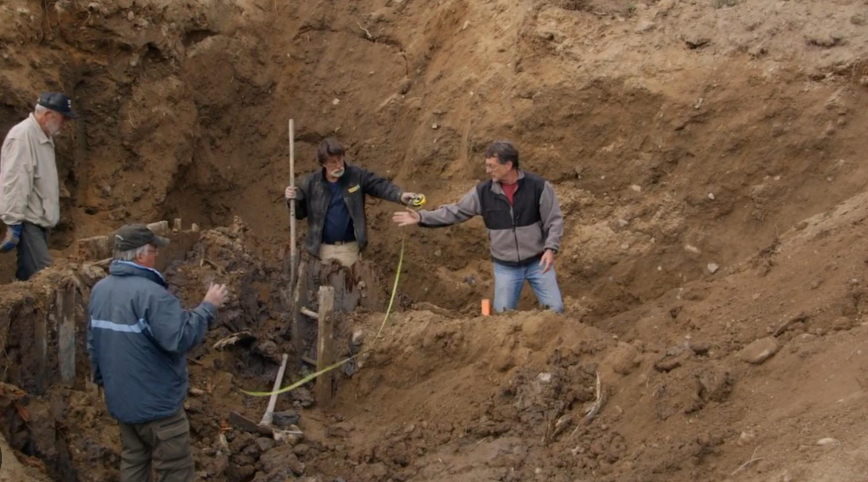
This discovery coincides with another high-stakes development beneath the surface. In the Money Pit area, the team’s massive 50-inch caisson has reached a depth of approximately 170 feet, where drill sensors indicate that the casing is resting on a flat, hard surface. Marty Lagina is heard saying, “This could be the vault,” referring to the legendary Chamber supposedly encountered by searchers William Chappell and Frederick Blair in 1897. Historical records describe a structured feature at this depth containing layers of metal, wood, and cement-like material—fueling speculation that the vault may hold objects of immense historical value.
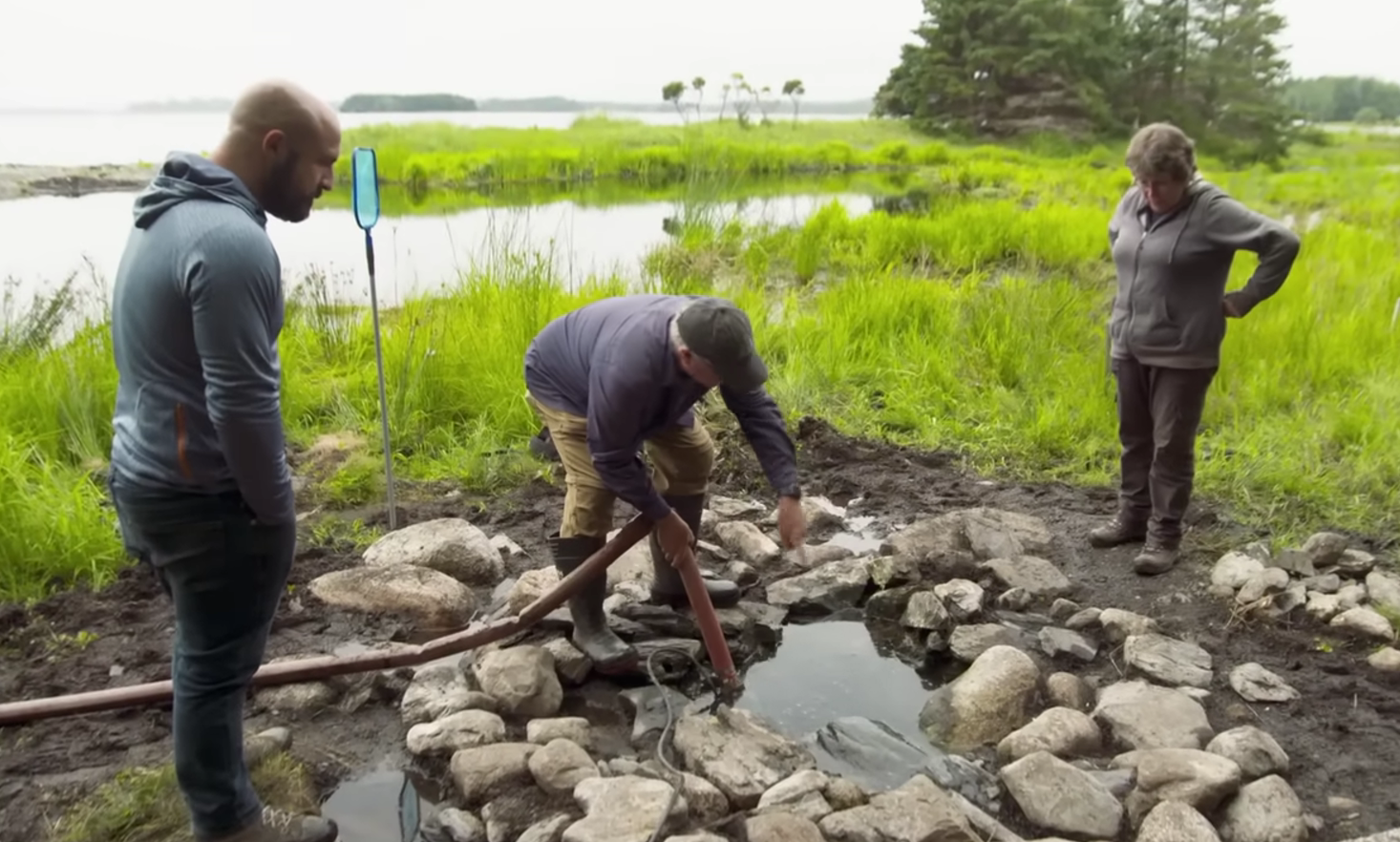
In a preview for upcoming episodes, the team also reviews a ship’s log that references the construction of “a deep pit” where treasure was to be buried, with “a secret entrance by tunnel from the shore.” The description closely mirrors Oak Island’s most persistent theories and aligns with the team’s ongoing evidence of man-made flood tunnels and subterranean engineering that appears far more advanced than what 18th-century settlers could have created.
An Island Guarded by Secrets for Centuries
Oak Island has always resisted straightforward answers. Its labyrinth of shafts, tunnels, and booby-trap systems has confounded searchers since the early 1800s. Flood tunnels rush seawater into excavations. Layers of engineered clay, coconut fibre, and timber appear in sequences far below natural grade. Every attempt to reach deeper strata has encountered obstacles that seem deliberately constructed.
Yet, over the last decade of the Laginas’ methodical excavation, technological advancements have allowed the team to probe deeper and with greater precision. Ground-penetrating radar has revealed anomalies in the Money Pit consistent with voids or chambers. Carbon-dated wood and artifacts have repeatedly confirmed activity on the island many generations before the famous 1795 discovery. Gold traces have been identified in the water of the solution channel, suggesting metallic objects may lie deeper within collapsed tunnel systems.
A Broader Historical Web
What makes the recent cross-shaped discovery particularly compelling is how it fits into a larger historical narrative the team has slowly assembled. Over the years, artifacts and materials from different eras—including medieval items, communications tokens, ancient structures, and metal fragments—have surfaced across the island. Some researchers believe these clues point to a coordinated, multi-phase effort by groups operating centuries apart.
The Templar theory, while long debated, gains renewed weight whenever such artifacts appear. Supporters argue that members of the Knights Templar, possessing significant resources and seeking safe haven after their suppression in 1307, may have transported sacred objects or wealth across the Atlantic. France’s Domme prison, where the cross engravings were found, was a key site where Templars were held. A matching artifact on Oak Island would be highly consequential.
Yet the theory extends further. Medieval mariners, early Portuguese navigators, and later European settlers all passed through the region. Some historians now suggest Oak Island may have been used repeatedly across centuries, its geography and natural features lending themselves to concealed operations.
A Potential Turning Point
In interviews shown during the episode, Rick Lagina acknowledges the tension and anticipation surrounding their latest efforts. As he watches the caisson descend toward the suspected vault level, he admits, “After all the work that we’ve done, this is the culmination.” When Marty asks how he is feeling, Rick answers simply: “Nervous.”
For viewers and experts alike, that sense of anticipation is palpable. Each new find appears to tighten the narrative, rather than expand it into unrelated fragments. The combination of the cross, the Money Pit depth readings, historical documentation, and ground scans has led to one of the strongest periods of optimism in the project’s modern history.
What Comes Next?
The upcoming episodes promise high tension. The cross-shaped artifact is set for detailed scientific analysis. The 170-foot structure beneath the caisson may be further explored. And the team’s research into archive materials—maps, ship logs, and early settlement records—may reveal additional clues about who engineered Oak Island’s subterranean systems and why.
If the chamber below truly contains preserved objects—whether coins, documents, metals, or engineered structures—the discovery could redefine Oak Island’s place in global history.
For now, the island remains silent. But with each passing episode, the sense grows stronger that centuries of guarded secrets may finally be approaching the moment of revelation.