Nolan’s Cross, Ancient Stonework, and a Growing Pattern of Human Effort on Oak Island
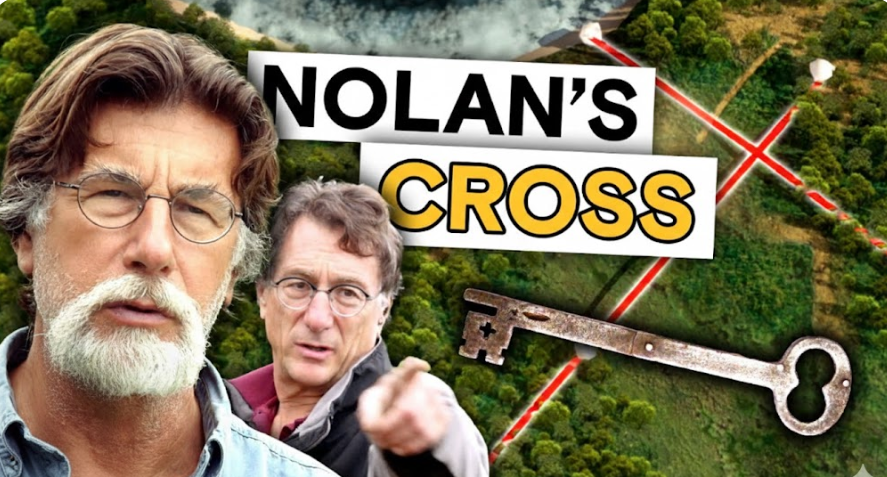
In The Curse of Oak Island, progress is rarely linear. Instead, discoveries emerge in fragments—stone by stone, artefact by artefact—slowly forming a picture of deliberate human activity that challenges long-held assumptions about the island’s past. Recent investigations on land once owned by the late Fred Nolan have brought several of those fragments into sharper focus, reinforcing the idea that Oak Island was shaped by intention rather than chance.
While drilling at the Money Pit was temporarily paused, Rick Lagina, joined by historian Charles Barkhouse and team member Jack Begley, turned their attention to one of Fred Nolan’s most controversial discoveries: Nolan’s Cross. First identified in 1981, the formation consists of five large, cone-shaped granite boulders arranged in a precise cross measuring roughly 720 by 867 feet. Nolan believed something significant lay at its centre, a suspicion that has lingered for decades.
At the heart of the formation lies a sixth boulder, long referred to as the “headstone,” which Nolan uncovered after digging beneath the cross’s intersection point. Its unusual shape—flatter than the surrounding stones and bearing features that resemble facial contours—has fuelled debate over whether it was naturally formed or intentionally modified. To reassess that question, the team invited stonemasons Mike Welling and Mark Fuir to examine the site with fresh eyes.
Their assessment was cautious but notable. While the surrounding boulders appear naturally cone-shaped granite, the headstone and the lower surface of one key stone displayed characteristics that raised questions. The underside of the granite showed an unusually smooth surface, inconsistent with typical weathering. According to the stonemasons, such smoothing could result from prolonged dragging, suggesting transport rather than natural deposition. If correct, this would imply the stones were moved intentionally—an effort that would have required planning, manpower, and tools.
From an analytical perspective, this observation matters because it reframes Nolan’s Cross not simply as a symbolic arrangement, but as evidence of logistical capability. Whether interpreted as a Templar-style cross, a representation of the Hebraic Tree of Life, or something else entirely, the formation points to deliberate placement. Symbols may inspire theories, but physical manipulation of multi-ton stones suggests action with purpose.
The day’s investigation did not end there. For the first time since Fred Nolan’s death, his son Tom granted the team full access to all 16 acres of the Nolan property. That cooperation immediately yielded results on nearby Lot 12, an area Nolan once described as an ancient dump site. Previous accounts suggested the location contained debris linked to early construction activity on the island, possibly associated with the original Money Pit.
Excavation quickly confirmed those stories. Pottery fragments, square nails, and iron pieces emerged in abundance, forming a concentrated layer rather than random scatter. The density of material indicated repeated disposal over time, consistent with sustained human presence. As Rick Lagina noted, confirming that Nolan’s accounts matched physical reality was itself a major step forward. In Oak Island terms, corroboration is often as important as discovery.
Among the most intriguing finds were decorative iron hinges, recovered by metal-detection expert Gary Drayton. Similar hinges have been documented on chests recovered from historic shipwrecks, raising the possibility that containers—perhaps boxes or chests—were once present at the site. While such objects do not confirm treasure, they strongly suggest storage and transport of valuable goods.
The investigation then moved east toward Lot 13, where Tom Nolan joined Rick and the team to examine a large stone near an old apple tree. Embedded within it were the remains of an iron ring bolt, first discovered by Fred Nolan roughly half a century ago. Tom’s confirmation that the feature matched his childhood memory added credibility to the find. Ring bolts are not decorative; they are functional hardware, typically used with block-and-tackle systems to move heavy loads.
Taken together, the evidence paints a consistent picture. Stone roads, ring bolts, dragged boulders, dump sites, and chest hardware all point to organised labour operating well beyond casual settlement. The scale of effort implied by these features suggests that whatever occurred on Oak Island involved planning, secrecy, and resources.
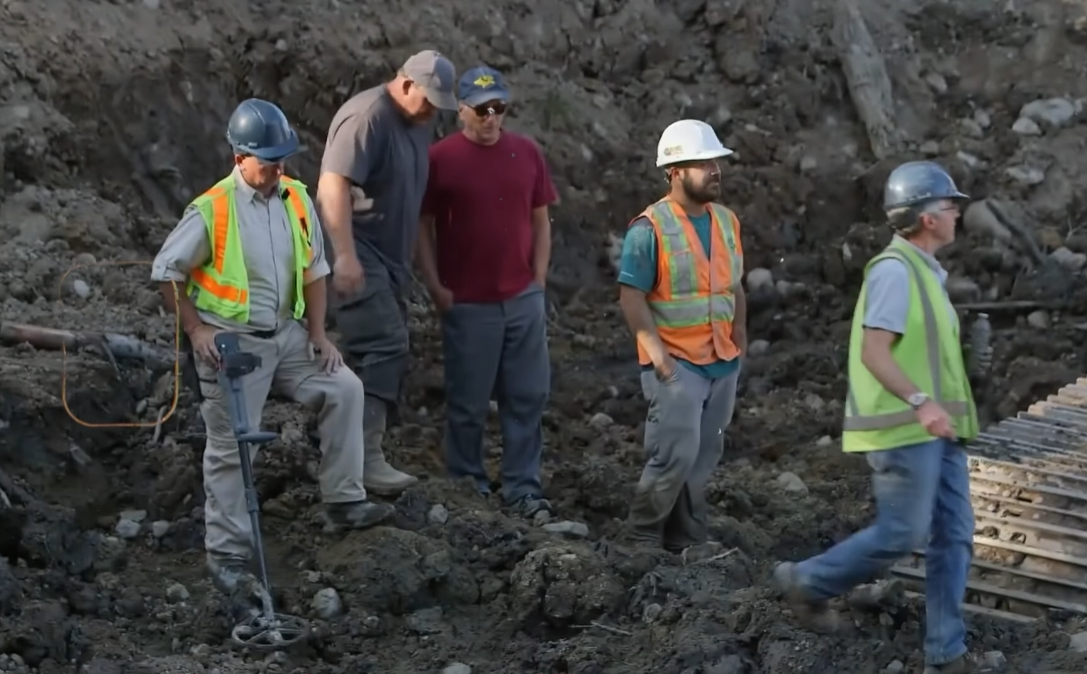
From a programme analysis standpoint, the importance lies not in any single artefact, but in pattern recognition. Each discovery reinforces the idea that Oak Island was engineered—its landscape altered deliberately to serve a purpose. Whether that purpose was treasure concealment, secure storage, or something else entirely remains unresolved. Yet the cumulative weight of evidence increasingly challenges the notion that the island’s features are coincidental.
Rick Lagina has often described Oak Island as a puzzle with hundreds of missing pieces. With each investigation on the Nolan property, a few more pieces appear to fall into place. None offer definitive answers, but together they narrow the field of plausible explanations. What becomes clearer is that substantial human effort occurred here long before modern treasure hunters arrived.
As excavation continues—through careful digging rather than dramatic leaps—the team appears committed to letting evidence guide interpretation. On Oak Island, certainty is earned slowly. But the growing alignment between Fred Nolan’s long-held observations and present-day discoveries suggests that his instincts about the island may have been closer to the truth than many once believed.