What Does Wool Under a Stone Reveal? The Clue That Has Experts Rethinking Oak Island

The latest developments on The Curse of Oak Island offer one of the clearest examples yet of how the investigation is slowly shifting from speculation toward structured historical analysis. What began as a routine archaeological examination on Lot 8 has evolved into a layered discovery involving engineered stonework, subsurface voids, and—most significantly—textile evidence that may help anchor activity on Oak Island to a specific time and place.
From an analyst’s perspective, the importance of this episode lies not in any single object, but in how multiple clues converge.
A Boulder That Refuses to Be Natural
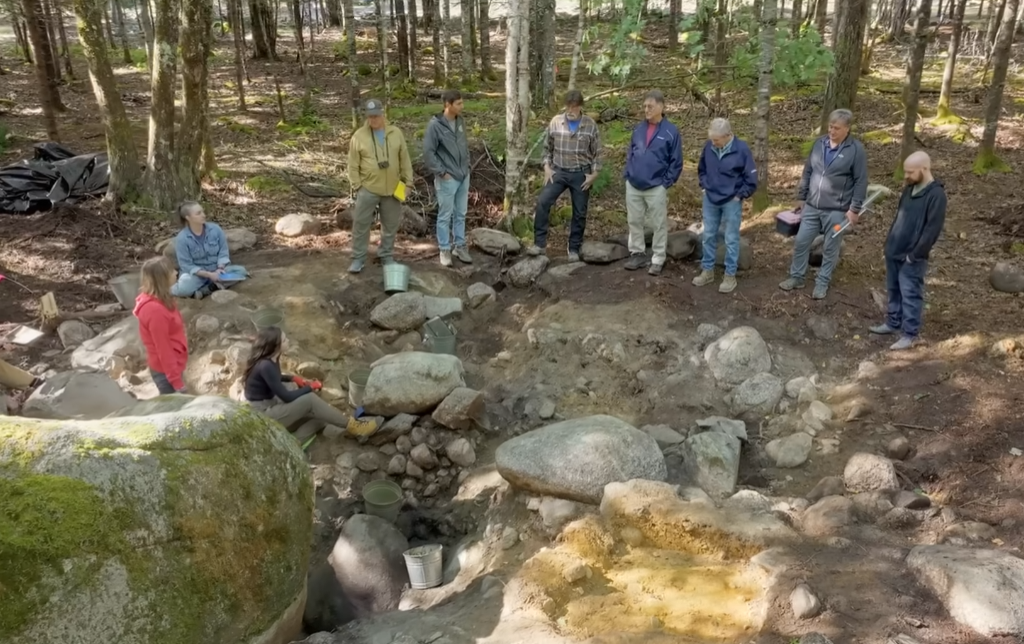
The focus of the investigation is a massive boulder resting atop a carefully arranged series of smaller, evenly spaced stones. Archaeologists on site quickly ruled out a natural formation. Beneath the boulder, a hand-dug trench—filled with rubble—extends well below its base, suggesting deliberate excavation. Camera probes revealed voids beneath the rock, reinforcing the idea that this was not random placement but intentional engineering.
Crucially, the team noted soil staining on the underside of the stones, indicating they had remained undisturbed for a very long time—possibly predating even the earliest documented searcher activity associated with the Money Pit. This distinction matters. Searchers dig chaotically; builders plan.
Context Changes Everything
What elevates this find is context. In recent weeks, Lot 8 has already produced a potentially 500-year-old chain link and a 700-year-old English bag seal. These artifacts alone raised eyebrows. Found near the boulder structure, they now suggest a shared activity phase rather than unrelated debris.
As Marty Lagina astutely observed, there is a critical difference between someone tunnelling under a rock to search for treasure and someone placing a “plug” designed to conceal something. The latter implies foreknowledge—and purpose.
From an analytical standpoint, that observation reframes the boulder not as an obstacle, but as a cover.
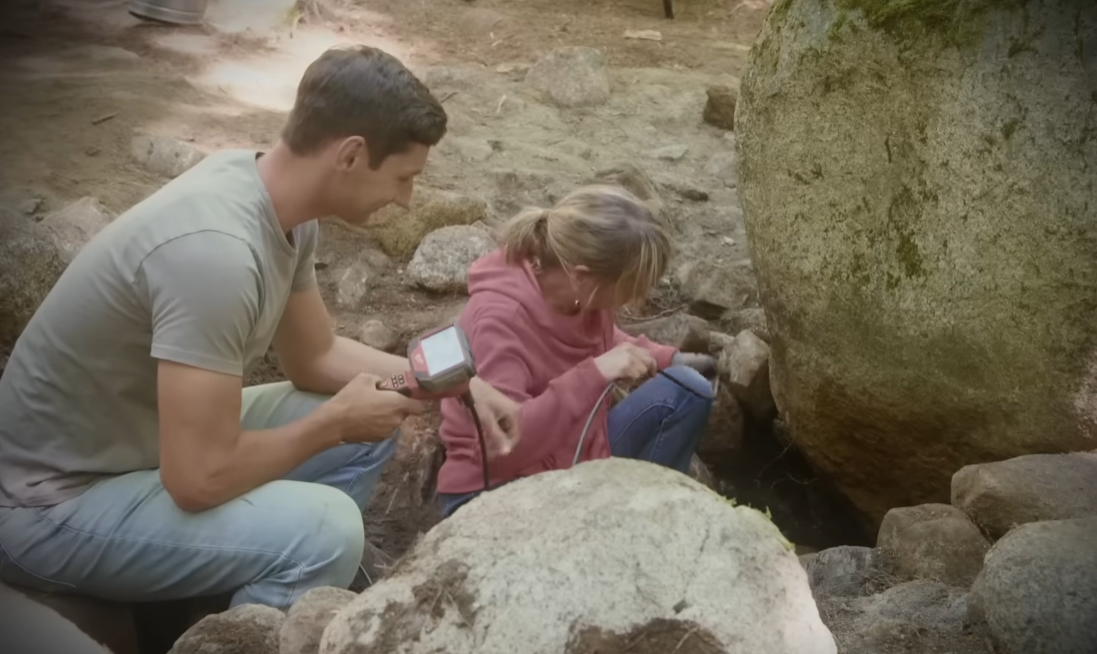
The Textile Discovery: Small Find, Big Implications
The most consequential moment came not from heavy machinery, but from careful sifting. Under one of the boulders removed to allow safer excavation, Craig Tester identified a fragment of red textile material embedded beneath the stone, roughly 18 inches below the surface.
At first glance, it appeared insignificant—shredded, aged, easily overlooked. But its location mattered. Being beneath a massive stone means the textile must predate the boulder’s placement. Even if it had been carried there by an animal, that movement could only have occurred after the stone structure was built, providing a relative date.
This is where Oak Island transitions from mystery to methodology.
Emma Culligan and the Science of Certainty
Enter Emma Culligan, whose return immediately shifted the tone from curiosity to confirmation. Culligan subjected the textile to CT scanning and XRF analysis, revealing a clear weft-knitted structure—an interlocking loop pattern characteristic of historic wool garments.
To determine material composition, Culligan performed a burn test, a simple but telling technique. The result was definitive: wool.
This finding carries extraordinary implications. Wool production, particularly in dyed and knitted form, aligns closely with medieval European industry. The significance deepened when Laird Niven connected the textile to the nearby English bag seal bearing a sheepskin symbol associated with Leeds—one of England’s major wool-manufacturing centres dating back to the 1300s.
Suddenly, Lot 8 is no longer an abstract puzzle. It is a site with economic, industrial, and geographic fingerprints.
Why This Matters More Than “Treasure”
From an analytical lens, this discovery is more valuable than gold. Textiles decay quickly; they do not survive unless conditions are right and disturbance is minimal. Finding wool beneath an engineered stone structure strongly suggests controlled placement and long-term stability.
More importantly, textiles can be dated through knitting style, dye composition, and fibre processing methods. Culligan’s recommendation to bring in specialists in knitting patterns and historical dyes signals that the team may soon narrow the activity window with unprecedented precision.
Oak Island has long struggled with dating. This find directly addresses that weakness.
What Comes Next
Predicting the next phase, several developments are likely:
-
Focused excavation beneath the boulder, guided closely by archaeologists rather than heavy equipment
-
Expanded laboratory analysis, including dye chemistry and fibre sourcing
-
Theory refinement, with increased emphasis on medieval European activity rather than later searcher interference
If further artifacts beneath the boulder align chronologically with the wool and bag seal, the team may finally establish not just that someone was there—but who, when, and why.
A Quiet but Profound Shift
This episode exemplifies a broader evolution within The Curse of Oak Island. The series is moving away from singular “wow” moments and toward cumulative evidence. The boulder, the trench, the chain, the bag seal, and now the wool fragment form a coherent narrative of intentional construction.
As Rick Lagina noted, what lies beneath the boulder may illuminate everything above it.
From an analyst’s standpoint, that assessment is accurate. Oak Island rarely reveals its secrets in dramatic bursts. Instead, it offers fragments—when interpreted correctly—that slowly collapse the distance between mystery and history. This textile may be small, but it could prove foundational.