An Ancient Stone Vessel in the Money Pit: What a $5 Million Discovery Could Mean for The Curse of Oak Island
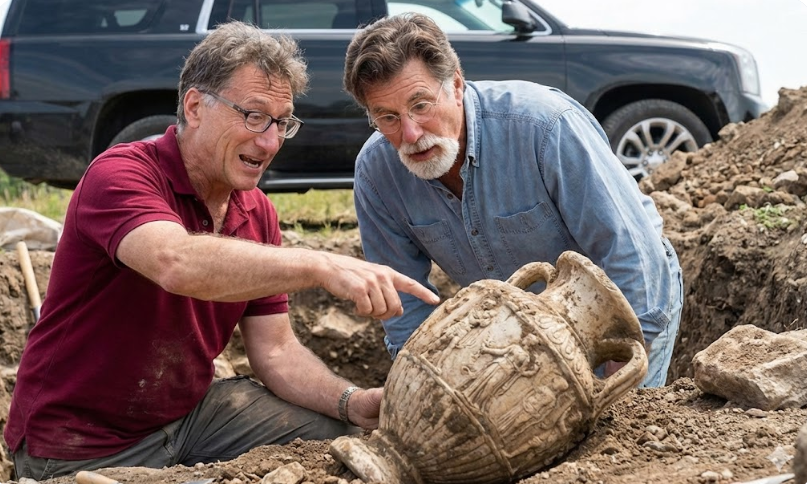
From an analytical standpoint, the reported discovery of an ancient stone vessel deep within the Money Pit would represent one of the most consequential moments in the history of The Curse of Oak Island. While the island has yielded coins, wood structures, metal fragments, and evidence of complex engineering, a complete stone vessel—particularly one valued at an estimated $5 million—would shift the investigation into an entirely different category of historical importance.
Unlike isolated artifacts, a stone vessel implies purpose, transport, and intention. Stone containers are not casual objects. They are heavy, difficult to move, and typically associated with ritual use, secure storage, or the safeguarding of valuable materials. Its presence in the Money Pit would immediately raise a central analytical question: why was such an object placed there in the first place?
Context Is Everything in the Money Pit
The Money Pit has long been defined by depth and design. From flood tunnels to layered platforms, every confirmed structure points to deliberate planning rather than random digging. A stone vessel found within this environment would reinforce that conclusion.
If recovered from a sealed or semi-sealed layer, the vessel’s stratigraphic context would be as important as the object itself. Analysts would focus on whether it was placed before or after known construction phases. A vessel embedded beneath engineered layers would suggest it was part of the original depositional plan, not a by-product of later searcher activity.
That distinction matters greatly. Searchers lose tools; builders place objects.
What the Vessel Could Represent
The valuation attached to the vessel—reportedly around $5 million—would likely be based not on material worth, but on provenance, age, and rarity. Stone vessels of high historical value are often linked to ceremonial, religious, or elite economic functions.
From an Oak Island analysis perspective, several possibilities would immediately come into play:
-
A ritual or symbolic container, possibly linked to religious orders or elite groups
-
A secure storage vessel, designed to hold valuable contents now removed or decayed
-
A transport object, suggesting long-distance movement of goods or knowledge
If the stone type is non-local, that would be a decisive clue. Geological sourcing could indicate whether the vessel originated in Europe or elsewhere, dramatically narrowing the range of possible depositors.
Scientific Scrutiny Would Intensify
A discovery of this magnitude would trigger an escalation in scientific involvement. Expect detailed petrographic analysis to identify quarry origin, tool-mark examination to determine carving techniques, and residue testing to assess what the vessel once held.
For Rick Lagina and Marty Lagina, credibility has always rested on documentation rather than spectacle. A stone vessel would demand slow, controlled extraction, extensive recording, and expert verification before any public conclusions could be drawn.
From a production-analysis angle, this would likely shift episodes away from excavation-heavy pacing toward laboratory work, expert consultations, and historical comparison—an approach that has defined the series’ most meaningful breakthroughs.
Legal and Preservation Implications
An object valued in the millions would not exist in a vacuum. Canadian heritage authorities would almost certainly become involved, potentially introducing new restrictions or revised permits. This could temporarily slow physical digging, but it would also validate the seriousness of the find.
Such oversight is often frustrating for viewers, yet analytically it strengthens the legitimacy of the investigation. Oak Island’s long-term value lies not in rapid conclusions, but in defensible historical claims.
What This Means for the Money Pit Theory
If confirmed, the vessel would strongly support the idea that the Money Pit was not simply a hole designed to hide something small and portable. Instead, it would suggest a broader system—one capable of concealing large, durable, and symbolically significant objects.
This would revive interest in theories involving organised groups with resources, planning capability, and reasons to protect knowledge or assets across generations. Crucially, it would not confirm any single theory outright, but it would eliminate many weaker explanations that rely on accidental loss or casual activity.

Predicting the Next Phase
Based on past patterns in The Curse of Oak Island, several developments would likely follow:
-
Targeted expansion of the Money Pit area, focusing on lateral chambers rather than deeper shafts
-
Renewed attention to flood tunnel architecture, assessing whether the vessel was protected intentionally
-
Cross-referencing with earlier finds, looking for material or chronological consistency
The vessel itself may not be the endpoint. On Oak Island, major discoveries tend to function as keys rather than answers.
A Turning Point, Not a Conclusion
From an analytical perspective, an ancient stone vessel valued at $5 million would not suddenly solve the Oak Island mystery. What it would do is confirm scale. It would demonstrate that the effort invested in the Money Pit matched the importance of what was placed there.
In that sense, the vessel’s true value would lie not in its market price, but in what it reveals about the people behind the construction. If such an object exists where many have searched for centuries, then Oak Island’s story is no longer about whether something meaningful was hidden—but about understanding why it was hidden so carefully.
For The Curse of Oak Island, that would represent one of the clearest signals yet that the search has entered its most serious and historically grounded phase.