The Farmer vs Tech Billionaire — Clarkson Says ‘NO’ Elon Musk’s Plan to ‘REPLACE’ 33 Million Sheep
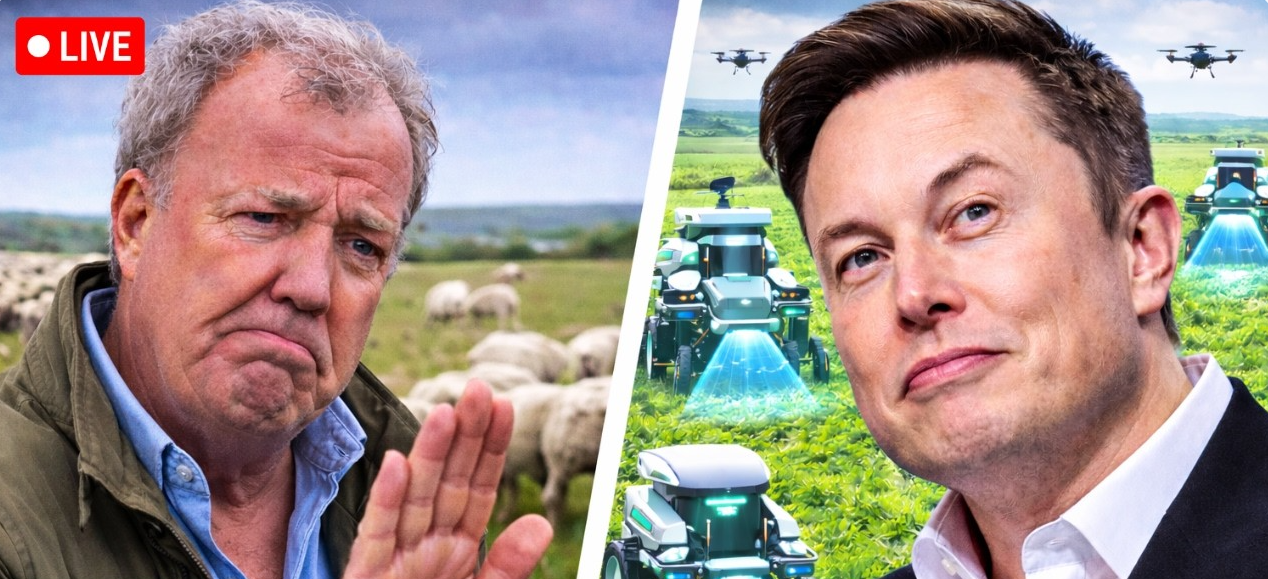
On the surface, the proposal sounded like the future arriving early. Satellites mapping soil to the centimetre. Artificial intelligence predicting yields before a seed touches the ground. Autonomous tractors working through the night. Methane tracking systems translating livestock into data points. When a representative from Elon Musk’s team reportedly reached out to Jeremy Clarkson, it was framed as a partnership—technology supporting farming, not replacing it.
Yet, as Clarkson’s reflections reveal, the offer exposed a far deeper tension now shaping British agriculture: who defines the future of food—those who work the land, or those who model it from afar?
Clarkson’s hesitation was not rooted in technophobia. Farming has always adapted. GPS guidance, yield mapping, precision spraying and improved genetics are already standard across much of the UK. But what unsettled him was the direction of travel. The early pages of the proposal focused on efficiency and cost reduction. The later sections turned their attention to livestock, emissions modelling, and “protein transition pathways”.
That shift mirrors a wider reality across British farming.
The United Kingdom has roughly 17 million hectares of agricultural land, and nearly two-thirds of it is grass. This is not an accident of poor planning; it is a reflection of climate and geography. Britain grows rain exceptionally well. Grass follows. Livestock follows grass. Cattle and sheep are not marginal add-ons to the system—they are the system.
This is a point often lost in technology-driven conversations. Synthetic protein trials, vertical farming, and laboratory alternatives are presented as scalable solutions, but they do not map neatly onto the British countryside. Marginal grazing land cannot simply pivot to crops or indoor systems without enormous capital, energy, and environmental trade-offs.
Clarkson’s conversations with neighbouring farmers illustrate the human cost of these abstractions. Sheep producers operating on upland ground already face volatile prices and tightening margins. Beef farmers are navigating increasingly complex emissions reporting and compliance demands, while consumers continue to expect British meat on supermarket shelves. The contradiction is stark: reduce production, but maintain availability; cut livestock, but protect rural economies.
These pressures are not emerging in isolation. Since the withdrawal from the EU’s Common Agricultural Policy, British farming has been undergoing structural change. Direct payments that once accounted for more than half of many farm incomes are being phased out, replaced by environmental schemes such as the Environmental Land Management programme. The principle—public money for public goods—is widely accepted. The execution, however, has proved challenging.
Payments are smaller, application processes complex, and cash flow unpredictable. Farmers now spend increasing amounts of time mapping hedgerows, measuring soil carbon, and submitting audits, while simultaneously absorbing rising costs for fuel, fertiliser, and infrastructure. Fertiliser prices alone surged dramatically during the energy crisis, compounding financial strain.
It is within this context that the appeal of large-scale technological investment becomes understandable. Average farm business income in England hovers around £40,000 a year before costs are deducted. One poor season can erase that entirely. When global investors speak of stability, capital backing, and guaranteed returns, it naturally commands attention.
But Clarkson’s account highlights the hidden trade-off. The investment was not simply about upgrading machinery or improving resilience. It was about redefining the purpose of the farm itself. Production measured as environmental data. Livestock integrated into emissions dashboards. Land allocated by carbon modelling rather than husbandry judgement.
In short, the farm would still function—but its priorities would shift.
This reflects a broader philosophical divide. Silicon Valley approaches agriculture as a system awaiting optimisation. British farmers experience it as a lived relationship with weather, soil, animals, and risk. Algorithms can inform decisions, but they do not replace instinct built over generations, nor do they account for the cultural and economic fabric of rural life.
There is also a strategic question that Clarkson implicitly raises: food security. The UK already imports around 40% of its food. Reducing domestic production while encouraging alternatives that remain commercially and culturally unproven introduces vulnerability. Resilience is not achieved by efficiency alone; it depends on diversity, redundancy, and local capacity.
Clarkson’s decision to decline the proposal was therefore less about rejecting innovation and more about asserting agency. Technology can support farming, but only if farmers remain central to decision-making. Progress imposed without that balance risks hollowing out the very communities that sustain food production.
The enduring appeal of Clarkson’s Farm lies precisely in this tension. It shows that farming is not an abstract system to be redesigned overnight. It is physical, unpredictable, and deeply human. Mud on boots, livestock in fields, and decisions made under uncertain skies do not lend themselves easily to disruption narratives.
As Britain debates the future of agriculture—through policy, investment, and technology—Clarkson’s experience offers a timely reminder. The future of farming should not be engineered solely in boardrooms or coded into platforms. It must be shaped with, not around, the people who produce food every day.
Because when the spreadsheets close and the satellites pass overhead, farming still happens where it always has: on the ground.