Miriam Amirault’s Discovery: Storm of the Century Unearths “Blueprint” to Oak Island’s $150M Templar Hoard
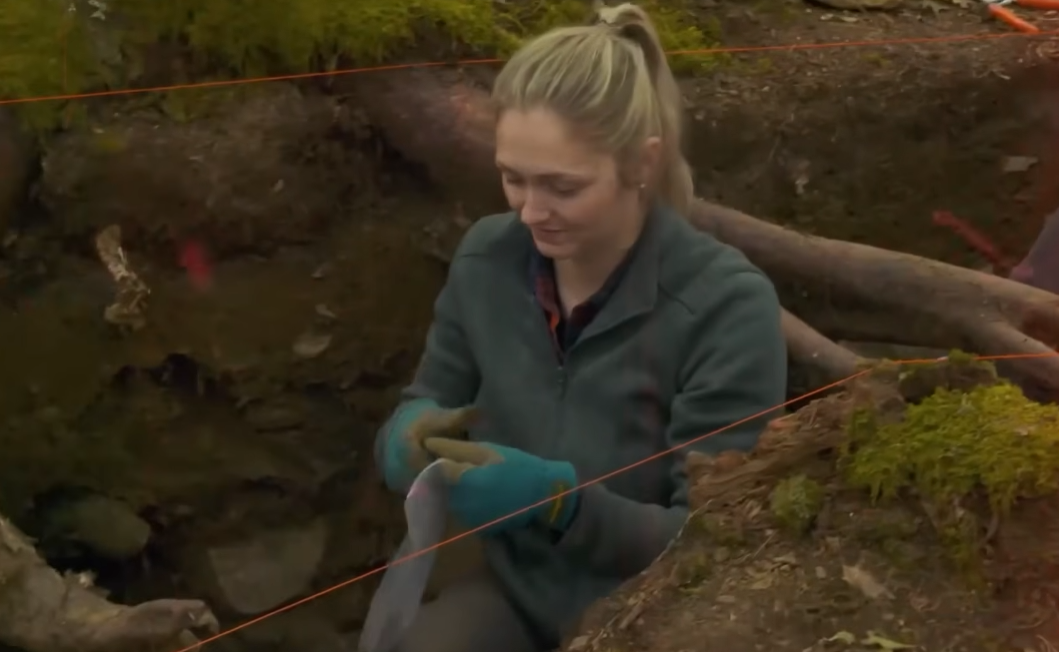
For over two centuries, Oak Island has been defined by mud, mystery, and the “Money Pit.” But following a violent Atlantic storm that reshaped the island’s coastline, a startling discovery by archaeologist Miriam Amirault has fundamentally shifted the search from a hunt for buried loot to the uncovering of a sophisticated medieval delivery system.
The discovery began not with a drill, but with nature. A fierce storm surge peeled back a section of untouched earth along an old stone path, exposing mineral-stained soil and a gleaming object that Rick Lagina described as “unsettlingly intentional.”
The Key in the Stone
Miriam Amirault, called in to document the site, recovered a curved bronze fragment etched with precise geometries. Unlike the corroded artifacts usually found on the island, this piece was pristine. Most significant was a carved eight-pointed star—a known Templar navigational symbol used by 13th-century Portuguese mariners.
The true breakthrough occurred when Amirault identified a matching groove in a nearby stone slab. “It wasn’t close; it was exact,” onlookers noted. When the bronze fragment was pressed into the stone, it acted as a functional key. Ancient engineering, dormant for seven centuries, responded with a grinding shift, sliding the slab to reveal a black void that exhaled cold, stagnant air—breath held since the Middle Ages.
Mediterranean Secrets 200 Feet Down
As the team lowered micro-cameras into the newly opened shaft, the narrative of “pirate gold” crumbled. The chamber was reinforced with wooden beams coated in Mediterranean pine resin, a substance historically used by European shipbuilders to seal treasure galleons.

“This isn’t a hiding place,” Amirault stated as the camera revealed precision-cut stone guide rails and heavy iron anchor rings. “It’s a delivery system. A vertical vault designed to manage massive, heavy cargo with pulleys and counterweights.”
The craftsmanship—interlocking stonework and silver-threaded ceremonial pins—points to the Order of the Sacred Covenant, a Templar splinter group believed to have fled Europe in 1307. The presence of heat-sealed timbers suggests a ritualistic “closing” of the vault, intended to protect its contents from both the elements and the unworthy.
The “Western Vault” and the Gold Bars
At the base of the shaft, the camera finally settled on the “holy grail” of treasure hunting. The team observed tight, orderly rows of rectangular bars wrapped in decayed linen. On the fabric sat the unmistakable crimson cross of the Knights Templar.
Where the linen had rotted away, the camera captured the unmistakable glow of solid gold. These were not loose coins, but bullion bars marked with medieval Roman numerals and weight indicators consistent with 12th-century European accounting.
However, the most explosive revelation was found on a preserved wooden plank. Inscribed in medieval Portuguese were the words: “West’s Passage, the Western Vault.”
A System of Secrets
The inscription suggests that the current discovery, while containing a fortune in gold, is merely a “secondary chamber” or a guidepost to a larger network. The team has identified a second, horizontal tunnel leading away from the gold, which appears to have been accessed and resealed more recently than the original construction.

This discovery proves that Oak Island was never a single-hole mystery. It was a massive, planned operation by an organized order with extraordinary wealth and the engineering genius to remove that wealth from the reach of European kings.
As Rick Lagina stood over the monitors, the weight of the moment was clear. The “Money Pit” may have been the distraction, but Miriam Amirault’s discovery has finally provided the blueprint to the real treasure—and it is far larger than anyone dared to imagine.