How Clarkson’s £45M Farm OUTSMARTED The TV SHOW Industry – They Never Saw It Coming!
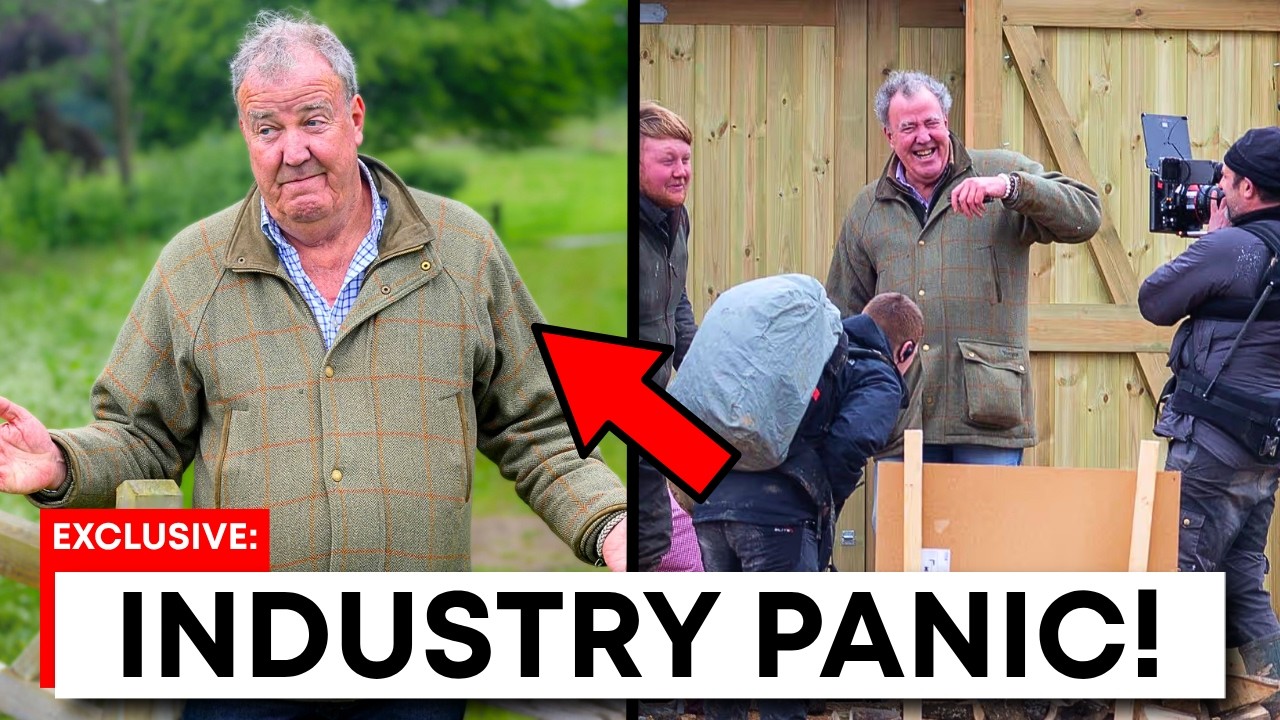
A television experiment that began as controversy has evolved into one of the most unconventional business empires in modern British media history. What the industry dismissed as a rural side project has instead become a self-funding ecosystem blending entertainment, agriculture, retail, and brand power.
In March 2015, the British television landscape shifted in a way few executives fully understood at the time. A dispute involving a “cold steak” led to the departure of Jeremy Clarkson from the BBC, ending his era on Top Gear and triggering what would become one of the most commercially significant relocations in modern broadcasting history. As one internal reflection later noted, the corporation did not simply lose a presenter—they inadvertently released a competitor into an entirely new creative environment .
What followed was not an immediate pivot into farming success, but a gradual construction of something the television industry failed to categorize. Clarkson’s acquisition of a large Oxfordshire estate, later known as Diddly Squat Farm, initially appeared to be a personal investment. However, it became the physical foundation for a media and commercial network that would eventually extend far beyond agriculture.
FROM TELEVISION STAR TO UNLIKELY INDUSTRY DISRUPTOR
When Amazon Prime commissioned Clarkson’s Farm, the expectation across both media critics and agricultural observers was limited. The premise seemed simple: a celebrity attempts farming, encounters predictable difficulties, and delivers light entertainment. Yet the result diverged sharply from that assumption.
The show quickly evolved into something structurally different from traditional reality television. Instead of manufactured storylines, it relied on operational reality—weather, machinery failure, planning disputes, livestock cycles, and market pressures. Each episode became both content and documentation. More importantly, it became a marketing engine operating without conventional advertising frameworks.

The key insight missed by most broadcasters was not the entertainment value, but the economic layering beneath it. Every narrative arc simultaneously promoted the physical farm, its retail operations, and its emerging product lines. The farm was no longer just a filming location; it was a production asset generating secondary industries.

THE FARM THAT FUNCTIONED LIKE A MEDIA PLATFORM
At the center of this system was a structural inversion of traditional television economics. Normally, shows are financed by networks, distributed to audiences, and monetized through advertising or subscriptions. In this case, the television production itself became the marketing expenditure for a real-world business ecosystem.
The Diddly Squat Farm Shop—initially a converted outbuilding—transformed into a destination retail site driven almost entirely by viewer engagement. Footfall increased not through conventional advertising campaigns but through episodic storytelling that built emotional familiarity with the location. Visitors were not merely customers; they were participants in a long-running narrative they had followed on screen.
This phenomenon produced what analysts now describe as “pilgrimage economics.” Consumers traveled not simply to purchase goods, but to physically experience a setting they had already emotionally invested in. The pricing structure of products became secondary to the perceived value of participation.
REGULATORY CONFLICT AS CONTENT INFRASTRUCTURE
One of the most unusual dynamics in the farm’s evolution was its ongoing conflict with local planning authorities. West Oxfordshire District Council repeatedly rejected expansion proposals, citing environmental impact and infrastructure strain. In a conventional business context, such refusals would have constrained growth.
However, in this environment, regulatory resistance became narrative fuel. Each refusal generated new episodes, each enforcement notice became plot development, and each dispute amplified audience engagement. Instead of limiting expansion, opposition effectively increased visibility.
This created a paradox: attempts to restrict commercial development inadvertently strengthened the brand’s cultural footprint. The more friction the farm encountered, the more valuable its story became.
THE EXPANSION INTO BEER, RETAIL, AND HOSPITALITY
The next phase of expansion demonstrated how deeply integrated the media and business elements had become. The launch of Hawkstone beer marked a transition from farm-branded merchandise into a fully operational supply chain business. Barley production, brewing, distribution, and retail were all connected to the same narrative ecosystem.
Rather than relying on traditional celebrity licensing models, Hawkstone was built on traceable origin storytelling. Consumers could directly associate the product with land, production methods, and the television series itself. This transparency created resistance to acquisition offers from larger beverage corporations, which could not replicate the embedded narrative without dismantling its authenticity.
Similarly, the creation of The Farmer’s Dog pub extended the model further. The venue combined food sourcing restrictions, on-site branding, and television set reuse into a hybrid space that functioned simultaneously as restaurant, filming location, and experiential marketing platform. Even under financial strain, the operation maintained strategic value as content infrastructure rather than a standalone hospitality venture.
THE CALCULATED FAILURE THAT BUILT SUCCESS
A defining moment in the series came not from conflict or expansion, but from an understated financial reality explained by farmhand Caleb Cooper. In a brief exchange, it was made clear that traditional farming margins alone could not sustain the operation at scale. That acknowledgment reframed the entire enterprise.
From that point forward, diversification was not optional—it was structural necessity. Beer, retail, tourism, and broadcasting became interconnected revenue layers designed to compensate for agriculture’s inherent volatility. The model effectively turned entertainment into subsidy for farming viability.
A SYSTEM THE INDUSTRY DID NOT RECOGNIZE IN TIME
The broader television industry initially evaluated Clarkson’s Farm through conventional metrics: viewership, critical reception, and genre classification. What it failed to recognize was that the show was not the product—it was the distribution mechanism for a multi-sector commercial system.
By the time this realization emerged, the flywheel effect was already in motion. Content drove visitation. Visitation drove sales. Sales funded expansion. Expansion generated new content. The system became self-reinforcing.
Industry observers now describe it less as a television program and more as a vertically integrated media-agricultural platform.
CONCLUSION: A NEW MODEL OF ENTERTAINMENT ECONOMICS
The legacy of this transformation is not simply the success of a farm or a television series, but the emergence of a hybrid model where storytelling and enterprise are indistinguishable. The BBC’s decision in 2015, initially seen as disciplinary, ultimately catalyzed a restructuring of how media value can be generated outside traditional institutional frameworks.
As the original account of this transition notes, what appeared to be the loss of a presenter was in fact the creation of an independent system that no longer required the broadcaster at all .
In that sense, the most important shift was not Clarkson’s move from television to farming, but the collapse of the boundary between the two. The industry thought it was watching a farming show. It was, instead, witnessing the construction of a self-sustaining commercial universe—one that continues to expand long after the credits roll.