Jeremy Clarkson announced the happy news that he welcomed his third grandchild.
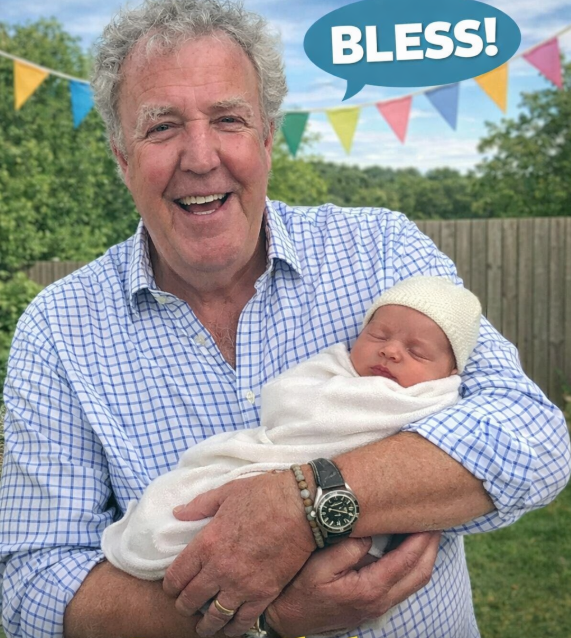
Jeremy Clarkson has spent much of his television career building a public image around noise, speed, argument and stubborn confidence. From motoring television to farming life, he has rarely appeared as someone who slows down easily. Yet the happy news that he has welcomed his third grandchild introduces a very different kind of storyline around the Clarkson’s Farm star. It is not about machinery, planning disputes, livestock problems or unpredictable weather. It is about family, legacy and how becoming a grandfather again may quietly reshape the way viewers see him at Diddly Squat.
From an analyst’s perspective, this kind of personal milestone matters because Clarkson’s Farm has never been only a farming show. Its appeal comes from watching Jeremy Clarkson’s larger-than-life personality collide with the reality of rural life. The show works because he is constantly being corrected by Kaleb Cooper, challenged by Charlie Ireland, supported by Lisa Hogan and humbled by the land itself. A new grandchild adds another emotional dimension to that formula. It gives the programme a chance to show Clarkson not just as a farmer learning through mistakes, but as a man thinking more seriously about the world he is helping to leave behind.
That theme could become especially important in future episodes. Clarkson’s Farm has already explored the fragility of British agriculture, the cost of running a farm, the pressure of weather, and the difficulty of making rural businesses survive. But when family enters the story, those issues feel more personal. Farming is never only about one season’s harvest. It is about continuity. It is about whether land can be maintained, improved and passed on. For a grandfather, that idea carries added weight.
The arrival of a third grandchild may therefore encourage a more reflective version of Jeremy on screen. Viewers may still expect the same humour, frustration and chaotic decision-making that made the show successful. But there may also be moments where he appears more aware of time, responsibility and long-term consequences. Diddly Squat is not just a television location anymore. It has become part of his identity, his business, and potentially his family legacy.
One likely development is that Clarkson may begin speaking more openly about the future of the farm beyond his own involvement. That does not mean he will suddenly become sentimental or abandon his usual blunt style. In fact, the contrast between his sharp humour and his softer family role could make the programme more compelling. Clarkson’s Farm is at its best when it reveals something human beneath the comedy. A new grandchild gives producers a natural way to explore that without forcing the tone.
This could also affect how Jeremy approaches decisions around Diddly Squat. In previous seasons, he has often chased bold ideas: opening the farm shop, expanding business ventures, dealing with livestock, investing in machinery and fighting through frustrating bureaucracy. Some decisions have been practical. Others have been impulsive. With another grandchild in the family, future storylines may frame those choices through a longer lens. Is he building something that can last? Is the farm becoming a genuine rural enterprise rather than a television experiment? Can Diddly Squat stand as more than a celebrity project?
Kaleb Cooper’s role could become even more interesting in this context. Kaleb often represents the next generation of farming: young, skilled, impatient with nonsense, and deeply connected to the land. Jeremy, now with three grandchildren, may increasingly be positioned as someone looking at the next generation from a different angle. Their conversations could become richer. Kaleb may still tease him, correct him and roll his eyes at his ideas, but the underlying theme may shift toward what farming means for younger people and families trying to build a future in the countryside.
Charlie Ireland may also become central to this narrative. If Jeremy is thinking more seriously about legacy, Charlie’s financial discipline becomes more important than ever. A farm cannot be passed down as a dream alone. It has to work on paper. It has to survive costs, regulations, market changes and unpredictable harvests. A new grandchild may give emotional weight to Charlie’s usual warnings. Every bad decision, failed investment or blocked plan becomes part of a bigger question: can the farm be made sustainable?
Lisa Hogan’s presence would likely add balance. She has often been one of the calmer forces around Jeremy, especially when his ambitions run ahead of practical reality. In a season shaped partly by family news, Lisa could help bring warmth to the story. Viewers may see more of the home-life side of Diddly Squat, even if the show remains focused on farming. That would not weaken the programme. It could broaden it.
There is also a public image angle. Jeremy Clarkson has often been a divisive figure, but Clarkson’s Farm has softened his reputation for many viewers. The series has allowed audiences to see him failing, learning, worrying and occasionally showing real vulnerability. Becoming a grandfather again strengthens that softer image. It does not erase the old Clarkson, but it complicates him in a way that is useful for television. The man who once seemed defined by cars and confrontation is now also a farmer, pub owner, rural campaigner and grandfather.
My prediction is that the third grandchild will not become a major plotline in a direct way. Clarkson’s Farm is unlikely to turn into a family documentary. Instead, the news may influence the emotional background of the series. Jeremy may talk more about the future. He may show more concern about health, time and legacy. He may become more determined to make Diddly Squat work not simply as a business, but as something meaningful.
That is where the story becomes powerful. Clarkson’s Farm has always been about a man discovering that farming is harder, more expensive and more emotionally demanding than he expected. A third grandchild gives that discovery a new layer. It suggests that Jeremy is not only fighting for crops, cattle, shops or planning permission. He may also be thinking about what remains when the cameras stop rolling.
In the end, this happy family news could bring a quieter but important shift to Clarkson’s Farm. The show will still need mud, machinery, arguments and comic failure. But beneath all of that, viewers may now see a grandfather looking at Diddly Squat with a deeper sense of purpose. For a programme built on chaos, that could be one of its most meaningful developments yet.