Billy Gerhardt Pushes 110 Feet Deep and Uncovers a $240M Oak Island Lead!
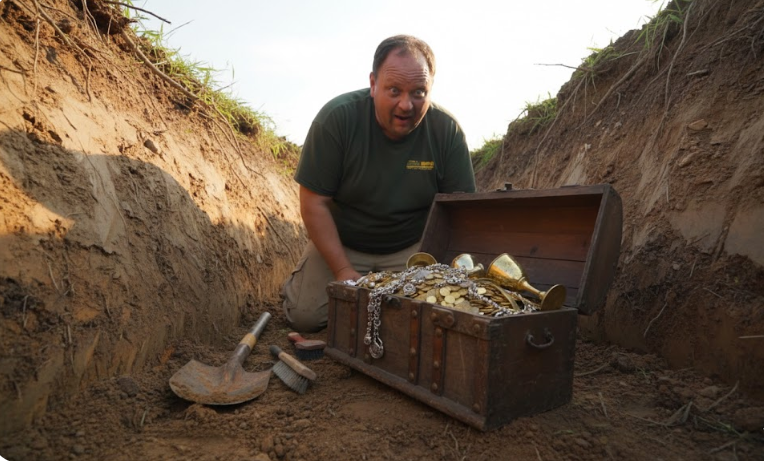
After more than 200 years of failed searches, flooded shafts and abandoned theories, Oak Island has once again become the centre of global attention. This time, the spotlight is on heavy equipment operator Billy Gerhardt, whose insistence on digging in an unconventional location has reportedly led to the most significant discovery in the island’s history.
According to accounts from the excavation team featured on The Curse of Oak Island, Gerhardt pushed to investigate an area between the traditional Money Pit and Smith’s Cove — a zone largely overlooked by generations of treasure hunters. His theory challenged two centuries of assumption: that any major cache must lie directly beneath the original Money Pit.
Instead, Gerhardt argued that if the island’s legendary flood tunnel system was designed as a defensive engineering feat, then the treasure itself would not sit in the most obvious target. It would be offset, protected by the same mechanisms but hidden at a depth and location designed to evade detection.
A Risk Few Were Willing to Take
Gerhardt’s proposal was initially met with skepticism. Team leaders Rick and Marty Lagina had already invested millions into deep drilling projects in the Money Pit area. Engineering reports warned that excavating beyond 65 feet in the new target zone would be extremely risky due to water infiltration and unstable soil conditions.
Despite the concerns, Gerhardt persisted. When preliminary excavation stalled amid mounting water pressure, he reportedly committed personal funds to continue the project — an investment said to exceed $60,000 before the broader team assumed financial responsibility.
At approximately 110 feet, the effort began to show results. Excavators uncovered hand-worked timber supports dating back more than two centuries. Carbon dating confirmed that someone had intentionally constructed reinforcements at that depth long before modern machinery existed.
Then came the pivotal discovery: a lead cross bearing markings consistent with 17th-century Spanish colonial craftsmanship.

Scientific Analysis Raises Stakes
The artifact was immediately transported for metallurgical analysis. Lead isotope testing indicated that the metal originated from South American mines under Spanish control during the colonial era. Chemical residue analysis detected traces of gold and silver compounds, suggesting the cross had once been stored in proximity to precious metals.
Experts consulted by the team proposed that the cross functioned not as treasure itself, but as a marker — a directional signpost pointing toward a deeper chamber.
Ground-penetrating radar scans conducted in the orientation the cross was found reportedly revealed a void at approximately 142 feet below the surface. Unlike natural cavities, the anomaly displayed straight edges and consistent geometry, characteristics commonly associated with man-made construction.
If accurate, the data suggested the existence of a chamber approximately 15 to 20 feet wide.
Engineering the Final Descent
Reaching 142 feet required an engineering project on a scale rarely attempted on Oak Island. A reinforced steel caisson was driven into the ground to stabilize the shaft, supported by concrete lining and a multi-layer pumping system designed to counteract the island’s infamous flood tunnels.
The total cost of construction is estimated to have exceeded $5 million. Investors reportedly wavered as pump failures and water pressure repeatedly threatened the excavation.
Yet by early fall, the shaft reached its target depth.
When the final two feet were cleared manually, Gerhardt reportedly breached into a void consistent with radar projections.
Inside the Chamber
Initial reports from the team describe a man-made stone-lined chamber containing deteriorated wooden chests. Within them were gold coins bearing Spanish colonial mint marks, stacked silver bars and religious artifacts including crosses and chalices.
Sealed lead containers believed to contain preserved documents were also reportedly recovered.
Independent appraisers brought in for preliminary valuation estimated the cache’s market worth at approximately $240 million, excluding historical premiums that could significantly increase auction value.
The find, if authenticated and verified by independent archaeological authorities, would rank among the most consequential treasure discoveries in North American history.
Historical Implications
Beyond monetary value, the discovery carries major historical implications. Spanish colonial treasure is well documented in South America and the Caribbean, but confirmed deposits in Atlantic Canada would reshape current understanding of early transatlantic activity.
Some historians suggest the treasure could relate to undocumented diversion routes of Spanish fleets or covert storage operations during periods of political instability in Europe.
Skeptics caution that full verification, authentication and government oversight remain necessary before any definitive conclusions can be drawn. Oak Island falls under Nova Scotia heritage regulations, and excavation sites are subject to legal review.

A Shift in the Oak Island Narrative
For decades, the Money Pit has been treated as the island’s primary focal point. Six men lost their lives in pursuit of that shaft. Millions of dollars have been invested in reaching ever-greater depths beneath it.
Gerhardt’s discovery suggests that the real prize may have been deliberately placed nearby but not directly beneath the original target.
Rather than discrediting the flood tunnel theory, the find appears to validate it — implying that the engineering was meant to guard a wider defensive perimeter rather than a single vertical vault.
The Man Behind the Dig
Gerhardt arrived on Oak Island as a contractor, tasked with operating heavy machinery. Over time, his practical excavation experience gave him a perspective distinct from historians and theorists.
By studying soil patterns, drainage flows and flood tunnel orientation, he developed an alternate hypothesis — one that ultimately led to the 110-foot marker discovery.
In doing so, he transformed from operator to key figure in what may become the defining moment of Oak Island’s modern era.
What Happens Next
Recovery operations continue under archaeological supervision. Detailed cataloguing, authentication and conservation efforts are expected to take months.
Whether the full valuation holds and whether additional chambers remain undiscovered are questions that will shape the next chapter of the island’s story.
For now, one fact stands clear: the Oak Island narrative has shifted dramatically. And if the evidence withstands scrutiny, the greatest mystery in North American treasure hunting may finally have a tangible answer.