THE FALL OF AN “INVINCIBLE” FIXTURE: WHY CHRIS DOUMITT WALKED AWAY FROM THE SCHNABEL EMPIRE
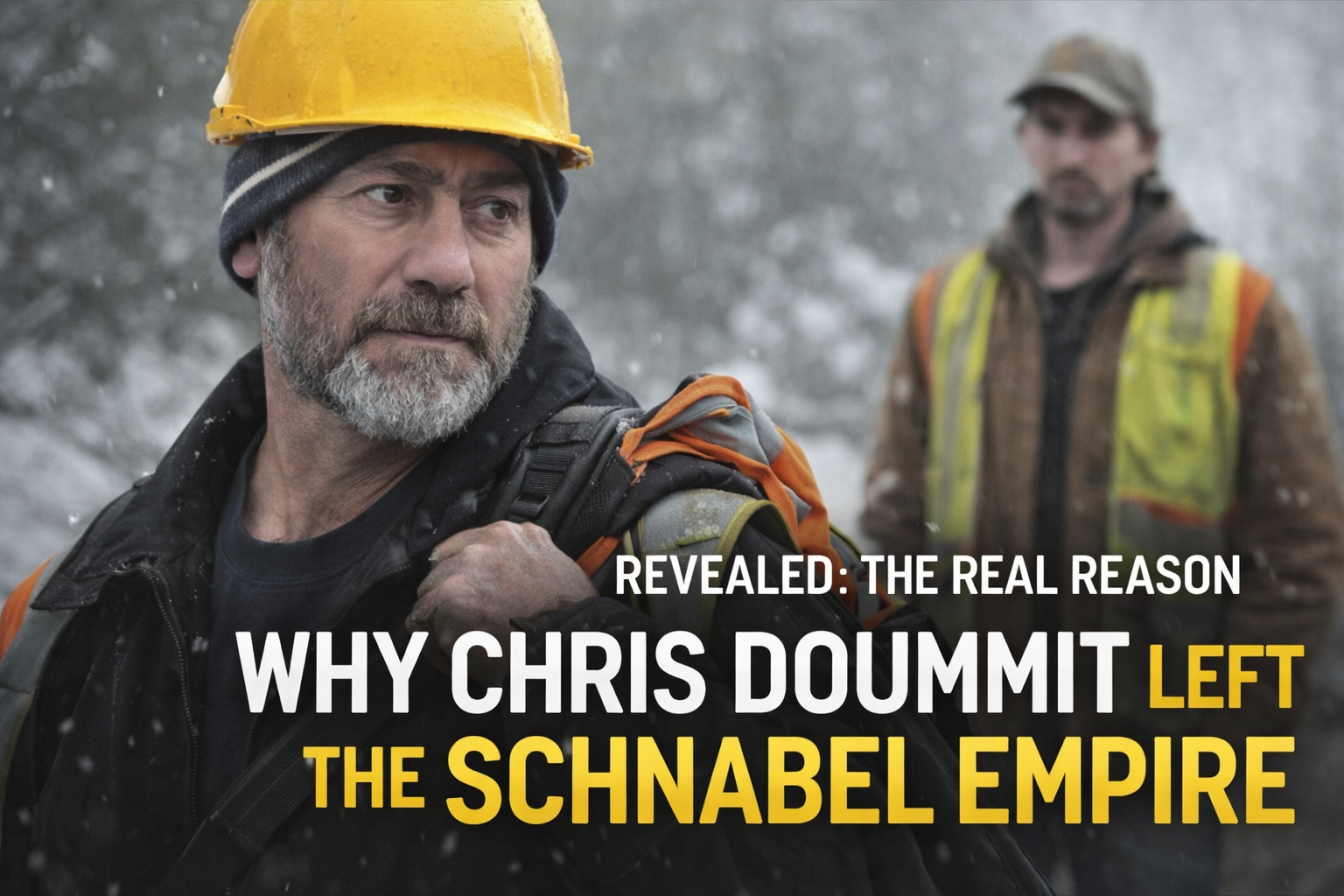
For years, Chris Doumitt has been viewed by fans of Gold Rush as one of the most stable, loyal, and quietly essential figures within Parker Schnabel’s operation. Known for his calm presence in the gold room, his mechanical intuition, and his reputation as someone who “never breaks under pressure,” Doumitt became something close to institutional memory inside the Schnabel mining structure. So when word began circulating that he had ultimately stepped away from the so-called “Schnabel empire,” the reaction among analysts and fans alike was immediate: something deeper than routine turnover had occurred.
From an operational perspective, Doumitt was never just another crew member. Within Parker Schnabel’s increasingly industrial mining network—spanning multiple claims, wash plants, and rotating seasonal crews—he functioned as a stabilizing node. In practical terms, that meant he bridged the gap between high-output field operations and gold room precision. His departure, therefore, is not just personnel news. It signals a potential shift in how the Schnabel operation is structurally managed going forward.
INTERNAL STRAIN IN A SCALING MINING MACHINE
The first and most plausible explanation lies in scale pressure. Over the last several seasons of Gold Rush, Parker Schnabel’s operation has evolved from a relatively tight-knit crew into a multi-site industrial system with heavy equipment fleets, subcontracted teams, and layered management.
In such environments, even highly experienced operators like Doumitt can find themselves gradually pushed away from decision loops. Analysts of the series have long noted a pattern: as production scales, legacy crew members often become less central to daily decision-making and more confined to specialized roles. While efficient on paper, this structure often erodes the informal authority that veterans like Doumitt once held.
Industry observers suggest this may have created a subtle but persistent tension—not personal conflict, but operational marginalization. In mining, where trust and immediacy matter as much as technical output, that kind of shift can be enough to change a long-standing working relationship.


THE PHYSICAL COST OF CONTINUOUS SEASONS
A second factor is far more human: endurance. Gold mining operations in the Yukon are not seasonal jobs in the conventional sense—they are compressed industrial campaigns. Long shifts, environmental extremes, and constant equipment pressure create a physical toll that accumulates over years.
Doumitt, while widely respected for his resilience, has been part of the Schnabel team through some of its most demanding production cycles. For veteran operators, there often comes a point where the cost-benefit equation shifts. Not in terms of money, but in terms of energy, recovery time, and long-term sustainability.
From a production analysis standpoint, departures like this are often misinterpreted as conflict when they are actually attrition-driven exits. In other words, the system did not fail the individual, but the intensity of the system eventually outpaced what the individual was willing to continue absorbing.

STRATEGIC EVOLUTION OF THE SCHNABEL OPERATION
Another layer worth considering is structural evolution within Parker Schnabel’s leadership model. Parker has increasingly transitioned into a CEO-like role rather than a field operator. This shift naturally changes crew dynamics.
In earlier seasons, decision-making was immediate, informal, and heavily influenced by senior field members like Doumitt. In the current model, decisions are increasingly data-driven, cost-optimized, and routed through a more formal hierarchy.
This evolution is efficient for scaling output, but it reduces the influence of veteran intuition. In mining environments, that intuition is often where experienced operators like Doumitt shine—spotting inefficiencies, anticipating mechanical issues, or making real-time judgment calls that don’t always appear in spreadsheets.
If Doumitt’s departure is indeed linked to this shift, it reflects a broader industry trend: traditional mining expertise being gradually replaced or constrained by industrial-scale optimization systems.
WHAT THIS MEANS FOR FUTURE SEASONS OF GOLD RUSH
Looking forward, the absence of Doumitt may have several measurable impacts on Parker Schnabel’s future operations.
First, expect a transitional gap in gold room efficiency. Even highly trained replacements require time to reach the same level of instinct-driven precision Doumitt brought to material handling and cleanup flow. Small inefficiencies in this area can compound into noticeable seasonal losses in recovered ounces.
Second, crew cohesion may face pressure. Veteran figures often serve as informal stabilizers in high-stress environments. Without them, younger crews tend to experience sharper learning curves and higher turnover.
Third, and perhaps most importantly, Parker may be forced to redesign how trust is distributed within his organization. The loss of a long-standing operator often exposes overreliance on centralized leadership. In mining, that can become a bottleneck.

POSSIBLE FUTURE DEVELOPMENTS
Based on observed patterns in Gold Rush, there are three likely scenarios moving forward:
One, Doumitt may return in a reduced or advisory capacity, similar to how veteran operators occasionally re-enter operations for specific technical phases. This would allow continuity without full-time commitment.
Two, his departure may accelerate internal promotions, pushing younger crew members into higher-responsibility roles sooner than planned. This often produces mixed results—short-term inefficiency, long-term resilience building.
Three, Parker Schnabel may respond by hiring more specialized external talent for gold room operations, shifting further away from the “family crew” model that defined earlier seasons.
FINAL ANALYSIS
Ultimately, Chris Doumitt’s exit should not be interpreted as a simple break or dispute. In the context of modern placer mining operations, it is more accurately understood as a structural consequence of growth.
The “invincible” label attached to Doumitt was never about literal permanence—it was about reliability in a volatile environment. But even the most reliable figures eventually encounter systems that evolve beyond the conditions under which they first thrived.
For Parker Schnabel’s empire, this moment marks less of an ending and more of a recalibration. And for viewers of Gold Rush, it signals a new chapter where operational scale, not individual loyalty, increasingly defines the future of gold mining in the Yukon.