TONY BEETS PUSHES TOWARD 5,000 OUNCE GOAL AS HESTER CUT OPERATION DELIVERS MAJOR PAYOUT DESPITE SWAMP CONDITIONS
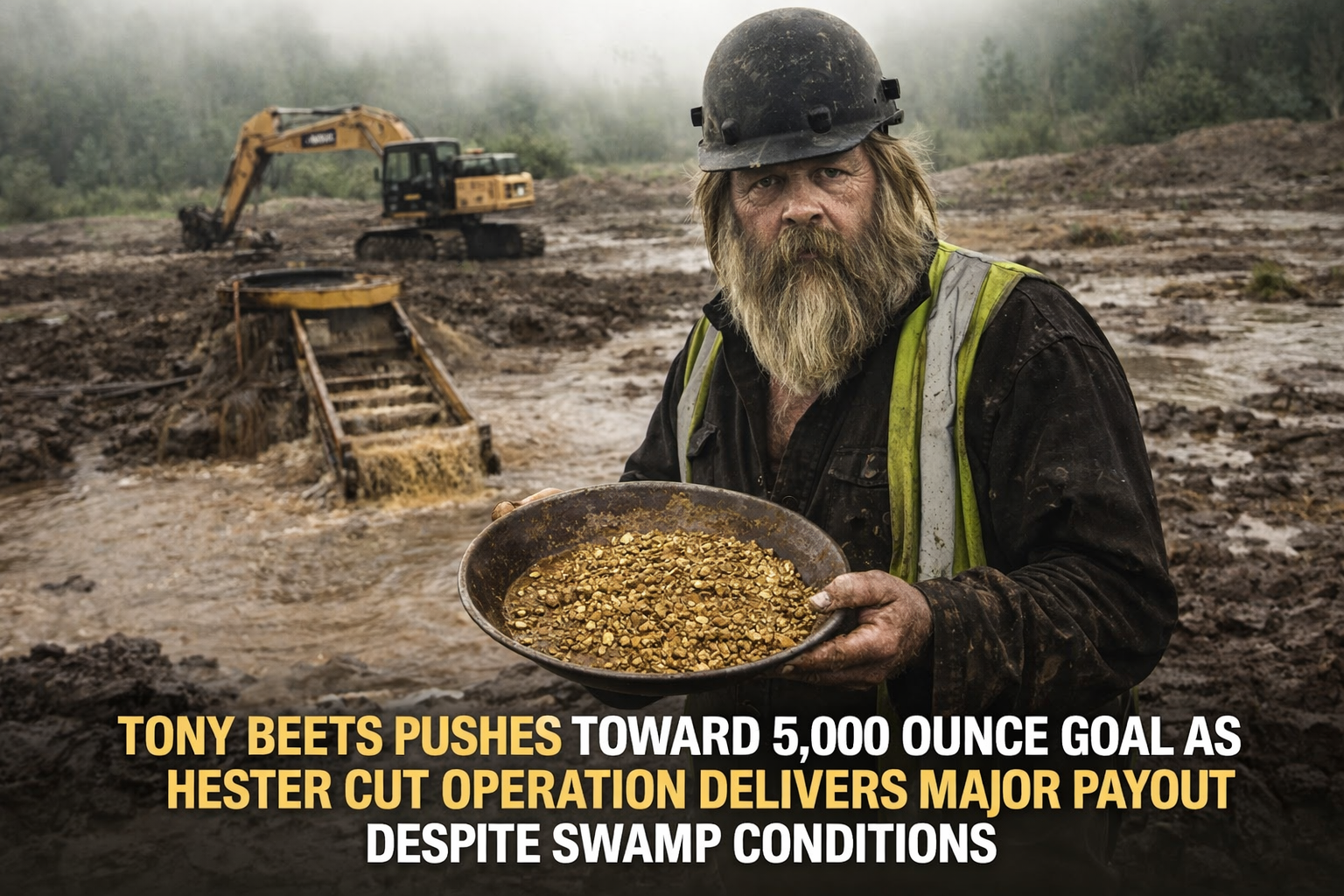
In a season defined by mechanical strain, weather challenges, and relentless pressure to meet production targets, Tony Beets’ operation in the Klondike has taken a decisive step forward with a significant gold recovery from the Hester Cut. The latest wash plant results, combined with an ambitious drainage and stabilization effort led by his family crew, have reinforced Beets’ position as one of the most resilient operators in modern placer mining.
The operation, however, remains far from stable. While the gold numbers provide a strong boost toward Beets’ stated goal of 5,000 ounces for the season, the physical condition of the Hester Cut continues to present serious engineering and environmental challenges that could determine whether the site remains viable in the final stretch of the mining season.
A SEASON UNDER PRESSURE: ONE WASH PLANT, HIGH STAKES
At the core of Beets’ current strategy is a constraint that has defined much of the season: only one wash plant is fully operational. Despite this limitation, the team has managed to maintain production flow, relying on disciplined coordination between excavation, hauling, and processing crews.
Industry observers note that running a single wash plant at this stage of the season significantly increases risk exposure. Any mechanical failure or slowdown in feed supply can immediately impact gold recovery targets. In this context, the push to expand capacity through additional drainage and site preparation at Hester Cut becomes strategically essential.
Tony Beets’ objective is clear: maintain steady throughput while accelerating access to previously submerged or unstable pay zones.


THE HESTER CUT CHALLENGE: WATER, COLLAPSE, AND DELAYED PAY ACCESS
The Hester Cut, once a promising excavation zone, has transformed into a technically complex environment due to excessive water saturation and bank instability. Recent footage and operational reports confirm that sections of the cut have effectively reverted to swamp-like conditions, with liquefied soil collapsing back into previously stripped areas.
This has created a dual challenge for the operation: not only must water be removed, but the structural integrity of the site must also be rebuilt before meaningful mining can resume.
To address this, the Beets crew deployed a high-capacity pumping system—described internally as a hybrid or “Frankenstein” machine—combining older pipe-laying infrastructure with a modern submersible pump system capable of moving approximately 1,000 gallons per hour. The objective is to redirect water 150 yards away into a designated settling pond, allowing the cut to gradually dry and stabilize.
However, drainage alone is not sufficient. The saturated banks have begun to fail, forcing the team to introduce coarse tailings material to reinforce slopes and act as a drainage medium. This creates a controlled stabilization layer while also preventing further collapse into active pay zones.

FAMILY-LED OPERATIONS AND STRATEGIC DELEGATION
A notable aspect of the current phase is the increased operational responsibility placed on Tony Beets’ family members. Monica Beets has taken an active role in managing both pump placement and excavation logistics, while coordinating with her brother Mike and field crews to ensure continuous operation.
This delegation reflects a broader structural reality in large-scale placer mining operations: efficiency increasingly depends on distributed leadership rather than centralized control. Monica’s involvement in both machinery deployment and material movement highlights a shift toward multi-point operational management within the Beets mining structure.
Observers note that such delegation is not merely logistical but strategic. By embedding family leadership across multiple operational nodes, Tony Beets reduces single-point failure risk while maintaining tighter control over critical production decisions.
GOLD RECOVERY RESULTS: A CRITICAL BOOST TO SEASON TOTAL
Despite environmental setbacks, the most recent wash plant run delivered a strong result: approximately 320 ounces of gold, valued at over $800,000. This brings the season total to approximately 4,159 ounces, placing Beets within striking distance of his 5,000-ounce seasonal target.
From an analytical perspective, this output is significant for two reasons. First, it confirms that the Hester Cut still contains viable pay zones despite water intrusion and structural degradation. Second, it demonstrates that when material flow is stabilized, the wash plant is capable of sustaining high-efficiency recovery rates.
However, analysts caution that maintaining this level of output will depend heavily on continued access to dry, stable ground—something that remains uncertain given the current condition of the cut.
ENGINEERING RISKS AND TIME CONSTRAINTS
The introduction of tailings into the Hester Cut to stabilize collapsing banks introduces both short-term benefits and long-term complexity. While the material helps prevent immediate landslides, it also alters water drainage patterns and may require repeated pumping cycles before full access to pay dirt can be restored.
Additionally, seasonal timing is a critical factor. As temperatures drop and ground conditions begin to harden, flexibility in excavation strategy decreases. Any delay in drying the cut could significantly reduce the remaining operational window.
Engineers familiar with similar Yukon conditions note that once saturation reaches a certain threshold, recovery efforts often become exponentially more difficult, requiring increased fuel consumption, heavier equipment use, and more frequent maintenance cycles.

OUTLOOK: CAN THE HESTER CUT DELIVER IN TIME?
Looking ahead, the key question for Tony Beets’ operation is whether the Hester Cut can be stabilized quickly enough to support sustained production before the season ends. If successful, the site could provide the final push needed to surpass the 5,000-ounce milestone.
If not, the operation risks being locked into a cycle of drainage, collapse management, and delayed access—effectively limiting production capacity during the most critical period of the mining calendar.
Despite these risks, current performance indicators remain cautiously optimistic. The combination of strong wash plant output, coordinated family leadership, and aggressive site management suggests that Beets’ operation retains the adaptability required to respond to evolving ground conditions.
CONCLUSION: A SEASON DEFINED BY CONTROL UNDER CHAOS
The latest developments at the Hester Cut encapsulate the broader reality of modern Klondike mining: success is not determined solely by gold availability, but by the ability to control unpredictable environmental variables.
Tony Beets’ team has demonstrated both resilience and technical adaptability in the face of significant operational disruption. While the road to 5,000 ounces remains uncertain, the latest gold recovery confirms that the potential remains firmly within reach—provided the team can stabilize the ground beneath it.
As the season progresses, all eyes will remain on whether the Hester Cut becomes the foundation of a strong finish—or another reminder of how quickly fortune can shift in the unforgiving world of Yukon gold mining.