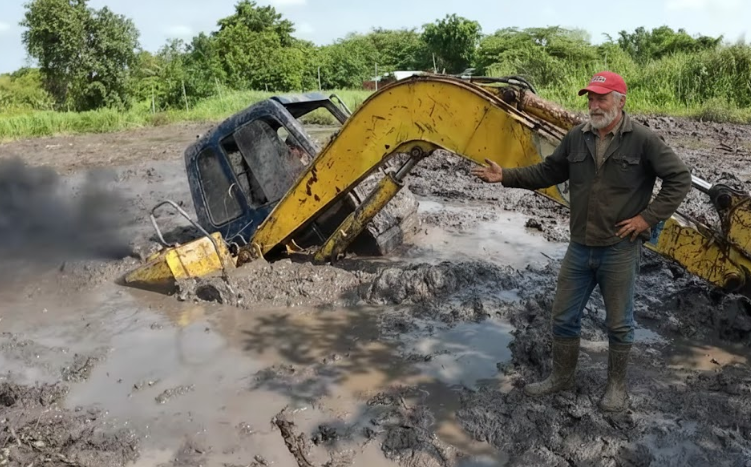
Tony Beets’ brand-new $700,000 excavator was destroyed in a horrific accident!

The sixteenth season of Gold Rush opened with the kind of momentum most Klondike miners only dream about. Just two weeks into the season, Tony Beets and his family were already sluicing pay dirt from the Early Bird Cut at Indian River. The first cleanup delivered an impressive 417.56 ounces of gold — worth nearly $1.5 million — putting the Beets operation firmly on track toward its ambitious 6,500-ounce target for the year.
For a brief stretch, everything appeared to be aligning perfectly. The weather held steady, machinery ran without issue, and the ground proved rich. But in the Yukon, even the most experienced operators know that early success can shift abruptly.
That reminder came in dramatic fashion at Paradise Hill.
A Divided Empire
This season, Tony Beets has divided his attention between two key claims: Indian River and Paradise Hill. At Indian River, Tony personally oversees production and early cleanups. Paradise Hill, however, remains the long-standing heart of the Beets family legacy — a claim worked for more than three decades and responsible for thousands of ounces of gold.
In a move that signals both trust and transition, Tony placed his son Mike fully in charge of Paradise Hill this year. The decision marks a significant test of leadership. While Tony pushes production at Indian River, Mike is responsible for running a nine-man crew and preparing new ground at Paradise Hill for sluicing.
The scale of the operation is immense. Over the past three seasons, the family has stripped nearly four million tons of overburden, carving out an 18-acre super pit. Beneath it lies the prized white channel pay — gold-rich material deposited from ancient hard rock sources. To date, Paradise Hill has yielded more than 4,000 ounces, worth approximately $15 million.
Tony expects the first acre of new ground to reach pay dirt within a week. To meet that goal, Mike’s crew has been operating continuously, supported by newly acquired heavy equipment, including six brand-new rock trucks.
For several days, the system ran efficiently. A D11 dozer tore through frozen surface layers. Excavators loaded rock trucks with waste material. The trucks hauled loads nearly half a mile to dump sites. It was a tightly coordinated cycle dependent on precision and communication.
Then came the call over the radio.
The Accident
“Guys, we’ve got a problem.”
One of the new rock trucks had tipped dangerously close to the edge of a 200-foot drop. The $700,000 machine — reportedly valued at approximately $750,000 — was left teetering on unstable ground. Inside the cab, driver Graham was trapped.
The truck’s tires were partially buried in loose gravel, and the vehicle shifted under its own weight. If the bank gave way, the truck and driver risked plunging to the bottom of the pit.
Tony and Mike rushed to the scene. Crew members attempted to stabilize the situation while communicating urgently over radios. Graham reported that the truck was still moving.
Tony immediately directed efforts to extract the driver. The crew broke a window and guided Graham through the narrow opening. After tense moments, he was pulled clear of the cab.
The immediate relief was palpable. No one was injured.
But the damage to the truck was severe. The cab was bent, body panels were cracked, and hydraulic components required extensive repair. For a new operation still building early-season momentum, losing a major piece of equipment posed a serious operational setback.
Recovery Effort
To retrieve the 36-ton vehicle, Tony and Mike deployed a D10 dozer and a large 480 excavator. The recovery required careful coordination. One miscalculation could have sent the truck sliding over the edge.
Slowly, the machines pulled the truck upright. Once stabilized, Tony assessed the condition with characteristic pragmatism.
Years of mining in the Yukon have conditioned him to expect mechanical setbacks. The terrain is unforgiving, and heavy equipment operates at extreme limits. While the financial hit is significant, Tony has consistently emphasized one priority: safety.
Machinery can be repaired or replaced. Lives cannot.
Financial and Operational Impact
Despite the strong start at Indian River, the accident places additional pressure on Paradise Hill. Fewer active trucks mean reduced hauling capacity, slower stripping progress and potential delays in reaching pay dirt.
For Mike, the incident intensifies scrutiny. This season represents his opportunity to demonstrate independent leadership. Managing a setback of this magnitude — particularly with new equipment — becomes part of that test.
Still, the broader Beets operation remains robust. Indian River continues to deliver strong cleanups, reinforcing Tony’s strategy of splitting focus between two high-potential claims.
Within just the first two weeks, the family’s production numbers suggest the season could still rank among Tony’s most productive.
Momentum and Perspective
The early $1.5 million cleanup underscores that Tony’s experience and preparation remain formidable advantages. Even with one truck sidelined, crews continue stripping overburden and preparing fresh ground.
The incident at Paradise Hill, while costly, appears to have sharpened the team’s focus rather than diminished it. Mining at this scale demands resilience. Each day lost to downtime reduces potential revenue, but the season is far from over.
Tony has long acknowledged that the Yukon exacts a toll on every operation. Setbacks are not anomalies; they are part of the terrain.
With winter months still ahead and thousands of ounces remaining in the ground, the Beets family faces the dual challenge of maintaining production pace while navigating the inherent risks of heavy industry.
Season 16 has already delivered both promise and peril. For Tony Beets, the measure of success will not be defined by one accident, but by how effectively his crews convert early momentum into sustained output.
The gold is there. The machinery, though tested, remains operational. And as the season unfolds, the Beets operation continues to push forward — determined to extract every ounce the Yukon will yield.