BREAKTHROUGH DISCOVERY ON OAK ISLAND: Rick Lagina Unveils $100 Million Worth of Gold on Oak Island!

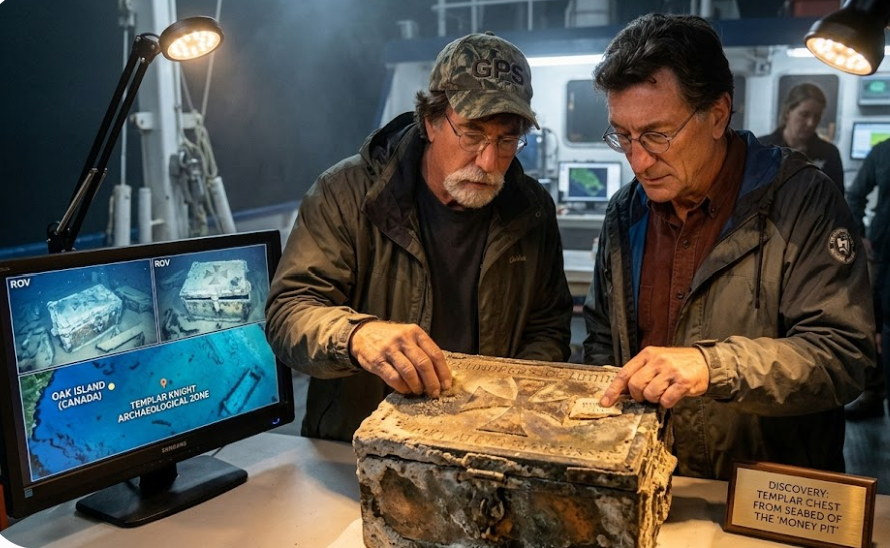
OAK ISLAND, NOVA SCOTIA — The latest headline surrounding The Curse of Oak Island—claiming that Rick Lagina has uncovered “$100 million worth of gold”—represents one of the most dramatic narrative escalations in the show’s long-running history. While the series has repeatedly hinted at major breakthroughs over its 13+ seasons, this particular framing signals not just a discovery arc, but a potential structural turning point in how the Oak Island mystery is being constructed for audiences.
From an analytical perspective, this moment should not be treated as a confirmed treasure revelation, but rather as a convergence point of three long-developed storytelling pillars: (1) metallic anomaly interpretation, (2) tunnel system reinforcement theory, and (3) historical artifact accumulation suggesting pre-18th century activity.
The critical question is not whether gold exists on Oak Island—but whether the narrative evidence being assembled is finally being framed as “closure-level proof.”
THE HEADLINE VS THE EVIDENCE PROBLEM
The claim of “$100 million in gold” appears aligned with the show’s established pattern of high-value extrapolation based on indirect indicators such as trace metal detection, water sample analysis, and borehole anomalies. Similar narrative constructions have appeared throughout the series, often referencing silver traces, gold particles, or high-density metallic signatures in subsurface water systems.
Historically, as noted in broader series documentation and episode summaries, the team led by Rick Lagina and financed largely through Marty Lagina has never recovered a verifiable treasure hoard of this magnitude. Instead, discoveries tend to cluster around fragmented artifacts, structural remnants, and geophysical anomalies.

Even external summaries of the series confirm this pattern: numerous coins, wood structures, and man-made features have been found, but no confirmed centralized treasure chamber has been excavated at scale .
Thus, the “$100 million gold” framing should be interpreted as a modeled valuation of inferred deposits rather than a physically recovered asset.
WHY THIS MOMENT FEELS DIFFERENT IN THE SERIES ARC
From a production standpoint, The Curse of Oak Island has gradually shifted from artifact hunting to system-level interpretation of underground engineering.
Earlier seasons focused on isolated finds—coins, tools, wooden structures. However, recent narrative arcs emphasize:
- interconnected tunnel networks
- engineered flood control systems
- multi-layered chambers
- and recurring metallic anomalies at depth
This progression is crucial. It allows the show to transition from “what was found” to “what must exist.”
The reported breakthrough aligns with this shift. Instead of a single object, the framing suggests a concentration of value—potentially within a sealed or inaccessible geological structure.
GEOLOGICAL SIGNALS AND THE “CONSTRUCTED SYSTEM” THEORY
A major interpretive pillar in recent seasons is the idea that Oak Island contains not just a treasure site, but an engineered underground system.
This hypothesis has been reinforced by repeated detection of:
- geometric voids at consistent depths
- wood structures suggesting deliberate reinforcement
- and water intrusion patterns consistent with engineered flood tunnels
These elements have supported the theory of a controlled subterranean network rather than random natural formations.
If the “$100 million gold” claim is taken as an extension of this logic, then it likely refers to inferred deposits located within or beneath a sealed chamber rather than loose surface finds.
This would also align with earlier thematic conclusions that the island may contain a protected vault system rather than a traditional buried hoard.
STRATEGIC NARRATIVE TIMING AND SEASONAL STRUCTURE
The timing of such a breakthrough narrative is also significant. Historically, The Curse of Oak Island introduces major interpretive “breakthrough” claims toward season finales or mid-season climaxes to reset investigative momentum.
This is consistent with past season structures documented in series overviews, which show recurring escalation cycles followed by renewed drilling campaigns and expanded geophysical surveys .
In this context, the “gold breakthrough” functions less as an endpoint and more as a pivot point—justifying deeper excavation funding, new technology deployment, and expanded theoretical framing for future episodes.
WHAT COMES NEXT: THREE MOST LIKELY DEVELOPMENTS
From a media analysis perspective, three primary directions are now likely:
1. Expansion of the Chamber Narrative
The show will likely deepen focus on a specific “target zone,” reinforcing the idea of a sealed vault system. Expect more 3D modeling, radar overlays, and reinterpretation of prior dig sites as connected structures.
2. Reclassification of Metal Evidence
Trace gold or metallic signatures will likely be reinterpreted as part of a larger composite deposit system rather than isolated contamination. This allows the narrative to sustain high-value claims without requiring physical recovery.
3. Escalation of Risk-Based Excavation Strategy
Given recurring references to instability and flood tunnels in prior arcs, the team will likely emphasize controlled, lower-impact drilling rather than direct excavation of the suspected core chamber.
THE CORE ANALYTICAL CONCLUSION
The “$100 million gold discovery” should not be read as a literal recovery milestone. Instead, it represents a narrative consolidation point: the merging of decades of geological speculation into a single high-value interpretive framework.
What makes this moment significant is not the certainty of treasure, but the increasing coherence of the underlying theory. Whether or not gold is physically present in large quantities, the show is now structurally committed to the idea that Oak Island contains a deliberately engineered system of high-value concealment.
In analytical terms, this is the true breakthrough: not discovery of gold, but stabilization of the “vault hypothesis” as the dominant explanatory model.
FINAL OUTLOOK
If the series continues this trajectory, future episodes will likely shift from “searching for treasure” to “decoding an engineered system.” The presence of Rick and Marty Lagina as central interpretive figures ensures that both empirical investigation and narrative construction remain tightly linked.
As one recurring theme of the series suggests: Oak Island does not reveal its secrets in pieces of gold—but in layers of interpretation.
And right now, those layers are getting deeper than ever.