Lot 5 Mystery Deepens: Is This the Break Oak Island Needed?
A routine investigation on Lot 5 has taken a promising turn as members of The Curse of Oak Island team uncovered a series of intriguing artifacts only feet from the mysterious rounded stone structure designated a “special place” by the province in 2024. The discoveries, found during a systematic metal-detection sweep of last year’s spoil piles, may provide new clues about who once occupied this area—and why.
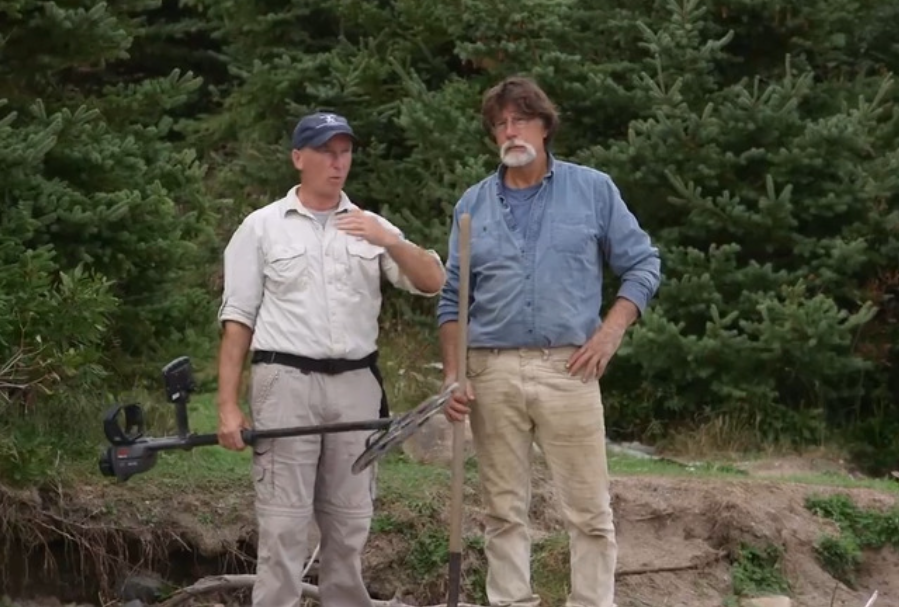
While drilling continues in the Money Pit area, metal-detection expert Gary Drayton, joined by Peter Fornetti and the archaeology team, focused their efforts nearly half a mile west near the shoreline. Their task: re-examining the spoil piles from the enigmatic circular foundation discovered last year. Early hopes were modest, as Gary noted that valuable items sometimes slip through quarter-inch screens during previous excavations.
But the team’s expectations shifted quickly.
A Bullet… and a Clue to Early Occupation
The first significant signal produced a small lead shot, likely dating back to the 17th or early 18th century. Lead shots, ramrod guides, and musket balls have surfaced repeatedly on Lot 5 since the team acquired it three years ago. The latest find reinforces the theory that armed individuals—hunters, military groups, or secret operatives—occupied this ground long before the Money Pit’s discovery in 1795.
“Somebody’s supper was probably made with this,” archaeologist Fiona Steele remarked, suggesting the shot may have been used by people camping or working in the area.
A Possible Door Hinge Near the Round Feature
Moments later, a larger iron target emerged—a thick, oddly shaped metal object featuring raised bumps and a possible design. Gary immediately suggested it could be part of a door hinge or locking mechanism, a theory supported by Fiona.
“If people were storing valuables here, they would have needed locks,” Gary noted.
The location of the find—just feet from the rounded feature—sparked further intrigue. Could this object belong to a chest, entranceway, or hidden structure connected to Lot 5’s puzzling layout?
A Much Bigger Discovery Beneath the Soil
But the most striking moment came when Gary detected a “screamer” signal deeper in the soil. As Fiona excavated carefully with a trowel, the soil revealed layers of coarse earthenware, fragments of older green-tinted glass, and a large piece of iron buried more than ten inches deep.
The combination of materials immediately drew attention.

“This could be a refuse pile… or it could be something else,” Fiona said. “What if this is another part of the foundation?”
Her assessment forced an immediate halt to digging. Under Nova Scotia’s regulations, once an area is suspected to contain structural remains, only certified archaeologists may proceed.
The find lies just a few feet from where the team previously unearthed two ornate buttons—the starburst and spiral designs—possibly linked to the Knights of Malta, a 17th-century successor organization to the Knights Templar. With the earthenware dating between 1600 and 1800, the evidence suggests multiple phases of occupation and activity by groups whose roles remain unknown.
A Growing Web of Clues on Lot 5
The continued discoveries reinforce a developing hypothesis: Lot 5 may have been used repeatedly over centuries, perhaps by different groups engaged in clandestine activity. The combination of iron hardware, weapon remnants, imported pottery, Venetian beads, and Templar-associated artifacts hints at a complex storyline unfolding west of the Money Pit.
“Lot 5 is the area that keeps on giving,” said Peter Fornetti. “We’re trying to help the archaeologists understand how what’s happening here ties back to the Money Pit.”
As the area is now flagged for controlled excavation, archaeologists will carefully uncover the newly discovered material in the coming days.
A New Section of the Feature?
If the buried iron object proves structural, it could represent an extension of the circular stone feature—one that has already triggered debate among historians.

As Fiona concluded:
“This is really encouraging. Every new piece adds to the puzzle.”
With each find, Lot 5 becomes less of a peripheral curiosity and more of a central chapter in Oak Island’s centuries-long mystery—perhaps even the key to understanding who built the Money Pit, when, and why.