MEDIEVAL FOOTPRINTS: 12th-Century Leather Discovery Rocks Oak Island Swamp
The long-standing mystery of Oak Island has taken a stunning leap backward in time. In a high-stakes briefing held in the island’s “War Room,” the Fellowship of the Dig revealed preliminary carbon-14 dating on leather fragments recently recovered from the northern swamp. The results suggest the artifacts date as far back as 1148 AD, potentially placing European activity on the island more than 600 years before the discovery of the Money Pit.
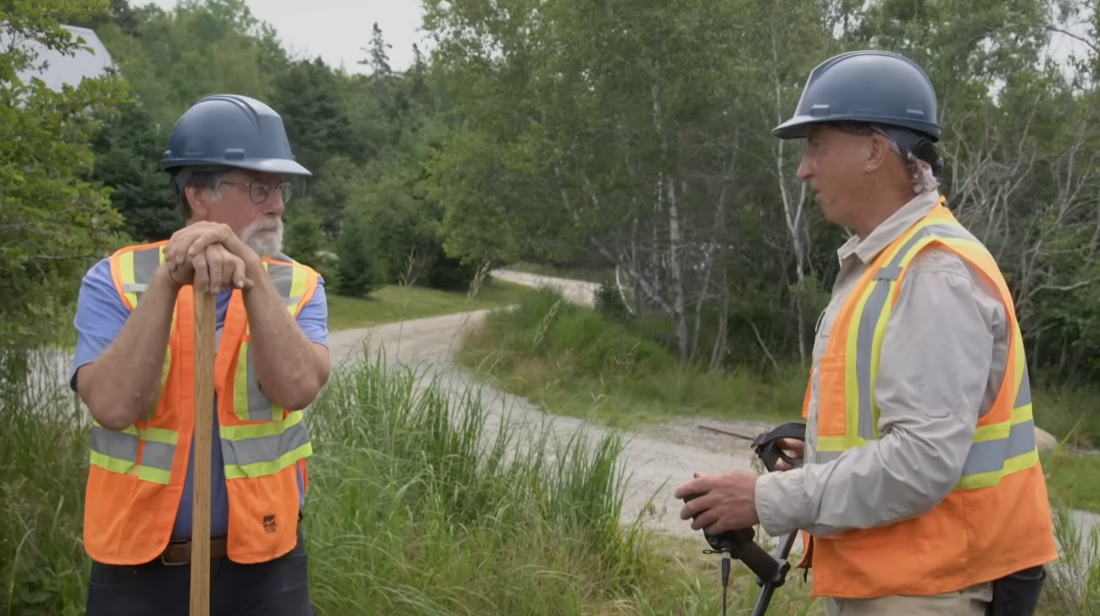
The leather, identified as the sole of a “hobnailed” boot or shoe, was discovered by Rick Lagina and Gary Drayton while they were excavating near a cobblestone pathway on property belonging to Tom Nolan. Unlike modern footwear, the specimen featured distinct holes where iron hobnails—used centuries ago to provide traction—would have been inserted.
The “Gaspani Era” Connection
The laboratory results provided a date bracket of 1148 to 1216 AD, a revelation that left the team visibly stunned. Marty Lagina noted that this timeline aligns “perfectly” with the research of Italian archeoastronomy professor Adriano Gaspani.
Gaspani’s peer-reviewed studies of “Nolan’s Cross”—a massive formation of boulders on the island—suggested the monument was aligned with celestial stars as they appeared in the early 13th century. Gaspani has long theorized that the cross was the work of the Knights Templar, the medieval order often rumored to have brought sacred treasures to North America.

“It aligns perfectly with what Professor Gaspani articulated to us,” Rick Lagina said. “The construction of Nolan’s Cross happened in the 13th century. Now, we are starting to accumulate dates in the swamp that match.”
[Image: Close-up of the medieval leather sole showing the irregular hobnail patterns]
The “Key to the Swamp”
The leather wasn’t the only find to electrify the team. Just yards away from where the shoe fragments were unearthed, a heavy, iron-rich signal led to the recovery of a unique artifact: a hand-forged iron key.
Found deep within the marshy soil alongside thick, one-inch-wide wooden planks, the key features a “spade-like” end typical of ancient mechanical locks. The proximity of the wood—which Rick Lagina speculated could be part of a chest or a buried structure—has raised hopes that a second, non-empty vault may be hidden in the northern bog.
Last year, the team discovered a brick-and-slate vault in the same region, though it was found to be empty. This new “swamp key” and the associated heavy planking suggest that the original depositors may have left more than one repository behind.
A New Mandate to Dig
The combination of 12th-century organic material and a potential treasure key has provided the Fellowship with its most clear-cut mandate in years. While the search continues at the 230-foot level of the Money Pit, the focus has increasingly shifted to the “Green Abyss” of the swamp.

“A treasure is never going to find itself,” Marty Lagina declared during the meeting. “We have the machinery, we have the time, and we have the data. Let’s use it and dig more in the swamp.”
The team’s next steps involve a specialized CT scan of the iron key to peer through centuries of rust and determine its exact mechanical design. If the metallurgy of the key matches the medieval timeline of the leather, Oak Island may finally transition from a legendary mystery to a proven medieval outpost.