OAK ISLAND MEGA-DISCOVERY: “ROSE GATE” VAULT AND ANCIENT RELIQUARY CHALICE TRIGGER GLOBAL HERITAGE CRISIS
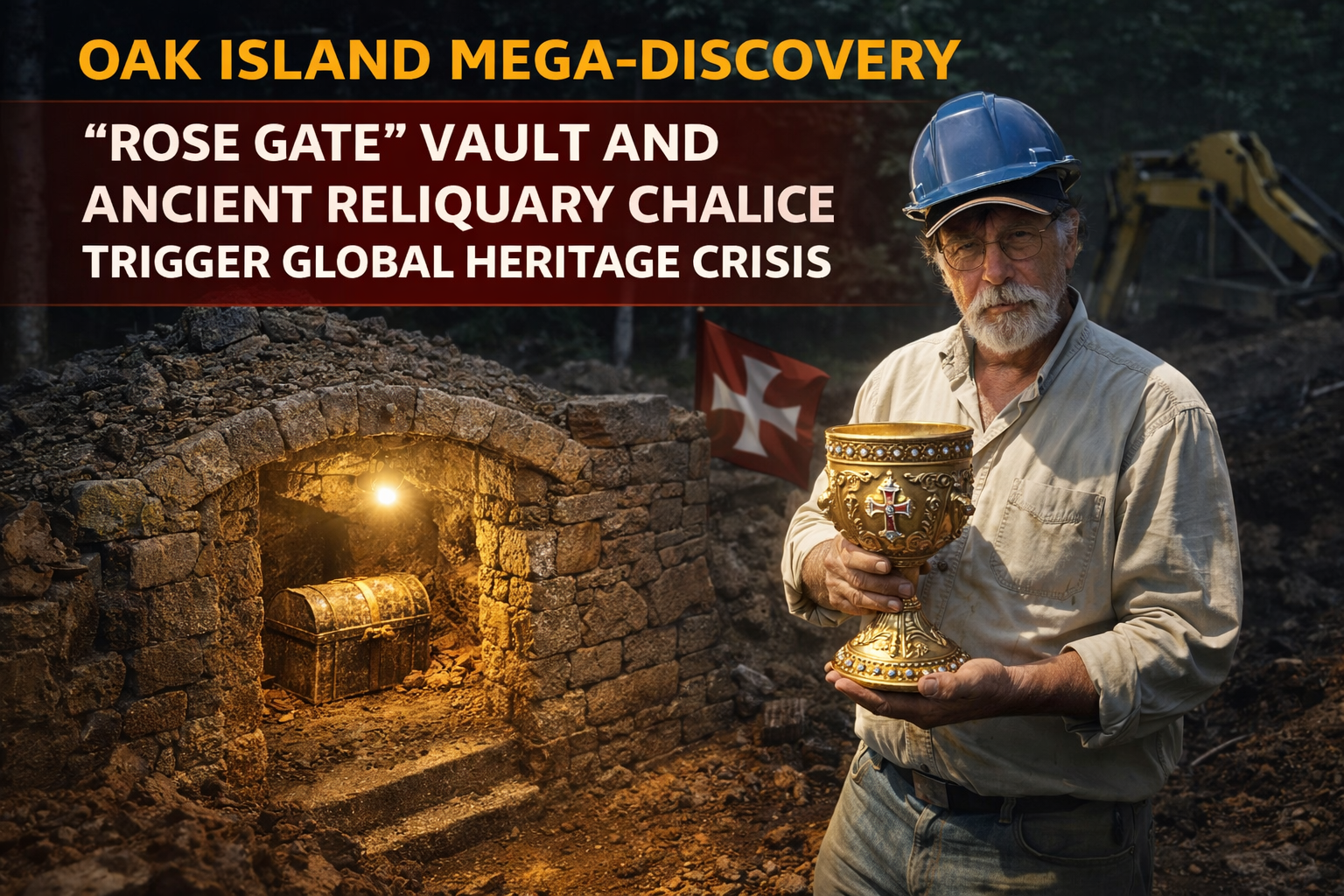
A newly surfaced excavation narrative from The Curse of Oak Island has reportedly pushed the long-running mystery of Oak Island into its most extraordinary and controversial phase yet, following the detection of a sealed subterranean vault, an engineered defensive network, and the recovery of a medieval reliquary described as a chalice of unprecedented historical significance.
According to detailed operational accounts and transmitted field analysis, the discovery sequence has escalated from routine excavation into what experts are now calling a “multi-layered engineered system” potentially spanning centuries of intentional concealment.
A VAULT BEYOND GEOLOGY: THE FIRST BREAK IN THE ISLAND’S SILENCE
The turning point reportedly began when subsurface scanning detected a massive void approximately 180 feet beneath the swamp region of Oak Island. Unlike natural formations, the anomaly displayed uniform density boundaries and structural alignment inconsistent with geological collapse or sediment displacement.
When excavation teams led by Rick and Marty Lagina approached the site, they encountered what appeared to be a deliberately sealed underground chamber constructed with engineered precision rather than natural stone formation.
What immediately distinguished the structure was its geometric consistency. Walls appeared smoothed and reinforced, with materials suggesting intentional design aimed at long-term preservation and concealment.

Within hours of initial breach confirmation, the team escalated operations into controlled archaeological entry protocols.
THE ROSE GATE: A SYMBOLIC AND STRUCTURAL BARRIER
At the heart of the discovery lies what researchers have termed the “Rose Gate”—an arched limestone structure engraved with a fully bloomed rose entwined with cross-like markings.
Far from decorative, the carving appears to function as both symbolic identifier and mechanical sealing interface. The structure’s precision suggests that it was constructed as a final barrier protecting a central vault zone beneath Oak Island.
The symbol closely resembles motifs historically associated with post-Templar esoteric traditions, particularly Rosicrucian iconography, which has long been speculated to preserve fragmented knowledge of earlier medieval orders.
The Rose Gate is now believed to mark the threshold of the island’s central chamber system.
ENGINEERED DEFENSE NETWORK: A HIDDEN MECHANICAL TRAP SYSTEM
Further analysis revealed that the vault is not an isolated chamber but part of a larger interconnected structure. Beneath and around the Rose Gate lies a network of mechanical and geological modifications including:
- Interlocking wooden and brass reinforcement systems
- Hydraulic water control channels
- Pressure-sensitive collapse triggers
- Cross-patterned structural supports embedded into bedrock
This system appears designed to react to intrusion attempts, potentially flooding or destabilizing access routes if disturbed improperly.
Experts reviewing the footage describe it as a “guardian mechanism”—a self-protecting architectural system far more advanced than previously documented medieval engineering capabilities.
The implications suggest not only concealment, but active defense against discovery.
THE CHALICE: A RELIC OF UNEXPECTED PROVENANCE
Inside the sealed chamber beyond the Rose Gate, investigators reportedly uncovered a central artifact resting on a limestone pedestal: an ornate chalice.
Initial examination describes the object as a finely crafted vessel made from a rare alloy of Byzantine gold and Frankish silver—materials consistent with high-status medieval ecclesiastical craftsmanship.
Inscribed along its inner rim are the words “Veritas sub rosa”—translated as “Truth under the rose,” a phrase historically associated with secrecy, oath-bound orders, and encrypted religious knowledge.
Laboratory analysis reportedly indicates the artifact dates back to the 12th–13th century timeframe, placing it within the broader historical period often associated with the Knights Templar and Crusader-era movements.
GLOBAL RESPONSE: RELIGIOUS AND POLITICAL INTERESTS EMERGE
Following internal verification protocols, the discovery has reportedly drawn immediate international attention, including communications referencing Vatican-level heritage interest in the artifact.
Historical specialists linked to ecclesiastical archives have suggested that the chalice matches descriptions of a long-lost reliquary believed to have disappeared during the early 14th century suppression of Templar holdings.
According to archival references, the artifact may have once held sacred relic fragments associated with early Christian Jerusalem traditions, making its rediscovery potentially significant not only archaeologically, but theologically.
If confirmed, this would elevate Oak Island from a regional mystery site to a location of global religious and historical importance.
THE ARCHITECTURAL THEORY: A DESIGNED SYSTEM, NOT A TREASURE HOARD
Perhaps the most transformative aspect of the discovery is not the artifact itself, but the structural logic surrounding it.
Researchers now believe Oak Island contains a deliberately engineered system consisting of:
- Geometric alignment markers across the island surface
- Subsurface vault chains connected by tunnel networks
- Mechanical flood prevention and activation systems
- Astronomical and symbolic mapping overlays
When reconstructed digitally, these elements appear to form a coordinated design rather than independent dig sites.
This suggests that Oak Island was not merely a hiding place—but a long-term engineered containment structure.
FROM MYSTERY TO ENGINEERED LEGACY
The implications of the discovery have fundamentally altered the interpretive framework of Oak Island.
Where earlier theories focused on lost treasure, shipwreck loot, or isolated burial activity, the current evidence points toward a unified system of concealment incorporating engineering, symbolism, and environmental manipulation.
The presence of repeating symbolic language, structural defenses, and high-value religious artifacts suggests a coordinated effort spanning geography and centuries.
ANALYST CONCLUSION: THE SYSTEM BEHIND THE MYSTERY
From an analytical perspective, the most significant shift is conceptual rather than material.
Oak Island is no longer being interpreted as a site where something was hidden.
It is being reinterpreted as a site that was built to hide.
The discovery of the Rose Gate and the chalice inside a controlled vault system indicates intentional design at a level far beyond accidental historical accumulation.
As seen in The Curse of Oak Island, each excavation layer does not conclude the mystery—it deepens it.
And according to the latest reports, this may only be the outer threshold of a far larger system still buried beneath the island.
FINAL NOTE: THE QUESTION THAT REMAINS
If the vault, the mechanism, and the chalice are all parts of a unified structure, then Oak Island’s true question is no longer “what is buried here?”
It is:
What was so important that an entire engineered system was built to make sure it was never found?