Rick Lagina Opens a 220 Year Old Hatch — What’s Inside Is Disturbing!
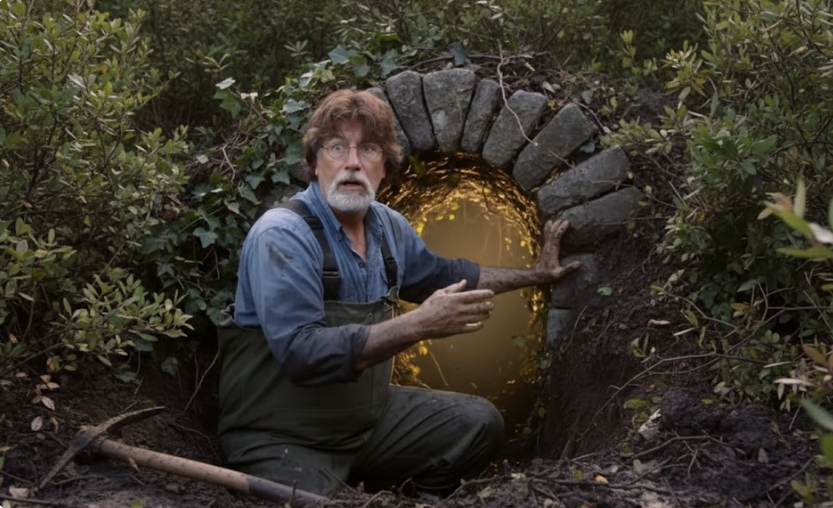
For more than two centuries, Oak Island has been defined by noise—digging, drilling, pumping, and the constant clash between human ambition and an island determined to resist it. Yet in Season 13 of The Curse of Oak Island, the most unsettling moment did not arrive with collapsing tunnels or surging floodwater. It arrived in silence.
That silence emerged as Rick Lagina and his team breached a sealed underground chamber that contained no glittering artifacts, no chests, and no obvious reward. Instead, they found emptiness—an intentionally preserved void that raised a troubling question: what if Oak Island was never designed to protect treasure, but to confine something far more important?
A Chamber That Was Never Meant to Be Opened
From an analytical perspective, the discovery marks a tonal shift for Season 13. Previous years focused on accumulation—more data, more artifacts, more possible links to pirates, Templars, or early European visitors. This season, however, reframes the narrative around purpose.
The chamber’s anomalous properties—unnaturally cold soil, timber that resisted decay, and unfamiliar carved symbols—suggest deliberate engineering rather than chance geology. When the final barrier was breached and revealed nothing inside, the absence itself became the evidence. In archaeology and intelligence analysis alike, empty spaces often signal containment, monitoring, or delayed access rather than failure.
That interpretation aligns with what followed.
Engineering Resistance, Not Random Obstacles
As excavation resumed, the island responded aggressively. Flooding intensified around the 65-foot level, overwhelming pumps and forcing constant reassessment. This was not the erratic water intrusion seen in earlier seasons. Instead, it appeared targeted—almost synchronized with progress.
Dumas Contracting’s discovery of a secondary cavern reinforced with wooden beams, isolated from the main shaft, added weight to the theory of a layered underground system. These features suggest compartmentalization—an approach consistent with complex substructures designed to confuse, slow, or deter intruders.
For Marty Lagina, this evidence was pivotal. His reaction throughout Season 13 reflects a noticeable shift from cautious optimism to measured concern. As an engineer, Marty has long approached Oak Island as a solvable system. This season, the system began behaving less like a puzzle and more like a defense.

Technology Brings Clarity—and New Questions
The introduction of advanced sonar mapping, particularly the Echologer DAS710 system, marked a turning point. The resulting 3D models revealed squared walls, angular voids, and what appeared to be a concealed entrance within a cavern dubbed “Aladdin’s Cave.” Such geometry is exceedingly rare in natural formations at that depth.
From an analyst’s standpoint, this data suggests intentional planning on a scale not previously proven at Oak Island. The implication is profound: whoever constructed these features anticipated intrusion centuries later and designed accordingly.
That foresight challenges the long-held assumption that Oak Island’s builders expected to return quickly. Instead, Season 13 points toward a long-term strategy—one that assumed abandonment, rediscovery, and resistance.
Progress at the Garden Shaft
While subterranean mapping advanced, physical excavation continued at the Garden Shaft. Rick and Marty themselves descended to assist in removing dense clay using pneumatic jackhammers—an act that underscored how close the operation felt to a breakthrough.
At roughly 95 feet, the team intersected a tunnel believed to be seven feet high, aligned toward the so-called “baby blob.” Timber alignment, hollow ground beneath circular logs, and construction techniques matching historical accounts of the original Money Pit all converged in one location.
For analysts, convergence is key. Independent data streams—sonar, excavation, historical documentation—rarely align by chance. Season 13 delivers one of the strongest convergence moments in the show’s history.
Lot 5 Expands the Timeline
Meanwhile, discoveries at Lot 5 widened Oak Island’s historical scope. Finds including a stone structure, 18th-century tools, and even a fragment of a Roman coin dating to around 300 BC complicate the island’s narrative further. While such artifacts do not confirm Roman presence, they reinforce the idea that Oak Island’s story spans multiple eras and purposes.
From a strategic viewpoint, Lot 5 may represent the surface counterpart to the underground system—a logistical or operational area rather than a ceremonial one.
What Season 13 Is Really Telling Us
Season 13 does not deliver a single, definitive answer—and that is precisely its significance. Instead, it reframes Oak Island as a site defined less by buried wealth and more by intentional concealment. The engineering, resistance, and empty spaces suggest that what lies beneath may be information, protection, or containment rather than conventional treasure.
For Rick Lagina, this reinforces a belief held since the beginning: Oak Island is about truth, not profit. For Marty Lagina, it raises legitimate questions about scale, risk, and consequence.
From an analytical standpoint, Season 13 represents a threshold moment. The mystery is no longer about whether something was built beneath Oak Island, but why—and whether uncovering it fully is even the original objective of those who built it.
The silence they encountered may not be the end of the story. It may be the first real warning.