Rick Lagina’s new discoveries on Oak Island reveal an ancient path leading to the legendary Money Pit.
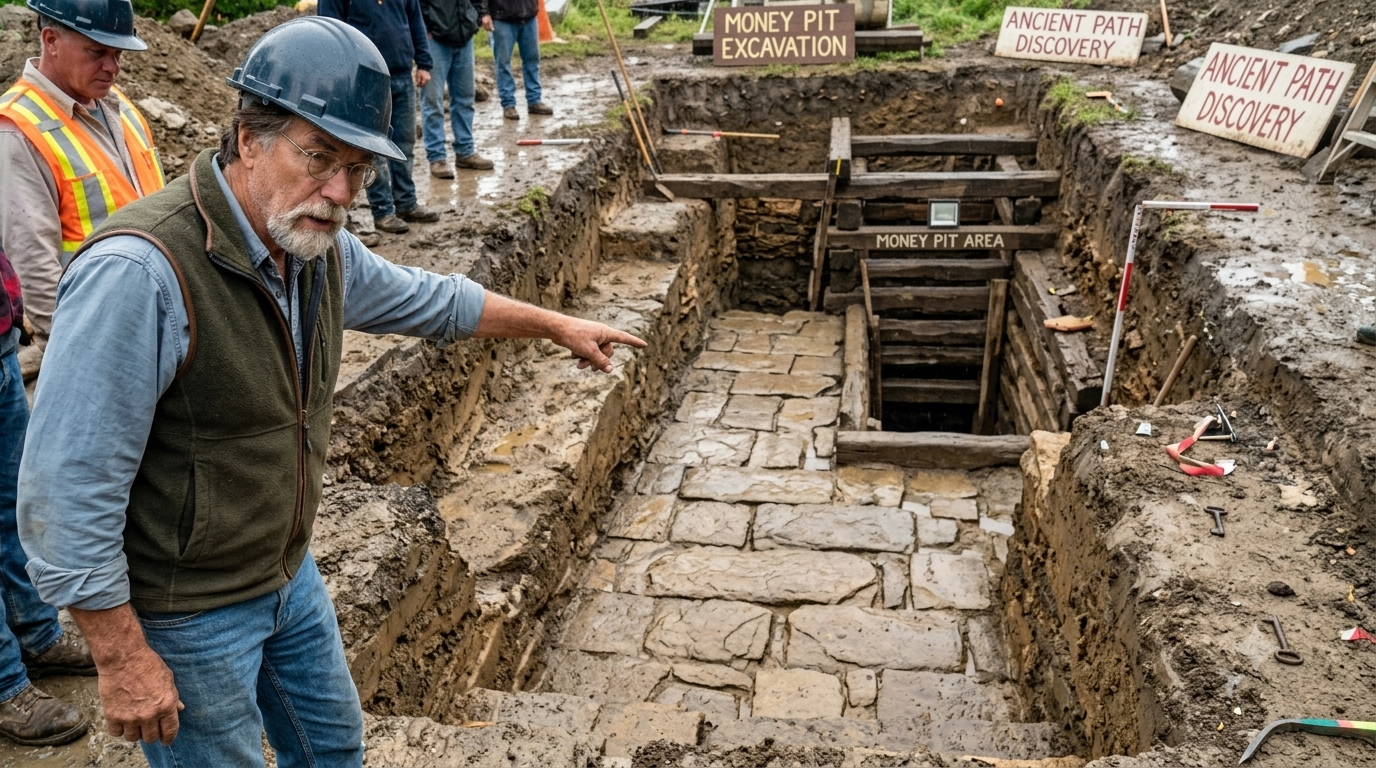
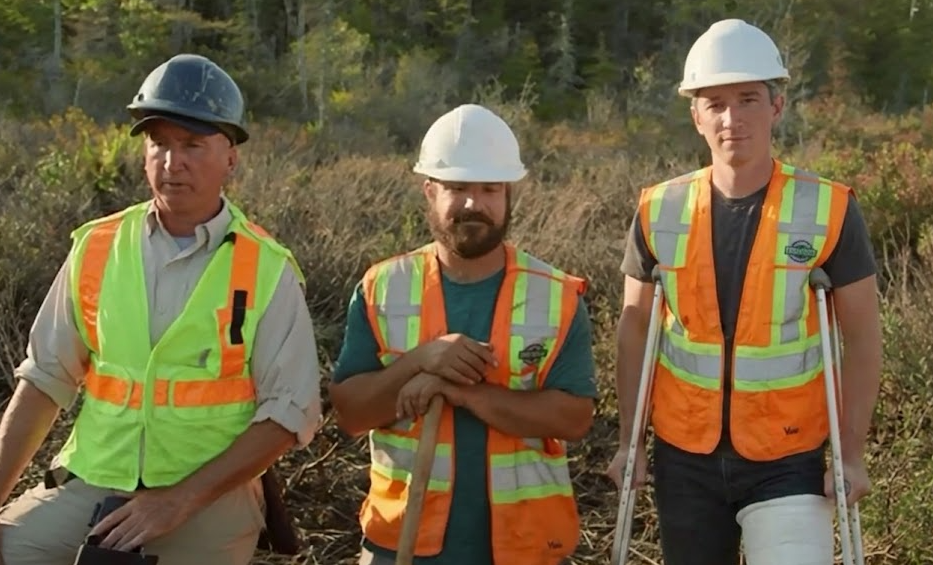
The investigation on Oak Island has entered a fascinating new phase as the team uncovered what appears to be a sand-covered cobblestone road potentially predating recorded surveys of the island. During the latest excavation, Peter, Billy, Gary, and Craig explored the western region of the swamp, revealing sections of a peculiar sand road lined with eight-sided wooden stakes. The alignment and construction of this road have prompted speculation that it may have been used centuries ago to transport materials or treasure to the Money Pit, offering new insight into the activities of Oak Island’s earliest inhabitants.
The discovery began when the team noticed that the sand road’s path seemed to connect to a stone road in the southeast corner of the swamp, a feature previously believed to date to European settlement periods. The stakes found along the sand layer were highly uniform and showed signs of careful placement, suggesting that this was not a simple pathway but a structured route with a purpose. Archaeological consultant Professor Adriano Gaspani analyzed these stakes and proposed that their orientation corresponds with specific stars, indicating astronomical knowledge and planning consistent with early 13th-century craftsmanship. He further speculated that the stakes might have been placed by the Knights Templar or other organized groups, raising the possibility that Oak Island was part of a sophisticated, pre-colonial network of exploration and construction .
The practical significance of the road became more apparent when the team discovered an ox shoe embedded deep within the sand. This artifact demonstrates that animals were used to transport goods along this route, reinforcing the theory that the road was a functional corridor for moving heavy items, possibly including treasure, across the island. The presence of oxen and the careful construction of the pathway indicate a level of operational planning that would have required both resources and engineering skill. Analysts suggest that if this road extends fully from inland locations to the Money Pit area, it could explain how early operators transported materials, offering a tangible connection between Lot 5, the Money Pit, and surrounding terrain .

Historically, the Center Road, which cuts through the middle of Oak Island and delineates the 32 four-acre lots surveyed by Charles Morris in 1762, has been considered a later addition, created by early treasure hunters to navigate the island. However, evidence uncovered in these recent digs suggests that the sand and cobblestone road may predate Morris’s survey. If true, it implies that the island’s engineering and logistical features were in place long before European surveyors arrived, fundamentally reshaping our understanding of Oak Island’s early activity. The alignment and construction of the sand road point to advanced planning, rather than a series of ad hoc pathways, and may indicate deliberate and sophisticated occupation or utilization of the island .
The team’s efforts to trace the road were limited by permit boundaries, but even within the excavated sections, patterns were evident. Stakes were not randomly distributed; they appeared consistently aligned and periodically spaced, reinforcing the notion of deliberate construction. Researchers hypothesize that the road may have been maintained over a long period, with subsequent layers of sand and soil deposited over centuries. If confirmed, this layered construction could explain the road’s remarkable preservation and provide clues about the techniques used to build durable transport routes on unstable, swampy terrain.
In addition to logistical implications, the discovery holds historical significance. The presence of cobblestones and carefully placed stakes, alongside artifacts like ox shoes, implies that early inhabitants had both a purpose and the means to manipulate the environment to meet their operational needs. This combination of evidence—structured pathways, animal usage, and alignment with astronomical markers—supports the theory that Oak Island was not merely an isolated location for occasional treasure hunting but a site of continuous human activity and planning across multiple generations.
Looking forward, analysts predict that the team will attempt to excavate cross-sections along Center Road to verify whether the sand-covered pathway continues beneath it. Such work could potentially reveal even older layers and artifacts, allowing researchers to construct a chronological framework for the road’s usage. If the road does connect directly to Lot 5 and the Money Pit, it would offer compelling evidence of systematic material transport to the legendary site, helping to resolve longstanding questions about the logistics behind Oak Island’s treasure operations.
The discovery also opens avenues for broader archaeological and historical interpretation. By examining the materials, construction methods, and spatial organization, researchers may be able to identify the cultural or organizational group responsible for the road. Combined with other findings from Lot 5, such as mortar-like material and artifacts dated to the 14th century, the sand road could provide a cohesive narrative of human activity, revealing insights into trade, craftsmanship, and settlement patterns on Oak Island before recorded European occupation.
For viewers of The Curse of Oak Island, the implications are substantial. The show has long blended treasure-hunting suspense with historical investigation, and this new discovery adds a concrete and verifiable dimension to the narrative. While the search for treasure continues to captivate audiences, the uncovering of an ancient, purposeful pathway demonstrates that the island’s mysteries are as much about human ingenuity as they are about gold.
In conclusion, the uncovering of the sand-covered cobblestone road and associated artifacts represents a major step forward in understanding Oak Island’s complex past. The road’s alignment, construction, and evidence of animal usage suggest deliberate and organized activity that may have been directly tied to the Money Pit. As the team prepares to explore beneath Center Road and beyond, both fans and analysts anticipate further revelations that could connect ancient engineering, historical occupation, and the legendary treasure narrative, cementing Oak Island’s status as one of North America’s most enigmatic archaeological sites .