THE SILENT STONES OF OAK ISLAND: New Evidence of Pre-Industrial “Grand Scheme” Discovered in Swamp
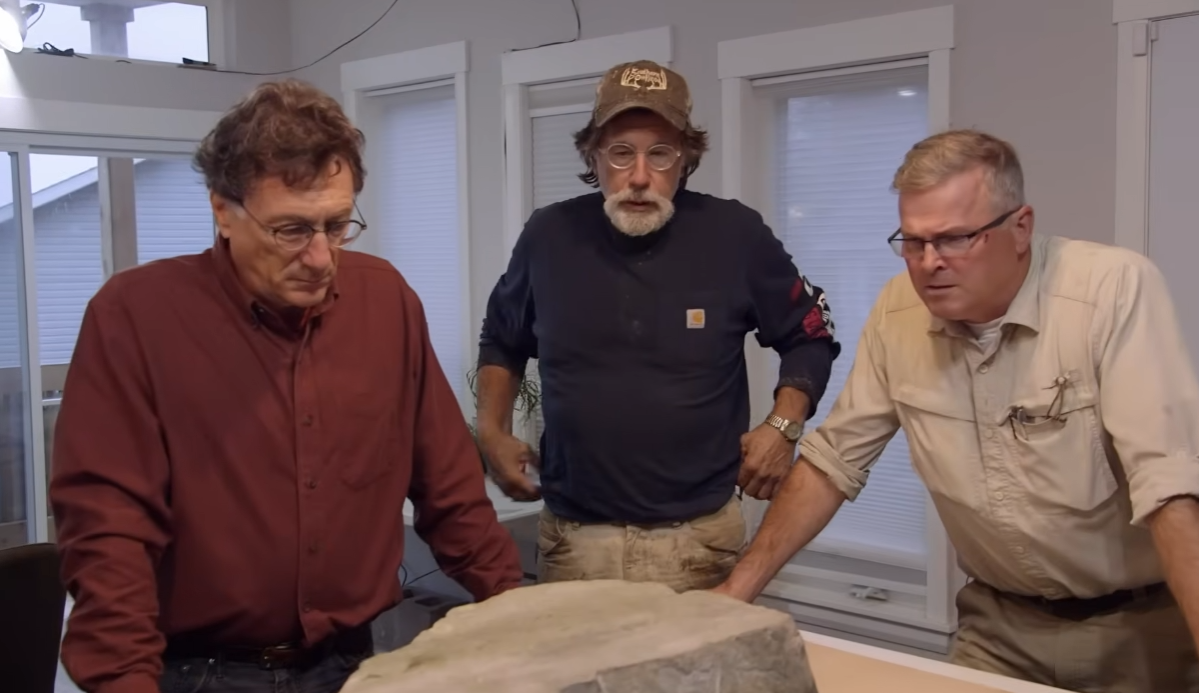
The ongoing excavation of the Oak Island swamp has yielded a series of high-stakes archaeological breakthroughs this week, as Rick and Marty Lagina’s team uncovered a collection of artifacts and stonework that suggest a massive, coordinated engineering project took place centuries before the discovery of the Money Pit in 1795.
From a suspected medieval carpenter’s tool to a “worked” stone face looking out to sea, the new evidence points toward a sophisticated pre-industrial presence on the island, potentially linked to the Knights Templar or early European military operations.
The Swamp’s “Connective Tissue”
Working along the eastern border of the swamp, metal detection expert Gary Drayton and archaeologist Miriam Amirault have focused their efforts on a massive stone pathway. This “road” has long been a point of contention, but recent finds have provided what Rick Lagina calls “incontrovertible evidence” of its purpose as a heavy-transport artery.
Amirault recently recovered a fragment of coal directly from the pathway’s surface. “I think the reason why we’re finding coal is because people were transporting it along this road,” she noted. The presence of coal and charcoal connects this site to a nearby stone feature on Lot 15, believed to be a 16th-century pine tar kiln. For the team, this “connective tissue” proves the road was part of an industrial-scale operation rather than a random geological formation.
The Carpenter’s Square and the “Wheel Bearing”
The swamp’s anaerobic (oxygen-free) mud continues to act as a perfect preservative for organic and metallic clues. Gary Drayton recovered an irregular, heavy iron object that he suspects is an ancient wheel bearing from a cart axle. If verified, it would explain how heavy cargo—potentially gold or military supplies—was moved from ships at the shore to the island’s interior.
The most “exquisite” find of the week, however, was a perfectly preserved wooden carpenter’s square. Carved from a single piece of wood, the tool closely resembles a stonemason’s square used for laying out 30, 60, and 90-degree angles.
“This mason’s tool has masonic connections,” noted historian Doug Crowell. Marty Lagina has fast-tracked the artifact for carbon dating, hoping to confirm if the wood dates back to the 15th century, a period often associated with the arrival of the Templars in North America.
The “Aha Moment” at the Money Pit
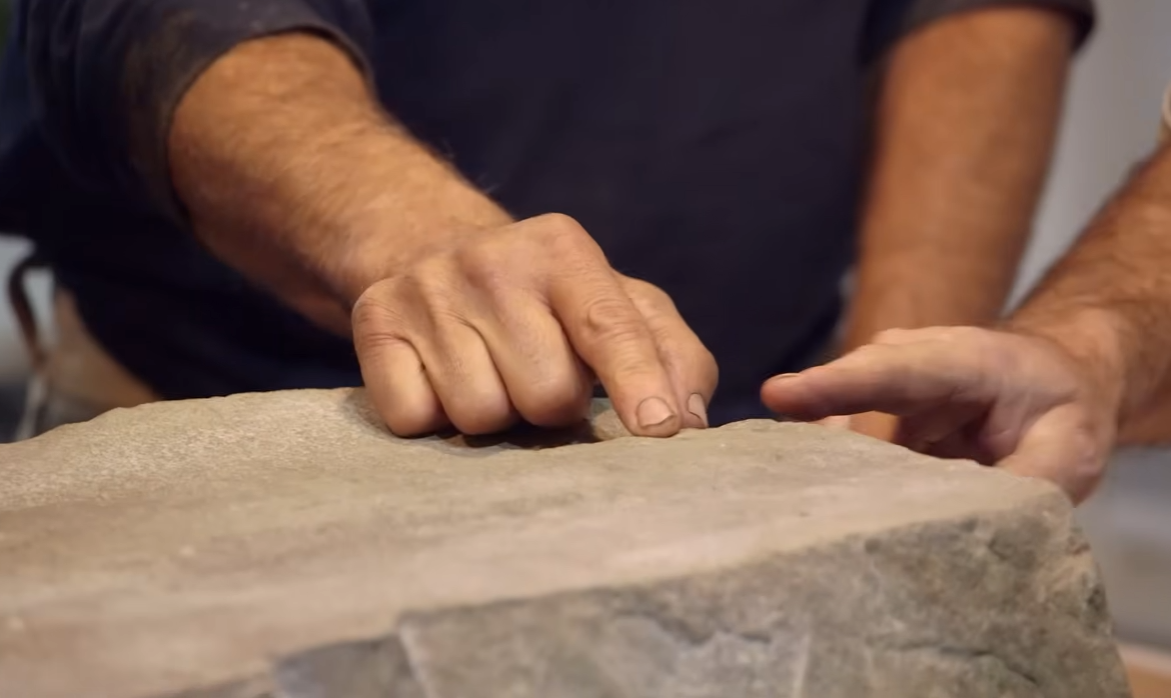
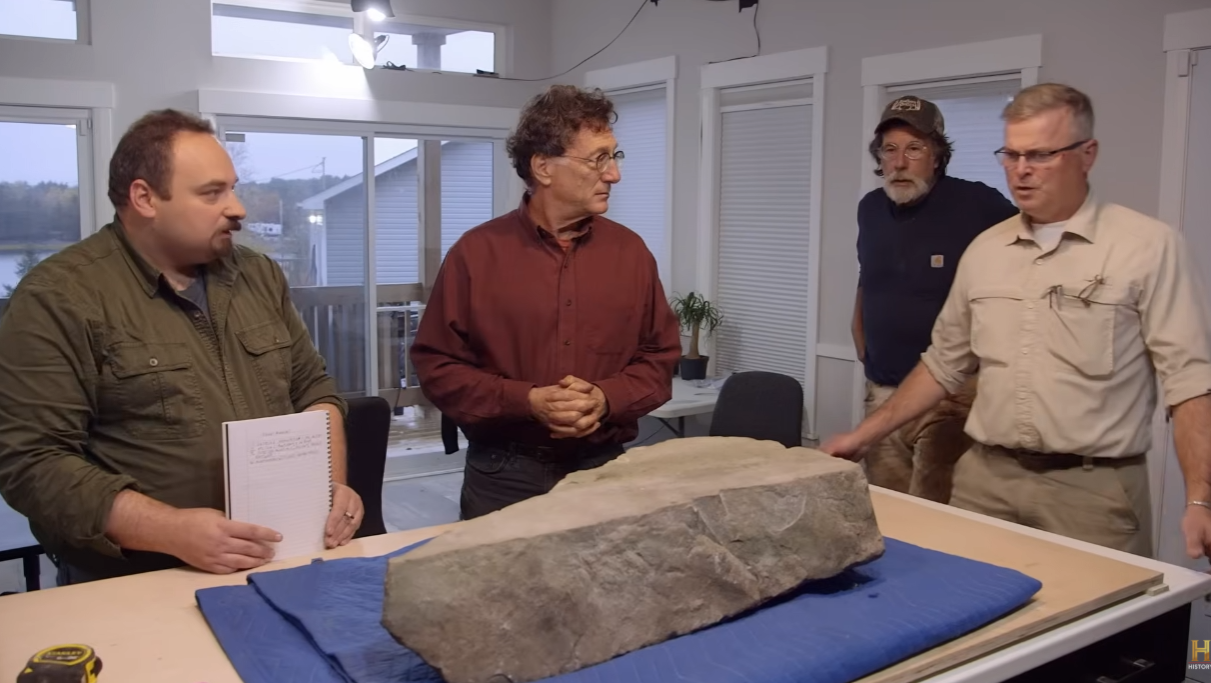
While the swamp provided industrial clues, the woods surrounding the Money Pit offered a symbolic mystery. Tory Martin, a gyroscope operator, noticed a “metamorphosis greywacke” boulder with unnaturally flat edges and strange etchings.
Upon closer inspection with geologist Terry Matheson, the stone revealed linear carvings that some team members believe resemble Roman numerals. These characters mirror the markings found on the U-shaped structure at Smith’s Cove, suggesting a unified marking system used by the island’s original builders.
The Face in the Stone
The week concluded with a trip to Overton, 144 miles west of Oak Island, where researcher Terry Deveau showed the team a massive boulder manipulated into the shape of a human face. The “Overton Stone” appears to be “shimmed” into position with smaller rocks and features surfaces that have been deliberately “hacked off” to enhance facial features.
For Rick Lagina, the worked stone is another link in a chain of petroglyphs and markers across Nova Scotia. “What else could have subsequently shaped it,” Rick asked, “other than the hand of man?”
As carbon dating results loom, the “Fellowship of the Dig” remains convinced that the island’s secrets are not just buried in pits, but written in the very stones of the swamp.