THE TEMPLAR CIPHER: Season 13 Finale Unearths Ancient Chamber Beneath Oak Island
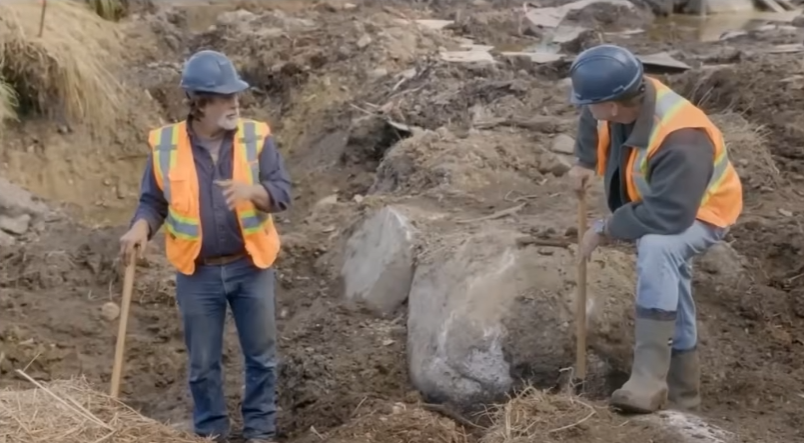
The two-century-old mystery of Oak Island has undergone a radical transformation following the Season 13 finale, as the Fellowship of the Dig announced the discovery of an intact, man-made stone chamber at a staggering depth of over 200 feet. The find, achieved via the massive “Cerberus” steel caisson, has shifted the show’s narrative from a hunt for pirate gold to a high-stakes investigation into a medieval transatlantic crossing.
While previous seasons focused on wood fragments and searcher debris, the Season 13 finale provided high-definition fiber-optic footage of a geometric vault constructed from dark basalt—a volcanic rock not native to Nova Scotia.
The “Cerberus” Breakthrough
The season’s success is attributed to the installation of “Cerberus,” the largest and most reinforced shaft in the island’s history. Despite early setbacks, including a catastrophic flood that nearly halted production, the team pushed past the 200-foot mark to find what geologists describe as a “geometric anomaly” in the bedrock.
Using a pressure-resistant fiber-optic camera, the team bypassed cloudy debris to enter an open void. The war room fell into stunned silence as the monitors displayed smooth, polished stone walls and a large circular metal plate etched with swirling celestial designs and unfamiliar symbols.
[Image: A grainy fiber-optic still showing the circular metal plate and etched symbols on the basalt wall of the 200-foot chamber]
A Message, Not a Mint
According to Dr. Aaron Taylor and Cambridge symbology expert Dr. Alistair Finch, the chamber does not resemble a traditional treasure vault. Instead, specialists believe it is a “signpost” or a time capsule.
Dr. Finch has identified a connection to a splinter faction of the Knights Templar known as the Order of the Sacred Covenant. He theorizes that the circular plate—possibly made of an exotic alloy like electrum or tumbaga—is not currency, but a sophisticated astronomical instrument or cipher device.
“This is not a vault; it is a marker,” Dr. Finch explained during the finale’s war room briefing. “The carvings represent celestial positions. This chamber was built to endure and to guide future generations to a final sanctuary.”
Discovery Highlights from the Finale:
-
Chamber Depth: 200+ feet (Deepest intact structure found to date).
-
Construction Material: Imported Basalt (Volcanic rock).
-
Primary Artifact: A large, etched circular alloy plate.
-
Symbolism: Celestial maps and “Sanctuary” crosses linked to 14th-century Scottish and Portuguese archives.
Rewriting History
The implications of the find suggest that a disciplined, seafaring military order reached the shores of Nova Scotia as early as 1307—nearly 200 years before Christopher Columbus. The precision of the 200-foot-deep engineering suggests a level of mathematical and hydraulic expertise that far exceeds the capabilities of 18th-century pirates.
Rick Lagina, visibly moved by the validation of his life’s work, noted that the Money Pit may have been a “decoy doorway” designed to protect this deeper, more profound legacy. “The island gave us fragments for years,” Rick stated. “Now, it has given us the centerpiece.”
The Journey Ahead
As the season concluded, the team was left not with chests of gold, but with a complex astronomical puzzle. The “Billion Dollar Secret” of Oak Island appears to be a repository of lost knowledge or sacred relics, protected by a medieval hydraulic system that continues to defy modern engineering.
With the Discovery team now consulting global experts in medieval metallurgy and epigraphy, Season 14 promises to be a forensic deep-dive into the “Templar Archive” theory.