SILICON AND STONE: Emma Culligan Deploys Next-Gen Technology to Decode Oak Island’s Final Treasures
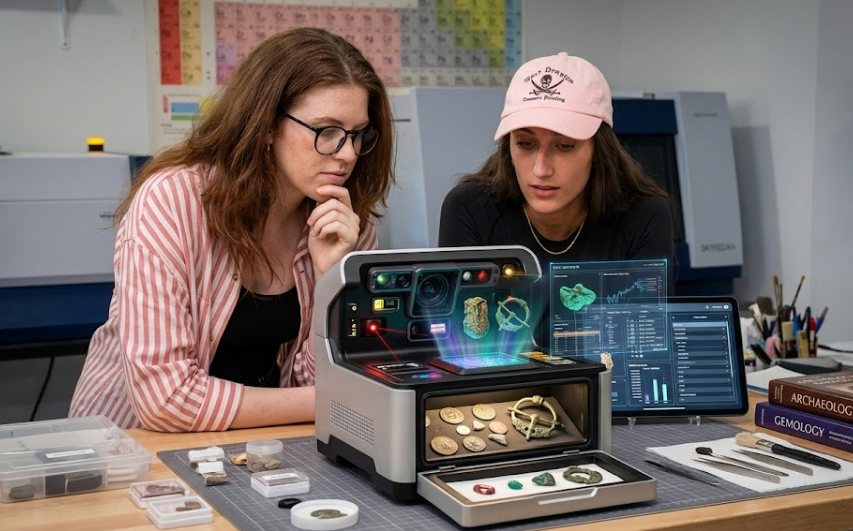
As the relentless pursuit of the Oak Island mystery charges toward its historic Season 13 finale, the primary battleground has officially shifted from heavy industrial earth-moving to the microscopic digital realm. While field teams celebrate a string of unprecedented structural breakthroughs—including the discovery of the Medieval Stone Vault Entrance in the deep woods—the task of proving a Pre-Columbian timeline has fallen squarely onto the shoulders of the research team. Inside the island’s high-tech laboratory, data analyst and archaeometallurgist Emma Culligan has deployed a suite of revolutionary, next-generation forensic technologies to analyze the staggering array of treasures found in the mud.
The end-of-season rush has completely overwhelmed traditional archaeological timelines. To process the sheer volume of high-value anomalies recovered from Lot 5 and the triangle-shaped swamp, Emma has bypassed standard laboratory methods in favor of cutting-edge, non-destructive digital imaging and elemental mapping.
Laser Induced Breakdown Spectroscopy (LIBS)
The cornerstone of Emma’s new technological arsenal is a state-of-the-art LIBS (Laser Induced Breakdown Spectroscopy) handheld array. Unlike traditional X-ray fluorescence (XRF) scanning, which only analyzes the surface layers of an artifact, LIBS utilizes a high-intensity focused laser to ablate a microscopic speck of material. This creates a micro-plasma plume that allows Emma to read the deep-core elemental composition of heavily corroded items without damaging their historical integrity.
Emma has immediately applied this laser tech to the rusted metal trim of the recently unearthed Knights Templar Kite Shield and the fragments of the black iron code box.
“The LIBS data has provided an absolute metallurgical fingerprint,” Emma explained, calibrating a digital spectrograph. “We aren’t just looking at iron; we are detecting trace amounts of slag and specific mineral impurities that match ancient smelting techniques used in 12th-century Europe. The laser allows us to pierce through seven centuries of rust and oxidation to see the exact furnace conditions under which these relics were forged.”
3D Volumetric Laser Scanning & AI Profiling
Beyond chemical analysis, Emma has partnered with field archaeologist Miriam Amirault to implement 3D Volumetric Laser Scanning paired with predictive AI architectural software. This system projects millions of microscopic light points over irregular artifacts, generating a flawless three-dimensional digital twin with sub-millimeter accuracy.
The team is currently utilizing this technology to analyze two of the season’s most polarizing discoveries:
-
The 12,000-Year-Old Astrolabe: The AI software has painstakingly reconstructed the heavily worn, faded celestial coordinates etched into the face of the artifact, cross-referencing ancient star maps to determine exactly when and where the device was calibrated.
-
The Sealed Lead Casket: Instead of physically breaking the ancient beeswax seal of the newly recovered Templar casket, Emma is using advanced Computed Tomography (CT) voxel scanning to peer directly through the dense lead walls. The software generates layered cross-sections, allowing the team to digitally view the interior contents—suspected to be sacred manuscripts or lost relics—in perfect safety.
A New Era of Exploration
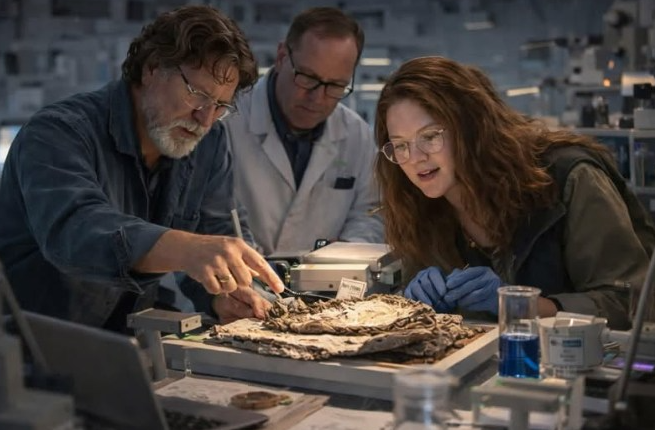
The integration of these next-gen technologies has fundamentally transformed The Curse of Oak Island from a standard reality television treasure hunt into a globally respected forensic operation. By replacing speculative theories with undeniable, empirical data, Emma’s laboratory work has silenced long-time critics who argued that the island’s legend was being stretched thin.
With Alex Lagina assisting from the data desk on his road to recovery, the laboratory lights are burning long into the night. Thanks to Emma Culligan’s brilliant mastery of modern science, the dirt of Nova Scotia is finally giving up its secrets, proving that while old-school grit can pull a treasure from the mud, it takes the cutting edge of 21st-century technology to truly rewrite history.