New Evidence Points to a Hidden Wreck Beneath Oak Island

For more than two centuries, Oak Island has tempted treasure hunters with hints of hidden riches. But in the latest phase of the investigation, the mystery is drifting further away from a simple buried vault and closer to something much bigger: the remains of a deliberately concealed ship.
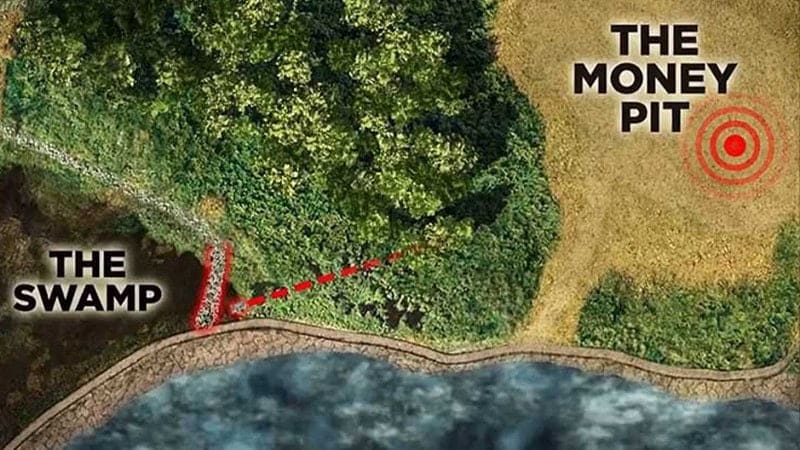
Recent work in the swamp, on nearby shores, and out in the surrounding waters has produced some of the strongest indications yet that a sizeable sailing vessel may have been used to offload treasure, then wrecked and hidden just off or even inside the island.
A Bent Ring Bolt and Signs of Fire
Along the eastern edge of the swamp, near the now-famous stone roadway, metal-detecting expert Gary Drayton and team member David Fernetti hit on a powerful iron signal among old boulders.
What they pulled from the mud was no ordinary scrap: a heavy, curved iron bar, bent in two directions and broken, which Drayton quickly identified as a ring bolt—the sort of robust fitting used to secure large timbers, rigging, or heavy loads, often on ships or wharves.
“It’s an inch-and-a-quarter solid steel bar,” the team noted. “That took some serious force to bend.”
When archaeologist Dr. Aaron Taylor examined it, the story deepened. The object was coated not just in swamp residue, but in charcoal.
“This thing has seen intense burning,” he observed. “It still has charcoal adhering to it. I think it was part of a wooden structure—maybe something tied into large timbers on a ship.”
The ring bolt, heavily burned yet preserved in the swamp, now sits alongside earlier finds of 17th–18th century ring bolts on the stone pathway—already interpreted as evidence that cargo was once offloaded from a vessel directly onto Oak Island.
Magnetometer Hits Point to a Shipwreck
While the swamp yields clues on land, the waters around Oak Island are now under just as much scrutiny. The team recently commissioned CSR Geo Surveys to carry out a magnetometer survey across the northern and eastern approaches to the island. The data revealed several strong anomalies, including one cluster near Lot 5 and another near Frog Island Shoal.
To interpret these, Rick Lagina assembled diver Tony Sampson and renowned underwater archaeologist Dr. Lee Spence, a veteran who has located more than 100 shipwrecks and millions of dollars’ worth of historic cargo.
Looking at the data, Dr. Spence did not hesitate.
“If I had done this magging and seen those targets,” he said, “I would think we have one or two shipwrecks right here.”
A dive team was dispatched to Frog Island Shoal. Working in roughly 20 feet of water and heavy kelp, Sampson and Spence used a handheld magnetometer to trace the sources of the magnetic hits. They confirmed large metallic masses buried beneath silt and vegetation, but no exposed cannon, anchor, or timbers—exactly the kind of material they need to visually document in order to secure a government permit for excavation.
“I’m absolutely convinced there’s a shipwreck there,” Spence said afterward. But under Canadian law, a magnetometer reading alone is not enough. The team must wait for storms or tidal action to strip away some of the silt before they can return and potentially capture the crucial images that could unlock a full investigation.
Ship’s Railing in the Swamp
Back on Oak Island itself, the swamp continues to behave less like a natural bog and more like a buried harbor.
Excavator Billy Gerhardt recently pulled up a remarkably smooth, shaped piece of timber from depth near the southern swamp edge. The wood appeared polished and contoured to fit comfortably in the hand.
“It looks like a handrail,” one team member remarked. “Something you’d find along the top of a ship’s rail, over balusters.”
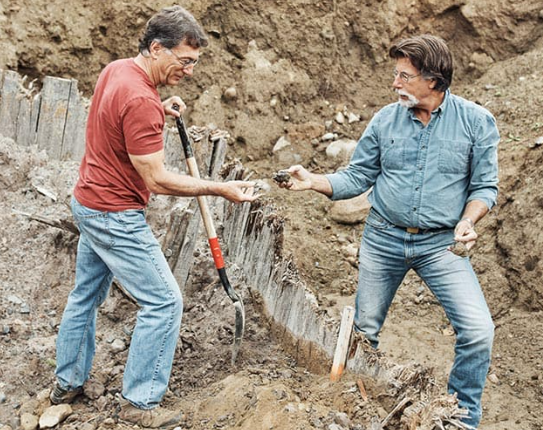
More digging in the same area produced additional crafted pieces, all at a depth around 10 feet below sea level, with the excavator bucket scraping along some large, buried obstruction that is not rock.
“We haven’t reached bottom yet,” Gerhardt reported. “Something’s there. The bucket is sliding along it.”
Two years earlier, seismic scanning had revealed a 200-foot, ship-shaped anomaly within this same region of the swamp. At the time, drilling failed to conclusively confirm a hull. Now, with worked railing coming up from just above a solid obstruction, the theory of a buried vessel has gained renewed strength.
18th-Century Ship Spikes – and a Brace from a Sailing Ship
Meanwhile, metal-detecting elsewhere on the island has produced large iron ship spikes, dated by archaeologist Laird Niven to the 1700s. These spikes are consistent with dock or wharf construction—or the fastening of major timbers on a sizeable vessel.
The most compelling piece so far, however, may be the burned ring bolt itself. Blacksmithing expert Carmen Legg examined it and concluded it was a brace from a typical nine-inch ship’s timber, broken and once forming a circular clamp around a major beam.
He dated the piece to between 1710 and 1790, calling it characteristic of a wooden sailing ship of that period—and confirmed that it showed signs of having been through a fierce fire.
Was a Treasure Ship Burned to Hide Its Cargo?
Taken together—burned ship fittings, worked railing at depth in the swamp, ship spikes from the 18th century, and offshore magnetic anomalies—an emerging narrative is taking shape.
One long-standing theory suggests a treasure-laden ship sailed into what is now the swamp, offloaded its cargo onto a hastily built stone platform, then became stuck or too damaged to refloat. The solution? Conceal the evidence. Burn or break up the ship, sink what remained, and let time, tides, and silt bury the truth.
“You don’t lay down stone roads and ring bolts in a place like this for no reason,” one team member observed. “Someone went to a lot of trouble.”
For now, the swamp and the sea are still holding their final answers. But with each ring bolt, spike, and railing fragment, Oak Island is sounding less like legend and more like the site of a deliberate maritime operation—one that someone clearly wanted hidden, and one the Lagina team is now closer than ever to exposing.