Lot 5 sends a clear signal: Could the discovery of this gem reveal a larger purpose on Oak Island?

From the viewpoint of a long-time analyst of The Curse of Oak Island, moments like this rarely arrive with fanfare. They emerge quietly, through small objects that initially seem insignificant—until their context begins to align. The recent discoveries on Lot 5, involving artificial gemstones, a tiny cuff button, and a deliberately folded coin, may represent one of the most coherent cultural signals the island has produced in years.
The sequence began with the unearthing of a dark, imitation gemstone embedded within a rounded stone feature on Lot 5. At first glance, it resembled costume jewelry. However, as Emma Culligan later confirmed through laboratory analysis, the object was a paste gem, or diamanté—a sophisticated form of simulated jewelry developed in France during the early to mid-18th century. Its composition, including glass mixed with metals and trace elements, closely matched a similar artificial stone found near the same feature a year earlier.
What matters here is not just the object itself, but its origin and intent. These gems were not trinkets for everyday use. Paste jewelry of this type was associated with elevated social status and, in some cases, military uniforms. The darker, matte version identified in this find has documented ties to formal dress rather than decoration alone. As Culligan noted, such items were manufactured in Europe, not in colonial North America.
For analysts, this immediately narrows the field. Someone of means—and likely authority—was present on Lot 5.

The context deepened when the team connected the timeline of the gemstone to the mid-1700s, aligning with the failed French expedition led by the Duke d’Anville. Historical records confirm that France launched a massive naval effort in 1746 to reclaim Nova Scotia. Though storms and illness devastated the fleet, archival references suggest that at least one ship carried valuable cargo and may have stopped at a wooded island in the vicinity of Oak Island.
This is where Oak Island’s story often becomes fragmented. Individual artifacts appear decades apart, scattered across different zones. But Lot 5 has been doing something unusual: clustering evidence. The paste gemstone did not stand alone. As Rick and Gary sifted through spoils from the same rounded feature, they recovered a tiny cuff button—delicate, personal, and unmistakably European in style. Buttons of this scale were not utilitarian. They belonged to tailored garments, reinforcing the idea of a high-ranking presence rather than laborers or settlers.
Then came the most symbolically charged object: a folded copper coin.
To casual observers, it might look like damage or waste. To experienced detectorists like Gary Drayton, it carried immediate meaning. Folded coins are rare in North America but well-documented in Europe, where they functioned as talismans—intentionally altered objects placed for protection, blessing, or ritual purpose. This practice dates back to ancient Rome and persisted through the medieval and early modern periods.
Crucially, people did not fold coins casually. Metal currency held value, especially in the 17th and 18th centuries. Folding one was an intentional act, often tied to belief systems rather than economics. When such an object appears in proximity to high-status personal items, the implications shift sharply.
From an analytical standpoint, Lot 5 is no longer just an area of occupation. It begins to resemble a site of preparation or safeguarding.
This aligns with a long-standing theory voiced by Rick Lagina: that Oak Island may have been constructed not merely to hide material wealth, but to protect something symbolic—an idea, a doctrine, or a historical legacy. The folded coin, placed intentionally in the ground, supports this interpretation. It suggests conscious ritual behavior tied to belief rather than chance loss.
When viewed collectively, the artifacts tell a consistent story. A European presence. A narrow time window in the mid-1700s. Objects associated with rank, uniform, and belief. And deliberate placement within a constructed stone feature.
What happens next is where prediction becomes possible.
First, Lot 5 is likely to become even more central to the investigation. Unlike the Money Pit, which has resisted interpretation for generations, Lot 5 is offering cultural clarity. Expect further excavation focused on spatial relationships—how these artifacts align within the feature and with surrounding terrain.
Second, analysts should anticipate deeper archival research. The Duke d’Anville connection is no longer speculative filler; it now has physical correlates on the ground. Ship logs, military inventories, and personal effects lists from the expedition may take on new relevance, especially if additional uniform-related items emerge.
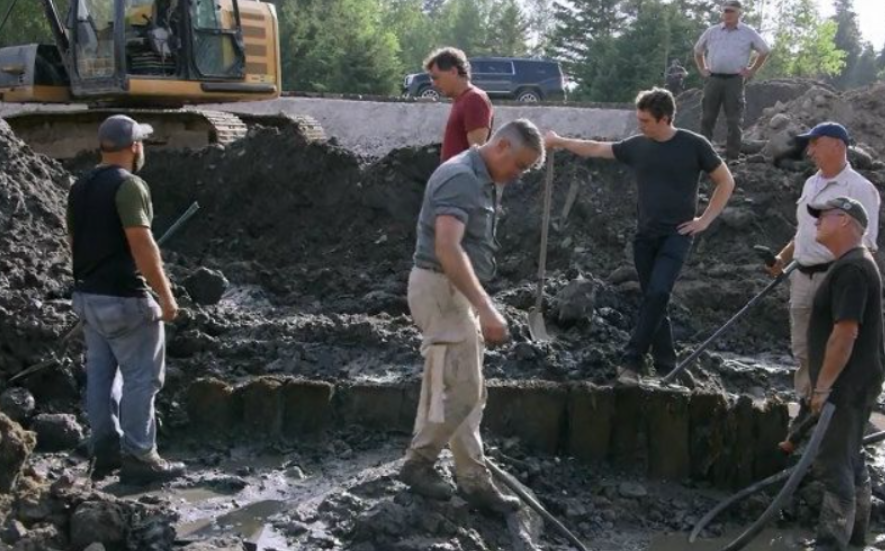
Third, the team may begin treating Lot 5 less as an ancillary site and more as a narrative key. If the island functioned as a system, Lot 5 could represent a surface-level ceremonial or logistical zone—distinct from, but connected to, deeper structures elsewhere.
What is striking is how restrained the conclusions remain. The team openly acknowledges that the “dots are far apart.” Yet, for analysts, the nature of those dots matters more than their spacing. These are not random finds. They share chronology, geography, and cultural logic.
Oak Island has long been associated with resistance—flooding, collapses, and frustration. Lot 5 feels different. Instead of pushing back, it seems to be speaking, slowly but coherently.
If the past 230 years have taught anything, it is that Oak Island rarely reveals its secrets through grand gestures. It does so through accumulation. And on Lot 5, that accumulation is beginning to look intentional.
In analytical terms, this may be one of the clearest signals yet that Oak Island’s purpose extended beyond concealment. It may have been designed not only to hide something—but to protect it in a way its creators believed would endure.