Lot 8 Raises New Questions as a 231-Year-Old Oak Island Pattern Appears Again
For more than two centuries, the search on Oak Island has revolved around a single point of fixation: the Money Pit. Since its discovery in 1795, generations of treasure hunters have poured time, money, and effort into unraveling what many believed was the island’s central mystery. But events unfolding in Season 13 of The Curse of Oak Island suggest that history may have been looking in the wrong place all along.
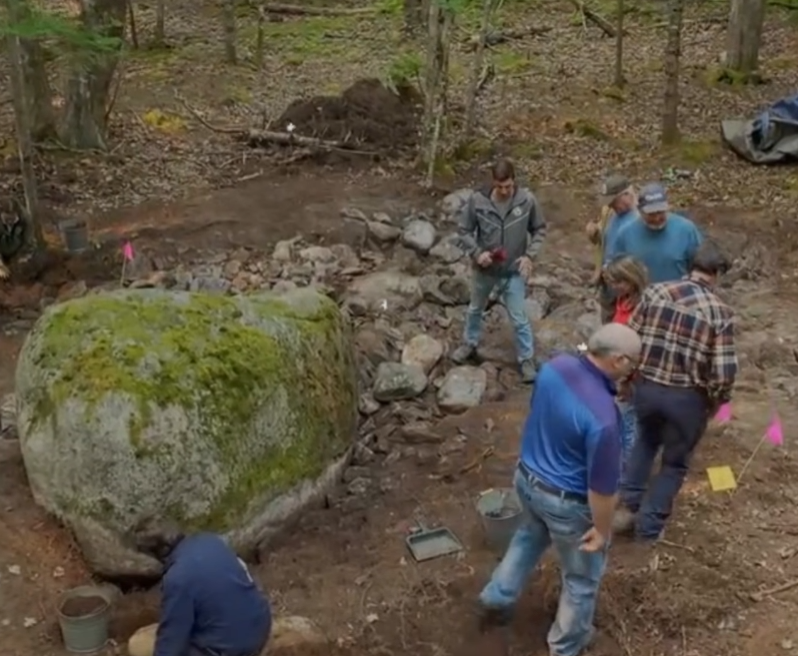
Recent findings on Lot 8, located on the island’s western rise, have introduced a parallel narrative—one that mirrors the original Money Pit discovery with unsettling precision while offering a far more practical explanation for how valuable material could have been stored and protected.
What the team has uncovered is not simply another anomaly. It is a combination of engineered features, historical artifacts, and documentary gaps that together point to a deliberate and sophisticated operation dating back to the early modern period.
A Familiar Pattern, in a Different Place
The original Money Pit excavation famously revealed non-native flagstones just beneath the surface—an engineered marker that signaled intentional human activity. This week, geologist Terry Matheson confirmed a strikingly similar discovery on Lot 8: a deliberately laid floor of granite flagstones positioned beneath a massive boulder weighing approximately 50,000 pounds.
Unlike the slate associated with the Money Pit, which many researchers believe was selected for its tendency to fracture and collapse, the Lot 8 stones are dense granite—flat, heavy, and arranged edge-to-edge in a stable horizontal pattern. This distinction matters.
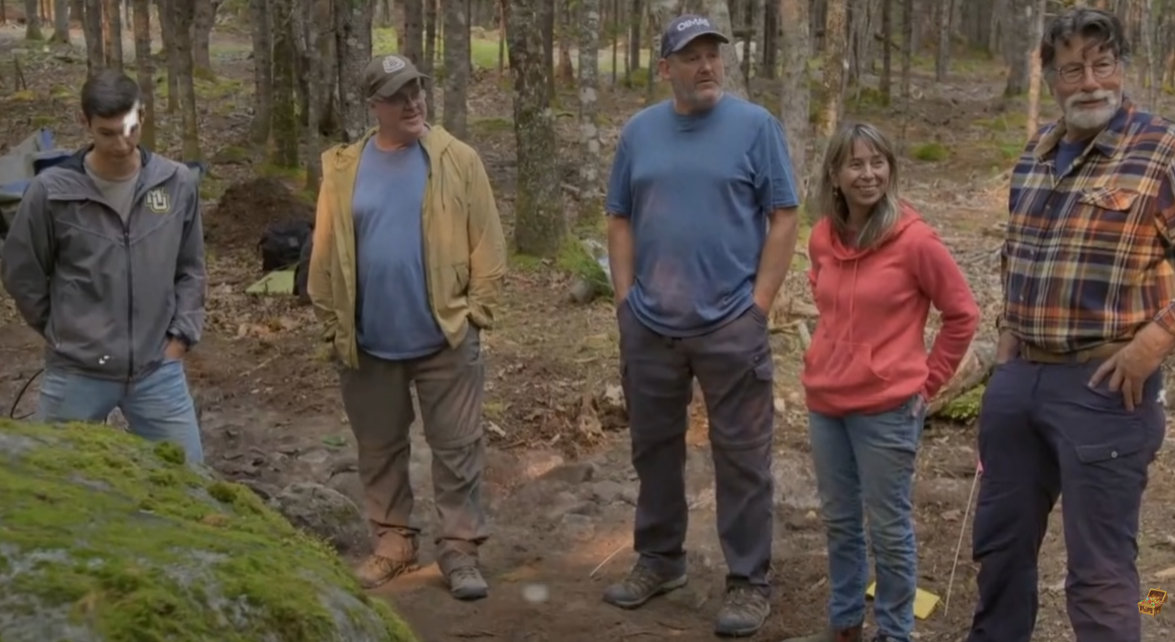
Where the Money Pit appears increasingly likely to have functioned as a complex hydraulic deterrent, Lot 8 presents the opposite engineering philosophy: solidity, permanence, and dryness. In short, if one location was meant to mislead and delay, the other may have been designed to preserve.
Physical Evidence of Heavy Transport
Adding weight to this interpretation is a critical artifact recovered nearby. Metal detection specialist Gary Drayton uncovered a length of oval-linked iron chain roughly 20 yards from the boulder.
Laboratory analysis conducted by Emma Culligan revealed the chain to be composed of nearly pure iron with trace phosphorus content—a composition consistent with European manufacture in the 1500s or 1600s. More telling, however, are the pronounced wear patterns along the inner curves of the links.
According to Culligan, this level of deformation suggests prolonged exposure to extreme tensile force. In practical terms, the chain was almost certainly used to haul something extraordinarily heavy—such as a multi-ton glacial boulder—across a hard surface like a granite-paved floor.
This is not incidental wear. It is mechanical evidence of an organized effort involving manpower, planning, and technical capability.

A Historical Gap Gains New Context
In the Oak Island War Room, historical researcher Emiliano Sacchetti introduced documentation that may provide a missing link between the physical discoveries and known history.
Sacchetti presented records related to Isaac de Razilly, a Knight Commander of the Knights of Malta and Governor of Acadia in the early 17th century. De Razilly maintained operations just 15 miles from Oak Island, placing him well within logistical range.
Following his sudden passing in 1636, inventories of his possessions revealed unexplained discrepancies. Several items listed in Acadia never appeared in the materials returned to France, including two leather-covered chests, two muskets, and specialized navigational instruments.
Significantly, artifacts consistent with this era—including a flintlock musket component—have already been recovered on Lot 8. Combined with recent camera probes that indicate a sizable void beneath the boulder, the theory that Lot 8 served as a secured storage site is gaining traction.
Rethinking the Money Pit Narrative
If Lot 8 represents a stable repository, the implications for Oak Island are profound. It suggests that the Money Pit may have functioned primarily as a distraction—an elaborate mechanism designed to consume attention and resources, while something more valuable remained safely removed from direct interference.
Rick Lagina summarized the shift succinctly: the chain demonstrates the effort involved, while the flagstones demonstrate the method.
This interpretation reframes the island not as a single-point puzzle, but as a system—one that blends psychology, engineering, and geography to protect assets over time.