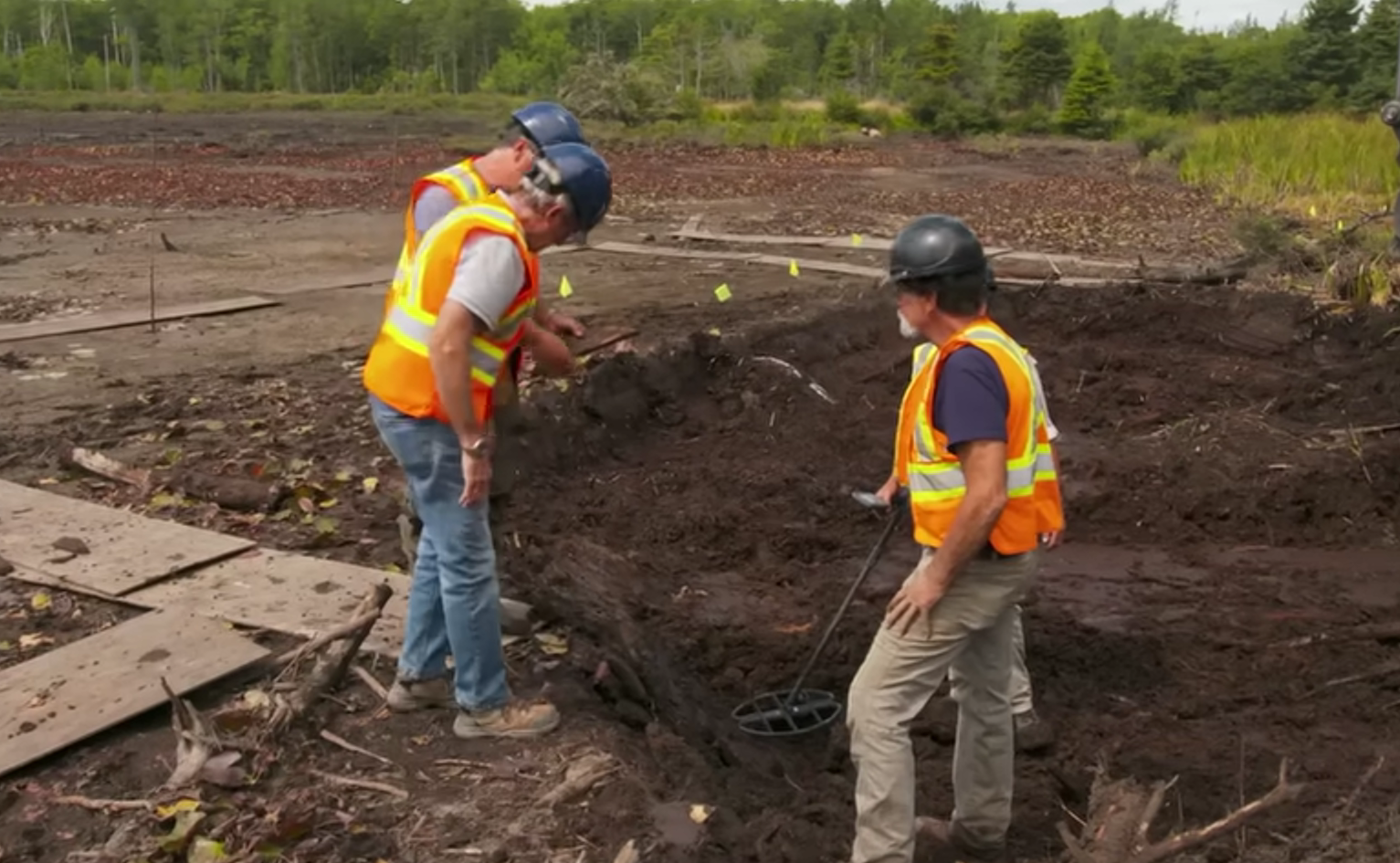
What equipment did Rick Lagina bring to search for artifacts on Oak Island?

For more than two centuries, Oak Island has been defined by trial, error, and persistence. From hand-dug shafts in the 18th century to industrial drilling rigs in the modern era, generations of treasure hunters have relied on intuition, fragmented maps, and educated guesses. Season 13 of The Curse of Oak Island, however, suggests a fundamental shift. For the first time, the team is not relying on a single method or isolated clue. Instead, they are combining multiple advanced technologies into one coordinated investigative strategy. For many fans, this raises a compelling question: has science finally caught up with Oak Island’s mystery?
At the centre of this season’s approach is integration. Rather than treating discoveries as standalone moments, the Lagina brothers and their partners are layering data from Ground Penetrating Radar (GPR), LiDAR scanning, magnetometer surveys, and sonic drilling. Each tool answers a different question, but together they are beginning to create a coherent picture of what lies beneath the island’s surface.
Ground Penetrating Radar has long been used on Oak Island, but Season 13 marks a more refined application. Modern GPR systems can now detect subtle differences in soil density and voids far more clearly than earlier versions. Instead of simply identifying “anomaly zones,” the team is able to estimate depth, shape, and continuity. This has helped shift decision-making away from guesswork and toward targeted excavation. Fans have noted that GPR results are no longer treated as vague suggestions, but as data points that actively guide where and how digging begins.
LiDAR has added another dimension entirely. By using laser-based aerial scanning, the team can strip away vegetation and modern disturbances to reveal the island’s underlying contours. What makes this especially significant is LiDAR’s ability to detect slight elevation changes invisible to the naked eye. In Season 13, this has helped identify unnatural straight lines, terraces, and subtle pathways that align with known features such as the swamp stone road and upland areas. For viewers, this has reinforced the idea that Oak Island may have been carefully engineered, rather than randomly altered over time.
Magnetometer surveys provide yet another layer. These instruments detect disturbances in the Earth’s magnetic field, often caused by metal objects or fired materials. On Oak Island, magnetometer data has proven useful in highlighting areas where human activity may have occurred, even when no visible artifacts are present. In Season 13, this technology has helped narrow down zones of interest before any soil is disturbed, reducing unnecessary excavation and preserving archaeological context.
Sonic drilling, meanwhile, represents a quieter but equally important evolution. Unlike traditional drilling, which can damage fragile structures, sonic drilling uses vibration to penetrate the ground while keeping surrounding material relatively intact. This allows for deeper sampling with less disruption. The team can extract cores that preserve stratigraphy, giving experts a clearer timeline of human activity. Fans have pointed out that this approach feels closer to professional archaeology than to the heavy-handed methods of earlier decades.
What excites viewers most is not any single technology, but how they are being used together. Data from LiDAR informs where GPR scans are focused. Magnetometer results help interpret what GPR anomalies might represent. Sonic drilling then confirms whether those anomalies correspond to human-made features, voids, or natural formations. This layered methodology has led many fans to suggest that the team is, for the first time, “ahead” of the island rather than reacting to it.
There is also a noticeable change in tone. Rick and Marty Lagina increasingly frame discoveries in terms of process rather than payoff. Instead of asking, “Is this the treasure?” the conversation has shifted toward, “What does this tell us about how the island was used?” This subtle change has resonated with long-time viewers who have grown accustomed to dramatic swings between hope and disappointment. Season 13 feels more deliberate, more analytical, and more grounded in evidence.
Still, skepticism remains. Oak Island has a long history of promising data that ultimately led nowhere. Some fans caution that advanced tools do not guarantee definitive answers. Technology can reveal structures and anomalies, but interpretation remains a human task, shaped by assumptions and expectations. Others argue that even if science can map every void and wall, it may still not explain who built them or why.
Yet, there is broad agreement that something has changed. The integration of multiple scientific methods has reduced reliance on coincidence and increased confidence in decision-making. Excavations appear more focused, pauses for analysis more frequent, and collaboration with archaeologists more central than ever before.
So has science finally caught up with Oak Island’s mystery? Season 13 does not offer a final verdict, but it suggests a turning point. The island is no longer being approached as a place to dig until something appears. It is being studied as a complex historical site, one that demands patience, precision, and interdisciplinary thinking.
For fans, that may be the most meaningful development of all. Whether or not a definitive answer emerges, Season 13 has reframed the search itself. Oak Island is no longer just a legend pursued with determination. It is a puzzle being examined with tools capable of matching its complexity. And for the first time in over 200 years, the methods may finally be equal to the mystery.