From Unwanted Barley to a £75m Brand: How Jeremy Clarkson Built Hawkstone Brewery
When Jeremy Clarkson harvested his first full barley crop at Diddly Squat Farm in 2020, it should have marked a milestone. Instead, it exposed a problem familiar to many British farmers: a high-quality crop with no viable buyer. Large maltsters showed little interest, grain merchants offered prices that barely covered fuel costs, and the economics of small-scale farming once again looked unforgiving.
That impasse, however, became the starting point for what is now one of the most talked-about rural business success stories in the UK. Hawkstone Brewery, founded in the middle of the pandemic, has grown into a drinks business valued at around £75 million—built not on trend-chasing or celebrity licensing, but on local supply chains and a deliberate challenge to how modern brewing works.
The idea was simple. If the barley could not find a market, Clarkson would create one himself. Drawing on decades of familiarity with traditional British beer, he decided to turn his crop into lager rather than sell it at a loss. Hawkstone took its name from Hawkstone Park, a historic estate associated with rural heritage—an intentional signal that the project was rooted in place rather than branding gloss.
Launching a new beer in late 2020 appeared ill-timed. Pubs were closed, hospitality was frozen, and much of the brewing industry was retrenching. Yet consumer behaviour moved in unexpected directions. With travel and leisure spending curtailed, demand rose for small domestic luxuries. Hawkstone lager, sold directly to households, found an audience faster than anticipated. What seemed like a commercial risk turned into early momentum.
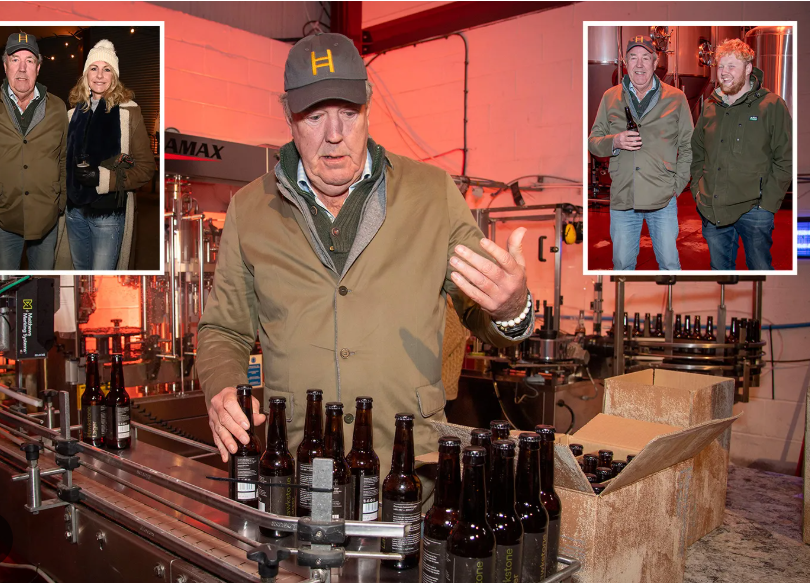
Unlike many celebrity-backed drinks brands, Hawkstone kept its supply chain visible. The barley was grown on Clarkson’s own land at Diddly Squat Farm and neighbouring farms in Oxfordshire and Gloucestershire. Grain was not imported from continental Europe, even when that would have reduced costs. The aim, Clarkson has said, was not efficiency at all costs, but proof that a modern drinks business could support British agriculture rather than marginalise it.
That approach resonated with consumers increasingly sceptical of industrial uniformity in food and drink. Hawkstone’s lager differentiated itself through consistency and transparency rather than novelty. Within two years, the brand had secured national listings with major retailers including Tesco, Sainsbury’s, Waitrose and Morrisons, outperforming several established craft beers in the same category.
Expansion followed, but cautiously. In 2022, Hawkstone introduced a pilsner, an IPA and a cider. The cider, in particular, drew attention for its insistence on traditional British apples sourced from the Vale of Evesham and the Cotswolds—an approach that ran counter to mass-market norms, where imported concentrate is common. Again, higher input costs were accepted in exchange for product integrity.
The growth of the brand had effects beyond supermarket shelves. The brewery, based in the Cotswolds, created dozens of local jobs at a time when rural employment opportunities have steadily declined. Staff wages were set above industry averages, reflecting a belief that quality production depends on workforce stability. Low turnover and retained expertise became part of Hawkstone’s operating model.
The next challenge was distribution into pubs. Britain’s tied-house system, dominated by large breweries, has long limited access for smaller producers. Rather than compete head-on, Hawkstone targeted independent pubs, offering direct supply, improved margins and straightforward commercial terms. Crucially, the brand also arrived with public recognition, fuelled by Clarkson’s television profile and the popularity of Clarkson’s Farm.
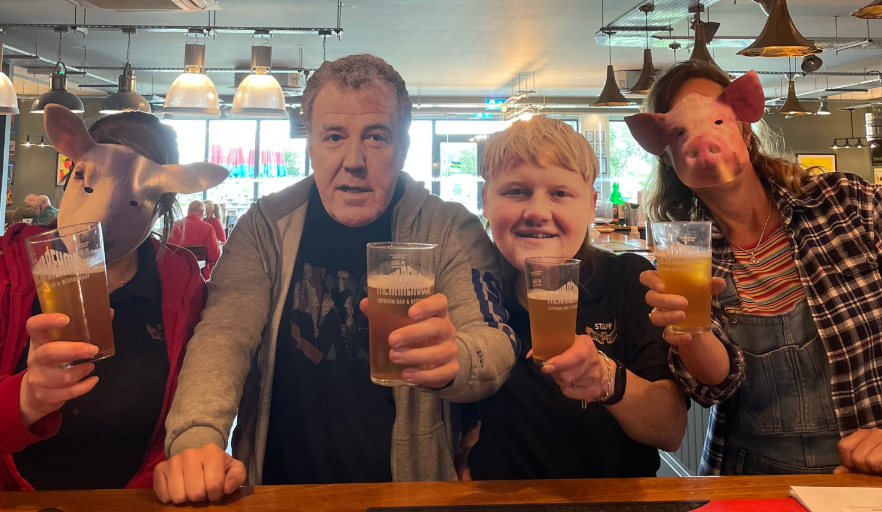
Many pubs found that Hawkstone attracted customers specifically seeking it out. Chalkboard signs advertising the beer became common, and within a year more than 500 independent venues across the UK had added it to their taps. For landlords, the appeal was not only the product, but the sense of partnership absent from large-scale supply contracts.
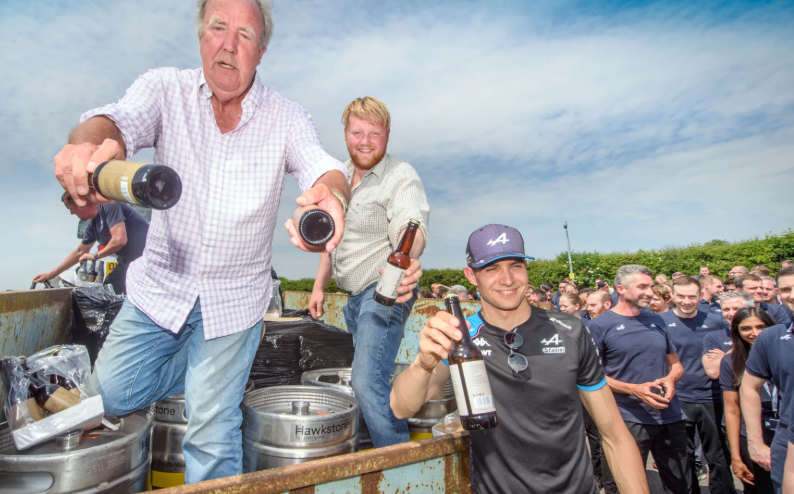
By 2023, Hawkstone had moved beyond survival into scale. National distribution expanded, sales increased sharply, and international interest followed. Exports now reach parts of Europe, Australia, Canada and Asia—markets where British provenance remains commercially valuable. Alongside the drinks business, Hawkstone has evolved into a wider brand, visible through merchandise, farm-shop retail and visitor experiences at Diddly Squat.
Yet Clarkson has consistently framed the venture less as a personal success than as a case study. Hawkstone provides a guaranteed buyer for British barley, supports local orchards, and demonstrates that rural-focused businesses can grow without abandoning regional identity. At a time when farming faces pressure from rising costs and uncertain markets, the model offers an alternative narrative.
What began as a surplus crop in a cold tractor shed has become a vertically integrated enterprise with national reach. Hawkstone’s trajectory suggests that, even within heavily consolidated industries, there remains space for businesses built on local production, transparent economics and consumer trust. For British farming, that lesson may prove as significant as the beer itself.