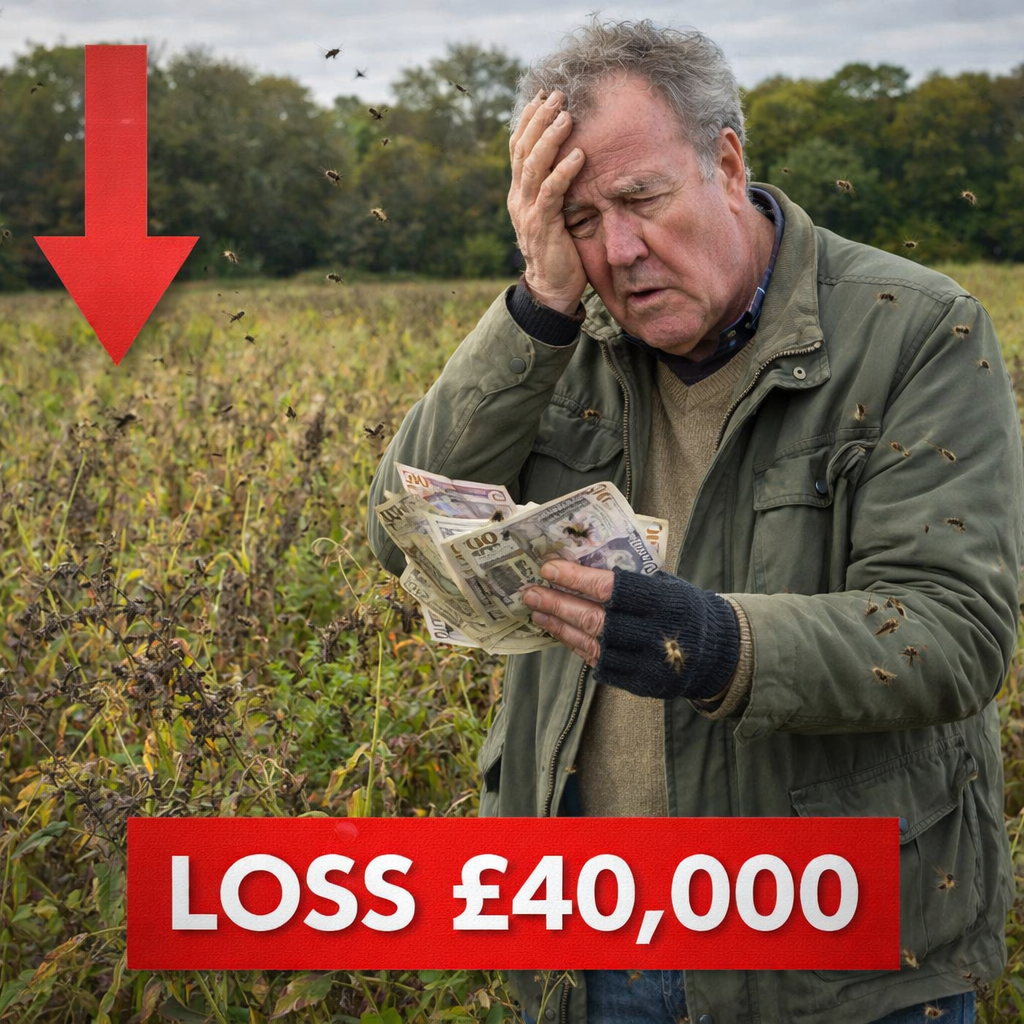
Jeremy Clarkson lost £40,000 for the first time this season due to insect infestation
Analysis from a Clarkson’s Farm performance perspective: how a sudden biological outbreak exposes structural weaknesses in high-risk farming operations
In what is shaping up to be one of the most unpredictable seasons on Clarkson’s Farm, Jeremy Clarkson has reportedly recorded his first significant financial setback of the year—a loss estimated at around £40,000 attributed to an insect infestation affecting crop performance and productivity. From an analytical standpoint, this is not merely a one-off agricultural incident, but a critical stress test of the farm’s resilience under biological pressure and operational scaling.
While Clarkson’s farming ventures have historically balanced entertainment with genuine agricultural risk, this latest incident highlights a recurring theme: nature remains the most uncontrollable variable in the entire system. And in this case, it has manifested in a direct, measurable financial impact.
A BIOLOGICAL DISRUPTION WITH COMMERCIAL CONSEQUENCES
Insect infestations are not unusual in UK farming environments, but their timing and intensity can determine whether they remain manageable or become financially damaging. In Clarkson’s case, the infestation appears to have struck at a point where crops were already exposed to environmental stress factors, reducing their resistance and compounding yield loss.
From a production standpoint, this type of disruption does not only affect output volume—it also affects grading, market readiness, and harvest efficiency. Even partial crop damage can lead to disproportionate financial losses once logistics, labour, and spoilage are factored in.


A £40,000 loss at farm scale suggests a mid-season production zone rather than total field failure. However, what makes this situation analytically important is not the number itself, but what it signals: a break in operational stability during a period where consistency is essential.
CLARKSON’S FARM MODEL UNDER STRAIN
One of the defining characteristics of Clarkson’s agricultural operation is its hybrid nature—part commercial farm, part public-facing media enterprise. This dual structure introduces unique pressures. Decisions are not made solely on yield optimization but also on timing, visibility, and narrative flow.
In a traditional farming model, an infestation would be treated as a localized agricultural problem. In Clarkson’s case, it becomes both a production issue and a storyline driver. That distinction matters when assessing operational risk, because attention can sometimes accelerate decision-making in ways that are not strictly agronomically optimal.
The £40,000 loss therefore represents more than crop damage. It reflects the fragility of balancing entertainment-driven farming with real-world agricultural constraints.
WHY INSECT PRESSURE MATTERS MORE THAN IT APPEARS
From an agronomic perspective, insect infestations introduce cascading effects that are often underestimated in early assessments. Initial damage typically appears localized, but secondary impacts—such as plant stress response, disease susceptibility, and uneven maturation—can extend losses far beyond the visible infestation zones.
In Clarkson’s operation, where efficiency margins are already tightly managed due to experimental farming methods and high operational variability, even moderate infestations can push systems into reactive mode.
This is where the financial loss becomes structurally significant. It suggests that pest control thresholds may have been exceeded before mitigation measures could fully stabilize the affected areas.
OPERATIONAL WEAK POINTS REVEALED
Every farming season contains stress tests, but not all stress tests are equal. What distinguishes this incident is its timing and its exposure of dependency points within the farm’s workflow.
Several key vulnerabilities emerge from an analytical perspective:
- Response lag between infestation detection and intervention
- Resource allocation strain during peak operational periods
- Crop uniformity disruption, affecting harvesting efficiency
- Increased labour cost pressure during mitigation efforts
These factors combine to create a compounding effect, where the financial loss is not just the result of crop damage, but also the operational cost of managing the crisis.

WHAT THIS MEANS FOR THE REST OF THE SEASON
Looking forward, the key question is not whether Clarkson’s Farm can recover from a £40,000 loss—it almost certainly can—but whether this incident signals a broader pattern of environmental volatility that will continue to challenge output stability.
There are three likely scenarios emerging from this event:
- Controlled Recovery Scenario
The infestation is contained, and subsequent harvest cycles stabilize. Financial loss remains isolated. - Recurrent Pest Pressure Scenario
Similar outbreaks appear in other zones, indicating systemic pest management weaknesses. - Yield Compression Scenario
Even if infestations are contained, residual plant stress reduces total season productivity.
From a production analysis standpoint, the second scenario carries the most operational risk, as it suggests environmental conditions are becoming increasingly favorable for recurring infestations.
THE BUSINESS OF FARMING UNDER CONSTANT UNCERTAINTY
Clarkson’s Farm has consistently demonstrated that modern farming is not a linear business—it is a reactive system shaped by weather, biology, machinery reliability, and timing sensitivity. The insect infestation episode reinforces this reality in a very direct financial form.
Unlike controlled industries, agriculture operates on thin margins of predictability. A single biological variable can shift projected income curves significantly, especially when layered onto experimental farming practices and diversified crop strategies.
In that context, the £40,000 loss is less a shock event and more a reminder of the underlying structural volatility inherent in the system.
CONCLUSION: A SMALL LOSS WITH LARGER IMPLICATIONS
While £40,000 may represent a manageable setback within the broader context of Clarkson’s agricultural and media operations, its significance lies in what it reveals about operational fragility under biological stress.
Insect infestations are not rare—but their financial translation depends entirely on timing, response speed, and system resilience. This incident suggests that even well-managed operations remain vulnerable to rapid environmental shifts.
As the season continues, the key analytical focus will not be the loss itself, but whether it represents an isolated disruption—or the first visible crack in a much larger pattern of agricultural instability.