Clarkson’s Farm season 5 to air moment Jeremy Clarkson rushed to hospital with heart emergency
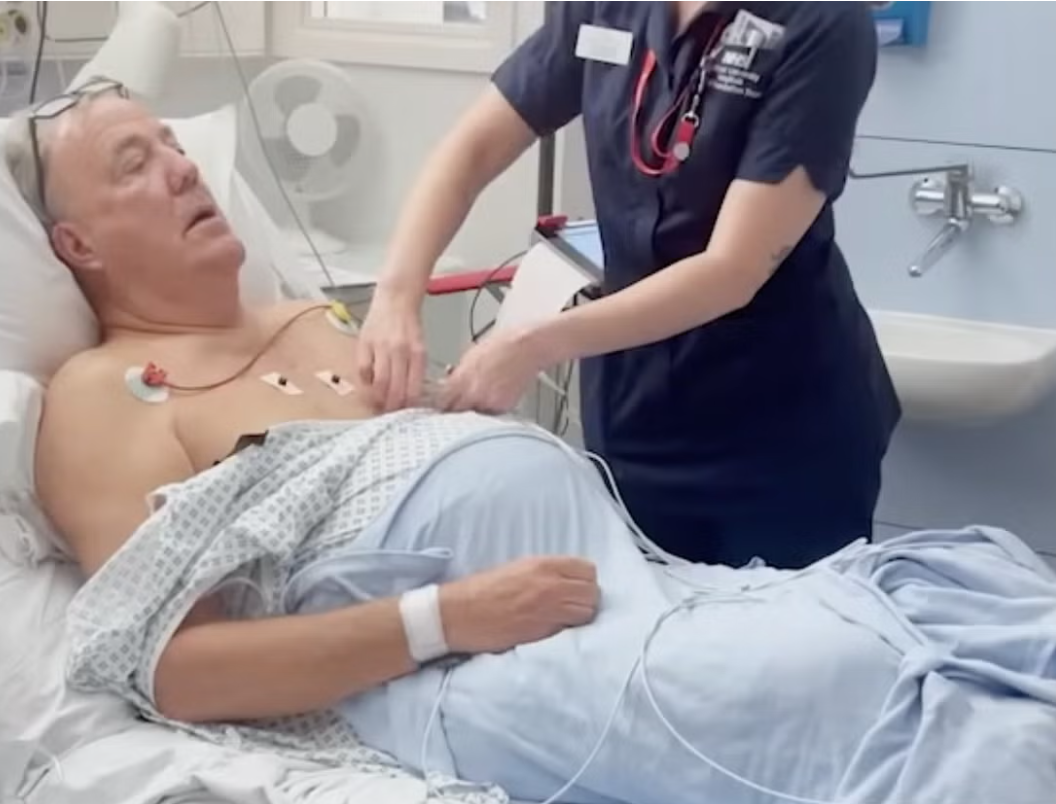
The announcement that Clarkson’s Farm Season 5 includes a moment where Jeremy Clarkson is rushed to hospital due to a heart emergency has shifted the tone of the entire series from rural documentary entertainment to something far more personal and structurally dramatic. From an analyst’s perspective, this is not simply a storyline—it is a narrative pivot that will likely influence both audience engagement and the long-term direction of the franchise.
Reports confirm that the new season opens with Clarkson recovering from a serious heart-related incident, shown in hospital with monitoring equipment attached as he undergoes urgent treatment linked to blocked arteries and reduced blood flow to the heart . He later explains that his condition was caused by severe arterial restriction, stating that his heart was “not getting any blood” during the episode .
This immediately places Season 5 in a different category from earlier seasons. It is no longer purely about farming inefficiency, rural bureaucracy, and comedic struggle—it now integrates real-world health vulnerability into the structure of the show.
SHIFT FROM FARMING COMEDY TO PERSONAL RISK NARRATIVE
Historically, Clarkson’s Farm has balanced agricultural education with controlled chaos, relying on Clarkson’s lack of farming experience as its primary comedic engine. However, Season 5 introduces a second axis: physical limitation and mortality awareness.
A trailer for the season shows Clarkson being rushed to hospital and later recovering, confirming that his condition required serious medical intervention, including stent-related treatment for blocked arteries . The visual framing of hospital scenes marks a tonal shift rarely seen in modern factual entertainment programming.
From a media analysis standpoint, this introduces three major structural implications:
- Heightened emotional stakes – Viewers are no longer watching only farm operations but also a health recovery journey.
- Narrative fragility – Clarkson’s physical condition may directly influence filming continuity and production pacing.
- Audience recontextualization – The character of “Clarkson the farmer” is now inseparable from “Clarkson the patient.”
This dual identity significantly deepens the show’s narrative complexity.
INDUSTRY CONTEXT: WHY THIS MOMENT MATTERS NOW
Season 5 is already positioned as a transitional chapter for the series. Production commentary and early reviews suggest increasing difficulty balancing farming realism with entertainment structure, particularly as Clarkson continues expanding business ventures such as the pub and farm retail operations.
According to industry reporting, Clarkson himself has acknowledged that overwork and expansion pressure contributed to his health scare, with his attempt to manage multiple business fronts—including farming and hospitality—placing significant strain on his body .
This aligns with a broader pattern seen in reality-based documentary programming: as real participants age and operations expand, the original “amateur challenge” narrative evolves into a more complex business documentary.
In this case, the farm is no longer a hobby project—it is a multi-revenue ecosystem under stress.
HEALTH INCIDENT AS A STRUCTURAL STORY DEVICE
From an analytical storytelling perspective, Clarkson’s hospitalization functions as a narrative “reset point.” It reframes earlier agricultural failures not simply as comedic incompetence, but as stress indicators within a larger system.
The show reportedly begins Season 5 with Clarkson in recovery, suggesting that the health incident is not a one-off subplot but a framing device for the entire season arc .
This has several implications:
- It provides continuity justification for reduced physical involvement by Clarkson in farm operations
- It allows secondary characters (Kaleb Cooper, Charlie Ireland) to assume greater operational prominence
- It introduces a “limits of expansion” theme into the series’ core message
In essence, Clarkson is no longer just fighting the land—he is fighting the consequences of scaling beyond sustainable personal capacity.
PREDICTED SEASON DEVELOPMENT PATHWAYS
Based on current narrative structure and production signals, three likely trajectories emerge for Season 5:
1. THE RECOVERY-LED REALIGNMENT ARC
Clarkson’s reduced physical role leads to increased delegation. Kaleb Cooper and Charlie Ireland become central operational decision-makers. The farm shifts toward systemized management rather than hands-on chaos.
2. THE EXPANSION CONTRACTION ARC
The health scare forces reassessment of business expansion—particularly hospitality ventures and high-risk farming experiments. Certain projects may be scaled back or abandoned.
3. THE LEGACY SEASON SETUP ARC
Season 5 may function as a transitional “end-cap” season, especially given prior indications that the series could pause after its fifth installment. Clarkson’s health event may symbolically reinforce this narrative closure structure.
IMPACT ON AUDIENCE ENGAGEMENT
From a viewer psychology perspective, this shift is significant. Audience engagement in Clarkson’s Farm has historically been driven by:
- Humor rooted in failure
- Relatable incompetence in farming
- Strong supporting cast dynamics
The introduction of a real medical emergency changes the engagement model toward:
- Empathy-based viewing
- Concern-driven retention
- Serialized emotional continuity
This often leads to higher viewer retention but also changes the tonal expectations of the franchise.
CONCLUSION: A FARMING SHOW ENTERING ITS MATURITY PHASE
Jeremy Clarkson’s hospitalization is not simply a dramatic plot point—it is a signal that Clarkson’s Farm has entered a maturity phase where real-life consequences increasingly shape narrative structure.
What began as a comedic experiment in farming has evolved into a hybrid of documentary, business case study, and personal biography. Season 5 appears to be the clearest expression of that evolution yet.
From an analyst’s perspective, the most important question is no longer whether Clarkson can run a farm successfully.
It is whether the farm—and the show built around it—can sustainably continue under the weight of its own expansion, ambition, and reality.
Season 5 may ultimately be remembered not for the machinery, the animals, or the harvests—but for the moment the show confronted its own limits.