Parker Schnabel’s most valuable gold finds to date: Worth millions of dollars.
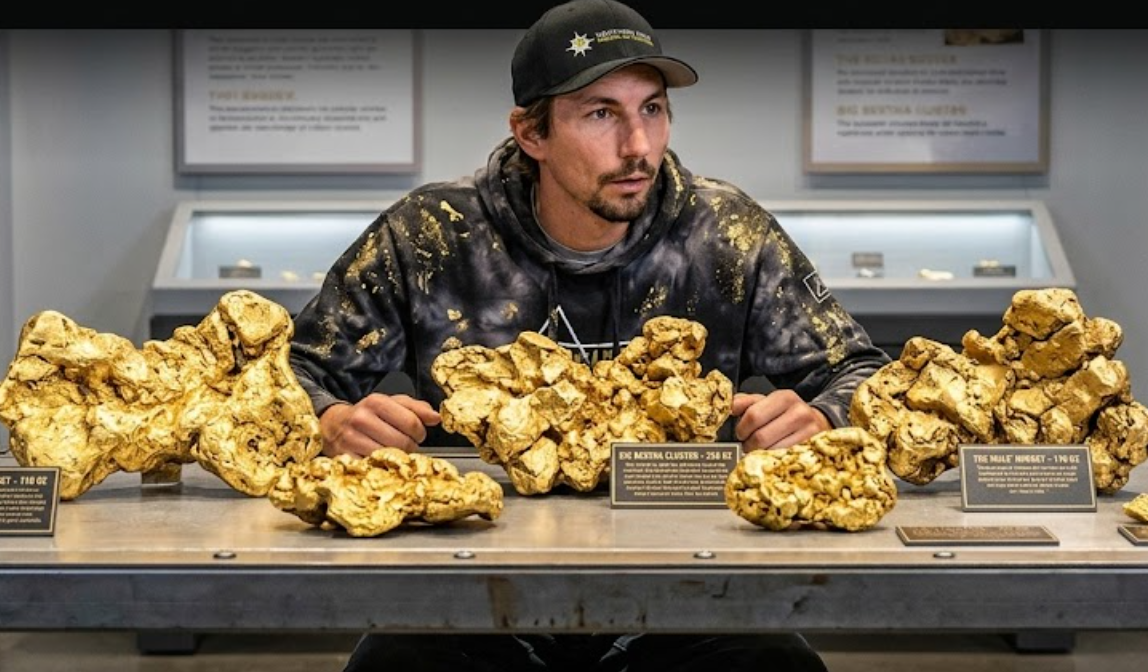
Parker Schnabel’s story on Gold Rush is not simply the rise of a young miner who learned how to run heavy equipment faster than most people his age. It is the story of a mine boss who repeatedly turned ground selection, equipment strategy, and relentless production into some of the most valuable gold recoveries ever seen on the series. His most important discoveries have not always looked like one dramatic nugget or a single “treasure” moment. More often, they have been entire cuts, claims, and pay zones that changed the scale of his operation.
From an analyst’s perspective, Parker’s greatest discoveries fall into several categories: the early Scribner Creek breakthrough that proved he could lead, the high-volume Yukon seasons that made him a serious industry player, the airstrip and Mud Mountain ground that pushed his operation to record levels, and the Dominion Creek acquisition that may define the next phase of his mining career.
Parker’s first major value shift came at Scribner Creek. After leaving the comfort of his grandfather’s Big Nugget mine, Parker had to prove he could operate away from family protection and under the pressure of lease payments, crew wages, and the Klondike’s short season. Scribner Creek became the ground where Parker transformed from a promising young miner into a true mine boss. According to widely reported Gold Rush season totals, his production jumped from 1,029 ounces in Season 4 to 2,538 ounces in Season 5, then 3,372 ounces in Season 6. That growth was not accidental. It reflected better ground understanding, better plant management, and a crew system that was starting to mature.
The true breakthrough came when Parker began producing at a level that placed him above nearly every other miner on the show. Season 8 and Season 9 became defining markers. In Season 8, his crew reportedly finished with 6,280 ounces, worth about $7.5 million at the values cited for that season. In Season 9, Parker exceeded his 7,000-ounce goal and finished with 7,427.25 ounces, valued at nearly $9 million. These were not just strong seasons. They proved Parker could build a large-scale, repeatable mining model rather than rely on lucky patches of ground.
One of Parker’s most valuable “discoveries” was therefore not a single hole, but a production philosophy: move more dirt, reduce downtime, and keep multiple systems feeding gold into the box. His best ground became valuable because his operation was disciplined enough to exploit it. That is why wash plants such as Big Red and Sluicifer became so central to his story. They were not just machines; they were the engines that turned pay dirt into record seasons.
The next major value point came when Parker mined his own ground more effectively and reduced the drag of royalties. In Season 10, even though his 7,223 ounces fell short of his previous record, reports noted that the haul was worth $10.8 million because of higher gold prices and improved economics around his ground position. This matters because a miner’s most valuable discovery is not always the highest ounce count. Sometimes it is the ground that allows him to keep more of what he produces.
Parker’s later high-output seasons strengthened that pattern. Season 11 reached 7,504.9 ounces, while Season 12 reportedly rose to 8,309.75 ounces, one of the strongest totals associated with his crew. These years showed that Parker’s most valuable gold discoveries were increasingly tied to bigger land packages and more aggressive seasonal planning. He was no longer simply trying to survive a season. He was trying to build a mining business with enough reserves to support years of production.
The airstrip and Mud Mountain-era ground became especially important because they showed Parker’s ability to extract value from large, complicated cuts. These areas required enormous stripping campaigns, heavy fuel spending, road building, equipment coordination, and tight timing. The reward was scale. In Gold Rush, Parker’s strongest moments often come when he commits to a difficult piece of ground and forces the operation to match the size of the opportunity. That approach can be exhausting for his crew, but it is also why his gold totals have reached levels most miners on the show cannot match.
Dominion Creek may be Parker’s most important discovery in long-term value, even if it is better described as an acquisition than a traditional find. Reports and trade coverage have described Dominion as a major gold-rich claim with multi-year potential. One TV Insider report cited Parker discussing six years and 60,000 ounces to mine there, which would make it one of the most consequential ground positions of his career if production continues to support that estimate.
This is where Parker’s future becomes interesting. Dominion is not just about one season’s gold. It represents control, reserves, and independence. A miner who owns or controls reliable long-term ground can plan differently. He can invest in custom wash plants, expand road systems, build better pads, and commit equipment without wondering whether the lease will disappear. If Dominion continues to produce, it may become the foundation of Parker’s next decade.
Season 16 numbers, as reported in public episode-tracking sources, suggest Parker’s operation may have reached another major benchmark with more than 10,000 ounces, while Tony Beets also posted an enormous total. These figures should be treated carefully because season documentation can vary by source, but they indicate the direction of the series: Parker’s world is no longer about small discoveries. It is about industrial-scale production.
My prediction is that Parker’s most valuable future discovery will not be a nugget, a single cleanup, or even one rich cut. It will be the next long-life claim that lets him build a stable mining empire beyond the familiar Yukon pattern. Alaska has already been teased as a possible new frontier for his operation, and that makes sense. Parker understands that gold mining is a ground business before it is an equipment business. The miner with the best reserves wins.

There is also a risk. Parker’s valuable discoveries have always come with rising complexity. More ground means more roads, more crew, more fuel, more maintenance, and more chances for one weak link to slow the entire system. If he expands too quickly, the same ambition that built his success could strain his operation. The challenge ahead is not whether Parker can find gold. He has already proven that. The challenge is whether he can keep building a company strong enough to mine the best ground efficiently.
In the end, Parker Schnabel’s most valuable discoveries to date are not just measured in ounces. They are measured in turning points. Scribner Creek proved he could lead. The 7,000-ounce seasons proved he could dominate. The 8,000-ounce seasons proved he could scale. Dominion Creek may prove he can build a long-term mining empire.
That is why Parker remains one of Gold Rush’s most important figures. His discoveries are not only about gold in the ground. They are about the evolution of a young miner into one of the most serious operators the show has ever followed.