THE KINGS OF DOMINION: Parker Schnabel’s $400 Million Industrial Empire Rewrites the Klondike Rulebook

At just 30 years old, Parker Schnabel is no longer just a “gold miner.” He is the architect of a self-contained industrial city. Controlling nearly 10,000 acres of prime Yukon wilderness, Schnabel’s operation at Dominion Creek has evolved into the most productive private placer mining empire in modern history, generating an estimated $40 million to $50 million in annual revenue.
While most miners his age are still learning the ropes, Schnabel has spent the last 14 years turning a $15,000 college fund gamble into a land empire with a gross asset valuation approaching $400 million, fueled by record-high gold prices and a ruthless commitment to industrial efficiency.
A $15 Million Gamble on “Virgin Ground”
The crown jewel of the Schnabel empire is the 2023 acquisition of Dominion Creek. In the largest private land deal in Yukon history, Schnabel purchased 400 mining claims for $15 million. Geological surveys estimate the ground holds 80,000 ounces of recoverable gold.
Unlike the leased ground of his early career—where he paid “King of the Klondike” Tony Beets royalties as high as 25%—Schnabel now owns the mineral rights and water licenses outright. This allows his company, Little Flake Mining, to capture 100% of the value from every ounce recovered, a strategic move that has shifted the balance of power in the Dawson City district.
The City That Never Sleeps

The Dominion Creek site functions less like a traditional mine and more like a high-tech manufacturing hub. During the peak 2026 season, Schnabel runs four massive wash plants simultaneously: Roxan, Big Red, Slucifer, and the ultra-scale Big Bob.
The logistics required to keep this “industrial city” running are staggering:
-
24/7 Operations: Two 12-hour shifts keep the equipment moving around the clock, effectively doubling the production capacity of standard mines.
-
The Fleet: A multi-million dollar array of CAT 7460 excavators and articulated rock trucks move millions of cubic yards of frozen overburden annually.
-
The Burn Rate: The operation consumes between $100,000 and $250,000 daily in diesel, wages, and maintenance.
-
Self-Sufficiency: Located two hours from the nearest cell service, the crew includes expert mechanics and fabricators capable of rebuilding collapsed infrastructure within 48 hours to prevent “production evaporation.”
The “Beets Defection” and the Data Edge
The shift in the Klondike landscape is perhaps best illustrated by the workforce. In 2025, seven veteran crew members famously defected from Tony Beets’ operation to join Little Flake Mining. Industry insiders credit this to Schnabel’s management style, which prioritizes maintenance and data over “brute force.”
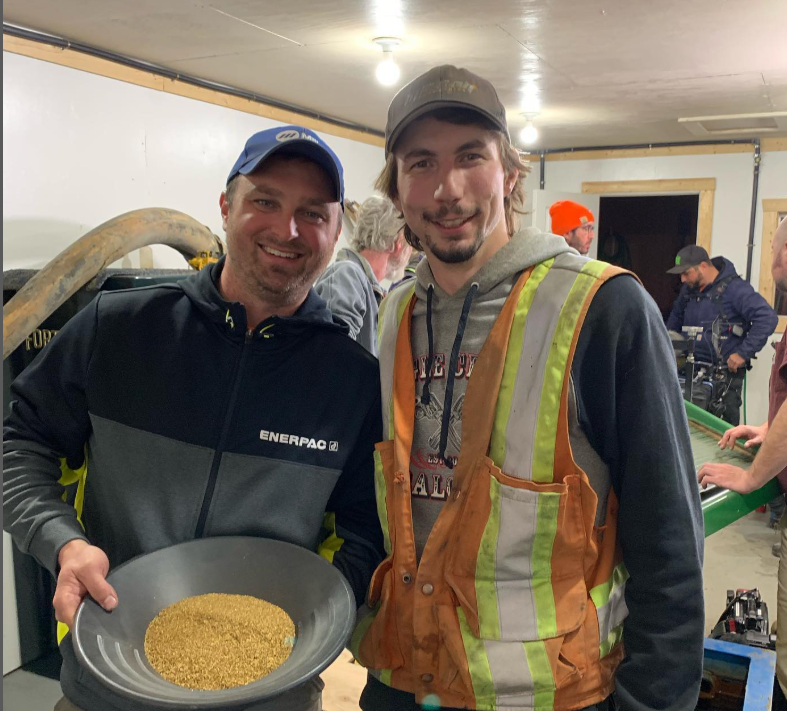
Schnabel employs a dedicated productivity adviser to perform time-and-motion studies, identifying micro-inefficiencies in truck routes and fuel consumption. This engineering-first approach has made his operation 30% more energy-efficient than it was just four years ago.
Environmental Stewardship
In a surprising pivot for an industry often criticized for land degradation, Schnabel received the Robert E. Leki Award for excellence in environmental stewardship. His 2026 strategy includes concurrent land-use recovery, where topsoil restoration and native species seeding happen alongside active mining. By exceeding regulatory standards, Schnabel ensures his water licenses—the lifeblood of any mine—remain secure through 2030.
As Schnabel looks toward the future, his reach is expanding to Australia Creek, where a production royalty agreement covers 5.5 miles of virgin ground. With a focus on AI-driven geological mapping and autonomous machinery, the “Kid from Haines” has officially become the most dominant force in the North, proving that in 2026, the Klondike belongs to the efficient.