A Golden Figure Beneath the Soil: What a Buried Statue Could Mean for The Curse of Oak Island
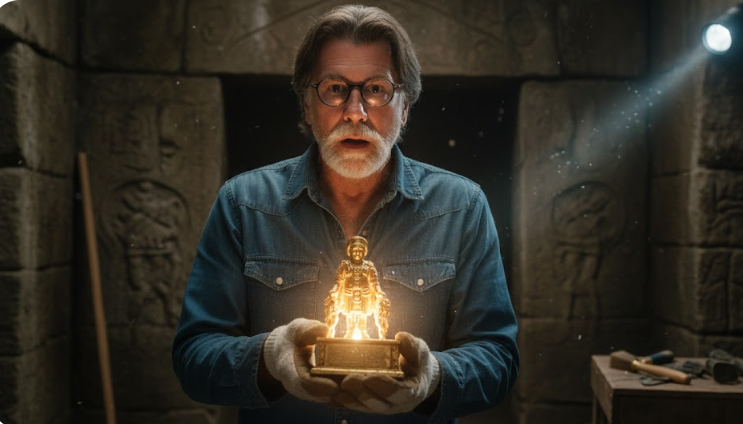
As an analyst of The Curse of Oak Island, few hypothetical discoveries carry more narrative and historical weight than the unearthing of an ancient gold statue deep below the island’s surface. While Oak Island has delivered an extraordinary catalogue of finds over the years—wooden structures, mysterious metal fragments, stone roads, and centuries-old artifacts—a fully formed golden statue would mark a dramatic escalation in both significance and consequence.
If such a discovery were to occur, it would immediately alter the direction of the investigation. Unlike coins, fragments, or isolated objects, a statue implies intentional placement, symbolic meaning, and considerable resources. Gold was never used casually in the ancient world. Its presence, especially in sculptural form, would point to a group with both wealth and a reason to hide something of exceptional importance.
Context Matters More Than the Gold Itself
The first question any serious analyst would ask is not “how much is it worth?” but “what era does it belong to?” The design, craftsmanship, and alloy composition would be critical. If stylistic elements resembled medieval Christian iconography, Templar imagery, or early Renaissance workmanship, the implications would be enormous. It would strengthen long-standing theories that Oak Island was used as a secure repository for religious or royal objects moved during times of conflict.
Alternatively, if the statue bore classical features—Greco-Roman proportions, pagan symbolism, or motifs linked to Mediterranean cultures—it would raise even more challenging questions. How would such an object have reached the North Atlantic centuries before formal European settlement? That scenario would force the team to consider early transatlantic contact theories that remain highly controversial among historians.

Depth Equals Intent
Equally important is the depth at which the statue is found. Oak Island has consistently demonstrated that depth correlates with purpose. Objects found near the surface often relate to later activity—farming, construction, or casual occupation. A statue buried deep underground, particularly below known engineered layers such as flood tunnels or platforms, would strongly suggest deliberate concealment.
In practical terms, this would signal a shift in excavation strategy. Expect immediate suspension of wide-area digging in favor of focused shaft work. Engineers would likely deploy additional boreholes, sonar scanning, and high-resolution imaging to determine whether the statue is isolated or part of a larger chamber. History suggests that Oak Island never delivers singular answers; one major discovery usually opens multiple new questions.
A Catalyst for Scientific Escalation
From a production and research standpoint, a golden statue would accelerate scientific involvement. Metallurgists, art historians, and conservation specialists would be brought in almost immediately. Carbon dating of surrounding materials, isotopic analysis of the gold, and soil stratigraphy would become central to the narrative.
Crucially, the team would need to prove context. A gold object without verifiable stratigraphic data risks being dismissed as a relocated artifact. The Lagina brothers and their partners are acutely aware that credibility depends not on spectacle, but on evidence. Expect meticulous documentation, slow extraction, and extended analysis before any definitive claims are made.
Legal and Political Implications
One often-overlooked factor is regulation. A discovery of this magnitude would almost certainly trigger involvement from Canadian authorities and heritage agencies. Depending on the statue’s age and origin, excavation permits could be revised or temporarily halted. This has happened before on Oak Island, and a gold statue—particularly one with religious or royal associations—would intensify scrutiny.
From a forecasting perspective, this could lead to a mid-season pause in digging, replaced by episodes focused on research, expert debate, and historical reconstruction. While some viewers may find this slower pace frustrating, it often produces the most meaningful insights.
What Comes Next?
Based on patterns from previous seasons, such a discovery would not be the end point—it would be a threshold. The most likely next developments would include:
-
Evidence of a secondary deposit, suggesting the statue was part of a collection rather than a lone object
-
Architectural features nearby, such as stone walls or wooden supports indicating a vault or chamber
-
Renewed focus on specific historical theories, particularly those involving transatlantic movements of valuable artifacts
It is also worth noting that Oak Island has a history of revealing objects that challenge assumptions without fully confirming any single theory. A gold statue would fit that pattern perfectly: undeniably important, yet frustratingly incomplete on its own.
A Defining Moment for the Series
If The Curse of Oak Island were ever to reveal a golden statue buried deep beneath engineered layers, it would represent one of the most consequential moments in the show’s history. Not because it would instantly solve the mystery—but because it would validate the core premise: that Oak Island was used intentionally, intelligently, and for reasons that extended far beyond local settlement.
From an analytical standpoint, such a find would not close the book on Oak Island. Instead, it would finally confirm that the island’s story operates on a far grander historical scale than even its most devoted followers have dared to imagine.