Anchor Stones, Ancient Maps, and a Possible Vault: Why Oak Island’s Latest Findings Matter
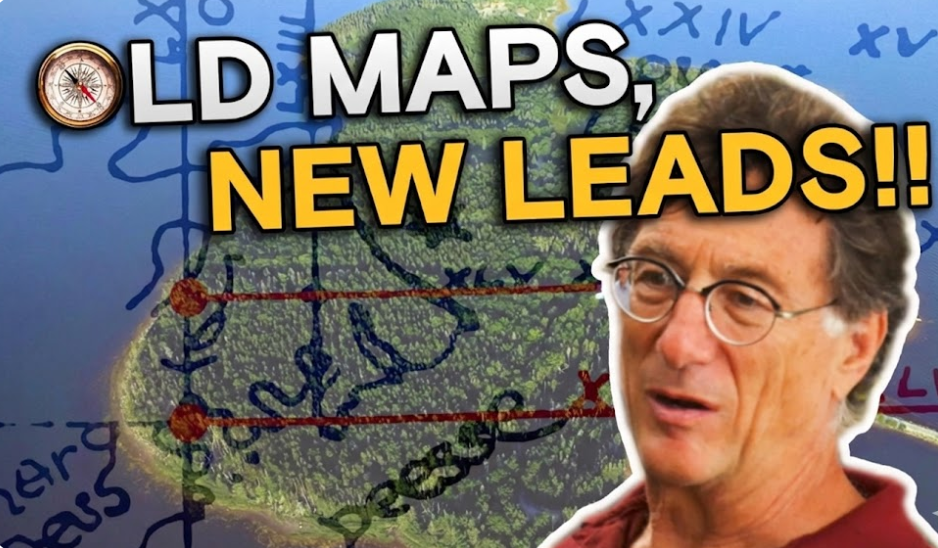
For more than two centuries, Oak Island has occupied a unique space between legend and methodical investigation. In recent developments on The Curse of Oak Island, that balance has tilted increasingly toward structured analysis, as the team led by Rick Lagina and Marty Lagina revisits one of the oldest questions surrounding the island: whether its features were deliberately designed as part of a larger, coherent plan.
The discovery of what researchers believe to be a second “anchor stone” along the island’s northern shore has renewed interest in a theory first raised decades ago and recently refined using modern tools. Surveyor Steve Guptill guided the team to the boulder after analysing historical references and contemporary LiDAR data. What they found was not simply another large rock on a rugged coastline, but a stone remarkably similar in size, shape, and placement to a previously identified anchor point near the swamp.
Its position, directly on the edge of what is known as Boulderless Beach, immediately stood out. From the perspective of an approaching vessel, the stone would have been visible and potentially usable as a fixed reference point. While no definitive carvings have been confirmed, surface markings prompted discussion among the team, particularly when compared with the so-called “boat stone” discovered in Westford, Massachusetts.
That stone, long debated among historians, features markings interpreted by some researchers as medieval symbols, including a ship and navigational elements. Oak Island theorist Robert Markus has argued that such markings form part of a broader navigational system linked to transatlantic voyages predating Columbus. While these claims remain controversial, they have gained renewed attention due to the consistency now emerging between physical features on Oak Island itself.
The significance of the northern anchor stone lies not in isolation, but in how it integrates with other known points. Geographic information specialist Erin Helton presented a detailed model in the war room showing how multiple boulders, documented as early as a 1939 Popular Science map, could be used to triangulate a specific subsurface location. By drawing intersecting lines from three anchor points—one to the west, one to the north, and one south of the traditional Money Pit area—Helton identified a convergence point within just a few feet of a previously excavated shaft known as RF-1.
RF-1, an eight-foot-wide steel caisson sunk the previous season, produced compelling evidence of human activity at depth, including worked wood and construction layers inconsistent with natural geology. The alignment between Helton’s model and the RF-1 data adds weight to the argument that the Money Pit was not a random discovery, but the centre of a deliberately engineered system.
What distinguishes this phase of the investigation from earlier efforts is the emphasis on corroboration. Helton has repeatedly stressed the importance of independent data sources—historic maps, modern satellite imagery, field surveys, and excavation results—supporting the same conclusion. In a field long criticised for speculative leaps, this convergence is notable.
Further complexity was introduced when Knights Templar researcher Zena Halpern shared previously unseen maps and a cipher believed to date back to the 12th and 14th centuries. One French map appears to label features that closely correspond with Oak Island’s geography, including the swamp, a dam-like structure, and a marked entry point near the Money Pit. References to “anchors,” a “valve,” and a “hatch” suggest functional elements rather than decorative symbols.
This led the team to investigate a square depression on the western side of the island, near property once owned by Dave Blankenship. The feature, partially filled and cut into the ground, was examined with the assistance of archaeologist Laird Niven, who noted characteristics inconsistent with natural formation. Loose fill, defined edges, and evidence of lateral continuation raised the possibility that the structure could mark an entrance point, though its purpose remains unconfirmed.
Crucially, the team chose to halt further digging until appropriate permits could be obtained. This decision reflects a broader shift in how the Oak Island project is conducted. Rather than rushing toward conclusions, the Laginas have increasingly positioned the island as a site of potential archaeological importance, deserving of regulatory oversight and careful documentation.
Taken together, these findings suggest a layered narrative rather than a single hidden cache. Anchor stones, mapped alignments, possible access points, and historical documents all point toward an organised operation that required planning, navigation, and long-term effort. Whether the objective was the concealment of valuables, documents, or something else entirely remains unresolved.
What is increasingly difficult to dismiss, however, is the idea that Oak Island’s features are interconnected. The emerging picture is not one of isolated curiosities, but of a landscape shaped with intention. As further analysis continues, the focus may shift from asking whether something was hidden on Oak Island to understanding who had the capability—and the reason—to design such a system in the first place.
For now, the island continues to offer more questions than answers. Yet, with each measured step, those questions are becoming sharper, more specific, and harder to ignore.