Ancient Clues Beneath Lot 26: Oak Island’s 900-Year-Old Well Reveals Another Layer of Mystery

For more than two centuries, Oak Island has challenged researchers, historians and treasure hunters with a maze of unanswered questions. Now, a newly revived investigation at one of the island’s most intriguing features—a 900-year-old stone well on Lot 26—may offer another crucial piece of the puzzle. Recent excavation efforts led by Jack Begley, archaeologists Laird Niven and Helen Sheldon have produced fresh discoveries that hint at organized activity on the island long before the Money Pit was uncovered in 1795.
What began as a simple clean-out of a flooded well quickly evolved into one of the most promising investigations of the season.
A Well Older Than Expected
The team’s renewed interest in the Lot 26 well followed a scientific test conducted by geoscientist Dr. Ian Spooner, which identified unusually high traces of silver in the water. While natural sources were possible, the readings raised an important question: could the well have been used to store something valuable?
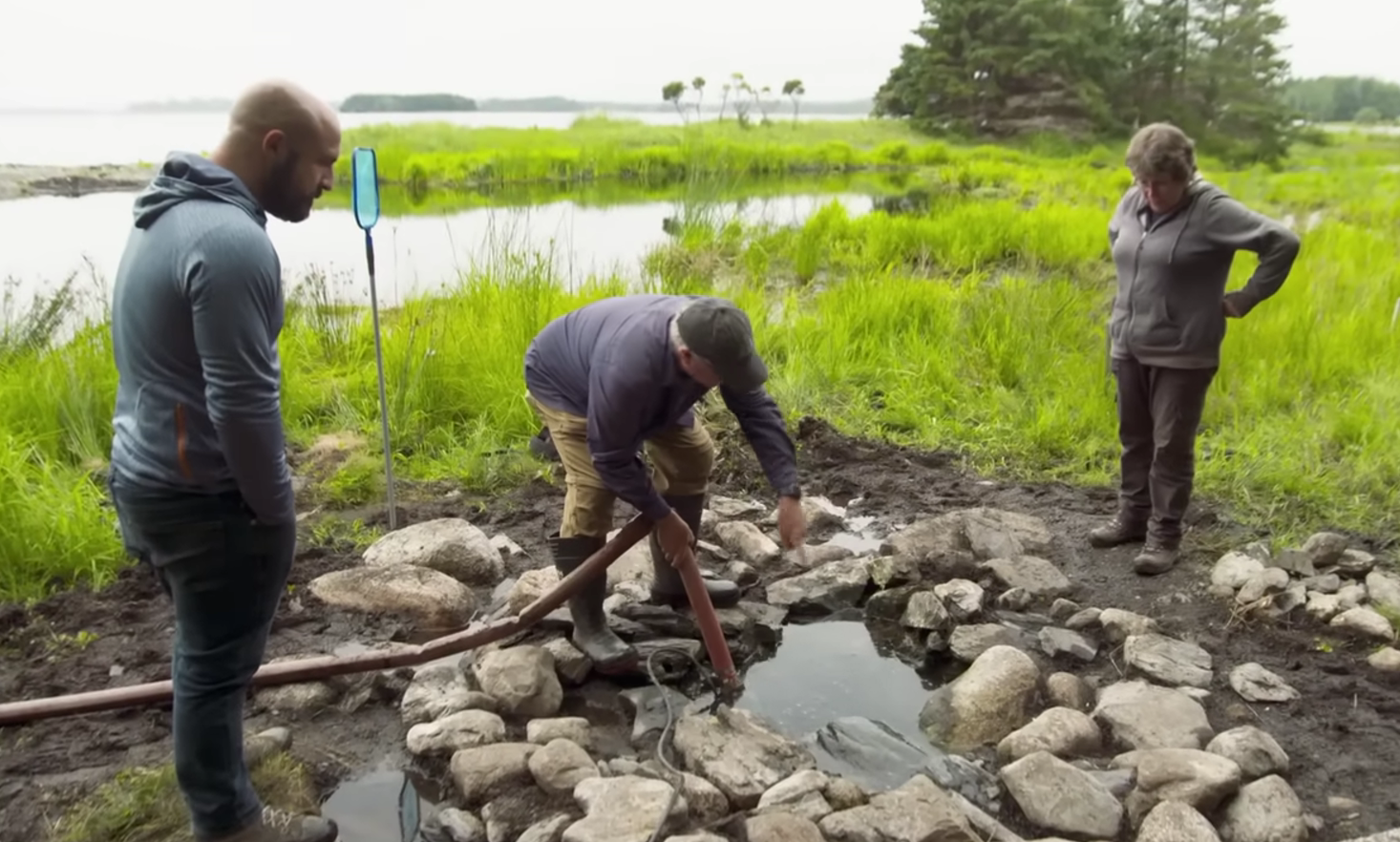
Arriving at the site, Jack Begley observed that the water looked clean but unusually full. Laird Niven outlined the plan—pump the well dry, scoop out debris, and preserve everything for detailed examination. As Jack worked his way down the circular stone shaft, he noted a shift from rounded stones to jagged, angular material, indicating multiple phases of construction or reuse.
“This well is as old as the 11th century,” Marty Lagina later reflected. “It fits with other outliers on the island, like the paved area in the swamp or the ship-like railing recovered years ago. It’s astonishing.”
If these features are truly connected, the island’s earliest visitors may predate the commonly accepted timelines by centuries.
A Discovery Hidden in the Mud
Once the debris was removed and left to dry, archaeologists Helen Sheldon and Emma Culligan began sifting through bucket after bucket of material outside the Oak Island Interpretive Centre.
Early results were unremarkable—mostly organics and sediment—until Helen stopped suddenly.
“Oh, there’s something. Look at that.”
The object was iron, weathered but oddly shaped. Its rounded tip and bent shaft did not match the profile of common hand-forged nails. Emma noted sulfur content in the metal, suggesting it had been smelted at lower temperatures, a technique typical of early-period furnaces.
Her preliminary estimate: the 1700s, possibly earlier.
To the untrained eye, it looked like a broken nail. But its weight, shape, and metallurgy challenged that assumption. One compelling theory offered by the team was that it may be a “clenched” fastener—a type used in early shipbuilding when builders hammered the nail through a plank and bent it back to secure the joint.
If confirmed, the artifact could indicate that maritime workers, not settlers, accessed Lot 26 long before the Money Pit drew attention.
A Second Opinion—and a Clearer Timeline
To determine a more exact age, Emma and the team delivered the artifact to Saint Mary’s University in Halifax. Using the powerful Scanning Electron Microscope (SEM), chemist Dr. Christa Brosseau examined the iron at high magnification.
The results were immediate and compelling.
“No manganese,” she reported. “We use that as a marker. It places this artifact before 1840. And based on structure, it appears older than that.”
This aligned with interpretations from blacksmithing expert Carmen Legge, who previously dated the object to the mid-1600s.
In other words: someone was on Lot 26 long before any recorded settlement, performing work that required tools—not merely passing through.
Historian Charles Barkhouse added another possibility:
“It’s nowhere near the Money Pit. The question is: what were they doing there? And were they placing something—or removing something—from the well?”
With its isolated position and unusual age, Lot 26 may have hosted activity separate from the better-known construction at Smith’s Cove and the Money Pit. Some theories even suggest the well could have served as a hidden access point or storage feature for those seeking secrecy on a remote island.
A Growing Web of Early Evidence
As more artifacts surface from different parts of Oak Island—Chinese coins, European brooches, ship fasteners, and now a pre-1700 metal tool—the narrative becomes increasingly complex.
Nothing found on Lot 26 seems accidental. The presence of hand-wrought hardware in a centuries-old stone well is consistent with deliberate use, not random discard.
Rick Lagina captured the significance:
“You can find all the artifacts you want, but they need to tell a story. This one might.”
If the object did originate from a ship or early expedition, it would reinforce the possibility that Lot 26 was an operational site for early visitors—possibly navigators, traders, or groups connected to the long-theorized maritime networks believed to have visited the island.

What Comes Next?
The team still has more material to examine. Additional buckets of debris await sifting, and the well itself requires further cleaning before deeper layers can be explored. Any future finds—especially if made of metal, textile, or wood—could tie the well to a specific time period or cultural group.
With scientific tools and renewed focus, Lot 26 stands as one of the most promising leads of the season. Every artifact recovered there strengthens the possibility that Oak Island was active centuries before modern records suggest.
The well may not yet reveal who built it or what purpose it served—but for the first time in years, the team feels closer to answering a question that sits at the heart of Oak Island’s enduring mystery.
Was Lot 26 part of something far larger than anyone ever realized?
The next discoveries may bring that answer into view.