BEYOND THE SURFACE: Lot 5 Discovery Challenges Long-Held Theories on Oak Island
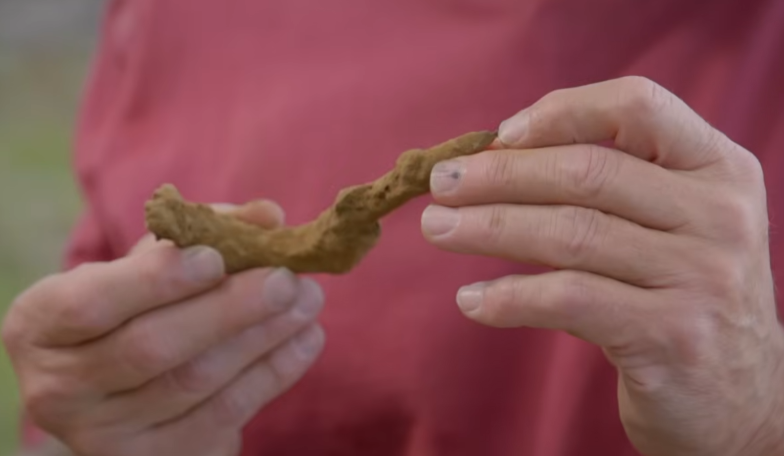
The investigation into the enigmatic “Lot 5” has taken a dramatic turn this week as brothers Rick and Marty Lagina unearth evidence that could dismantle decades of assumptions regarding the island’s colonial history. A simple iron hook, recovered near a stone well previously dismissed as a 20th-century construction, now points to a much older, potentially European origin.
For years, the late Robert Young, who owned Lot 5 until his passing, maintained that the stone well and a nearby rounded feature were relatively modern additions. However, the Lagina team’s recent foray into the site suggests that Young—and the historians who followed him—may have been looking at a much deeper mystery.
A “Trampoline” of History
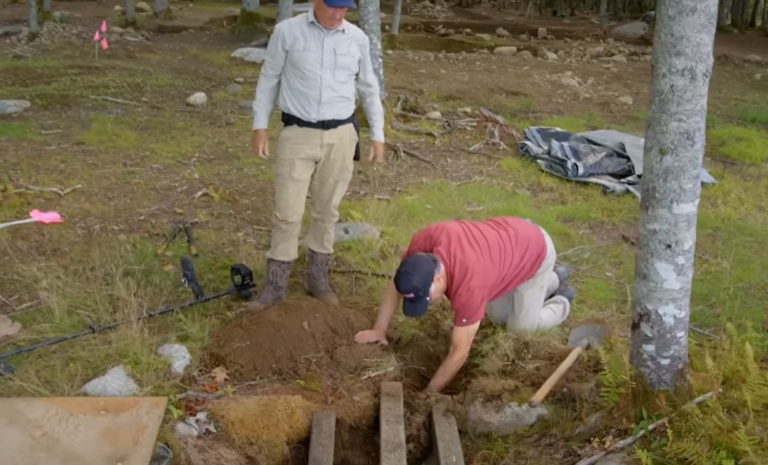
The discovery began when Marty Lagina and metal detection expert Gary Drayton ventured onto the lot, focusing their search on a well covered by weathered plywood. Upon descending several feet into the shaft, Lagina discovered that the “bottom” was actually a false floor comprised of several feet of tightly packed leaves and debris.
“This is like metal detecting on a trampoline,” Drayton remarked, noting the soft, shifting ground beneath them. “We are nowhere near the bottom of this.”
Despite the challenging conditions, a deep, non-ferrous signal led the pair to a large stone. After several minutes of excavation, they recovered a substantial iron object. Initially suspected to be a “pintle”—a pivot pin used for ancient gates—subsequent laboratory analysis has refined the artifact’s identity.
The European Connection
Back at the Oak Island Interpretive Center, archaeometallurgist Emma Culligan and archaeologist Laird Niven put the artifact through X-ray fluorescence (XRF) scanning. The results provided a startling contradiction to the “modern well” theory.
Culligan identified the object as a driven hook, likely used to lower buckets into the shaft. More importantly, the chemical signature of the iron revealed a “high chromium and copper content” with an absence of modern alloying elements. This specific elemental profile points to European iron-working regions and suggests a manufacturing date prior to 1800.
“It does point toward the mid-1700s as the most likely origin,” Culligan stated. This dating aligns the well with the “bulk” of Oak Island’s pre-discovery artifacts, suggesting the feature was active long before the official 1795 discovery of the Money Pit.
Rewriting the Map
The find is part of a growing body of evidence on Lot 5 that predates the 20th century. Only last week, Italian archeoastronomy professor Adriano Gaspani analyzed the alignment of a separate rounded feature on the lot, suggesting its construction could date as far back as the 13th century based on celestial star alignments.
The presence of an 18th-century hook in a “20th-century well” has prompted the team to reconsider every feature Robert Young documented. “Just about everything Robert Young touched… seems to be not what it seems,” Marty Lagina observed.

Archaeologist Laird Niven has now recommended a full-scale excavation of the well’s interior. “Everybody drops artifacts down the well,” Niven noted, suggesting that the true treasure may lie buried beneath the feet of debris currently masking the shaft’s original floor.
As the team prepares to “get to the bottom” of the Lot 5 well, the island continues to prove that its secrets are not just found in deep shafts, but in the overlooked corners of its surface.