Miriam Amirault’s New Discovery CONFIRMS the $150M Oak Island Treasure!
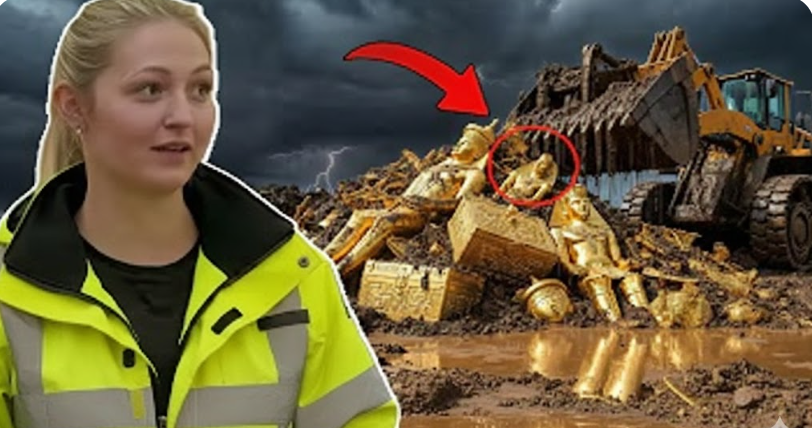
A violent Atlantic storm may have done what centuries of excavation could not — expose what appears to be one of the most significant structural discoveries ever made on Oak Island.
Following hours of heavy wind and coastal erosion, members of the Oak Island team identified a newly exposed fracture along an old stone pathway near the Money Pit axis. What initially appeared to be routine storm damage quickly evolved into something far more compelling when archaeologist Miriam A., called in to examine the site, identified unusual mineral staining and a metallic glint embedded within the freshly opened seam.
The exposed soil bore deep red and dark blue streaking inconsistent with the island’s typical geological profile. Embedded between two jagged edges of the fracture, Miriam identified a curved bronze fragment, unusually well preserved and marked with carved geometric symbols. Among them was an eight-pointed star motif that closely resembles medieval Templar navigation glyphs documented in parts of Portugal.
Rather than removing the fragment immediately, the team mapped the fracture using GPS and subsurface scanning equipment. The results were striking. The line of the exposed crack aligned almost perfectly with the central axis of the historic Money Pit. A second subsurface reading revealed a corresponding alignment toward the western swamp — forming a triangular intersection centered on a previously undetected density anomaly.
“This wasn’t random erosion,” one crew member observed. “The geometry is too precise.”
When the bronze fragment was carefully extracted and positioned over a nearby stone slab containing a shallow carved depression, the curvature reportedly matched exactly. According to the team, applying light pressure caused the slab to shift sideways, revealing a concealed chamber beneath.
Inside, the chamber was lined with smooth timber beams coated in what analysis suggests may be Mediterranean pine resin — a material historically used in medieval shipbuilding for waterproofing and cargo preservation. The beams were secured with iron pins containing trace amounts of silver, an unusual inclusion that some historians interpret as symbolic rather than structural.

Further inspection revealed controlled V-shaped heat patterns on the timber, consistent with historical fire-sealing techniques used in medieval vault construction. Such methods were sometimes employed in European sanctuaries and fortified storage chambers.
To avoid disturbing the fragile environment, the team deployed a micro-camera into a vertical shaft beneath the chamber. The footage showed precisely stacked stonework, interlocking masonry techniques uncommon in early colonial North America but documented in certain medieval European fortifications.
Carved guide grooves along the shaft walls suggested that heavy cargo had once been lowered into the chamber using rope and pulley systems. An iron anchor ring embedded in the wall reinforced the theory that the shaft functioned as a controlled lowering mechanism rather than a simple burial pit.
At the base of the shaft, the camera captured rows of rectangular metal bars arranged in compact stacks. Portions of the bars were wrapped in decayed cloth bearing faint red cross markings. Preliminary visual assessment indicated that the exposed metal had a deep yellow hue consistent with gold. However, laboratory testing would be required for confirmation.
Alongside the bars, the team documented a preserved wooden plank branded with what appears to be medieval Portuguese script. Rough translation suggests a reference to a “Western Vault,” implying the possibility of additional chambers elsewhere on the island.
Further exploration of a horizontal tunnel adjacent to the main chamber revealed a curved copper sheet partially embedded in sediment. Once exposed, the sheet displayed engraved outlines resembling Oak Island’s topography. Several marked points corresponded with known excavation areas, including the Money Pit and swamp. Three additional symbols indicated unexplored locations connected by carved lines resembling hydraulic channels.
According to Miriam’s assessment, the engraving appears less like a treasure map and more like an engineering schematic — potentially outlining a flood-control system designed to protect multiple chambers. That interpretation aligns with longstanding theories that the island’s infamous flood tunnels were deliberately constructed as defensive mechanisms.
Ground sensors placed above one of the newly identified symbol locations detected low-frequency harmonic vibrations approximately 40 feet below the surface. The signal pattern resembled residual water displacement cycles seen in medieval hydraulic systems, suggesting the presence of a hollow cavity of significant size.
“If accurate, this would indicate a sealed chamber rather than collapsed rubble,” a geotechnical consultant noted.
While speculation about Templar involvement has surrounded Oak Island for decades, direct material evidence linking medieval European engineering to the site has remained elusive. The combination of resin-treated timber, carved sigils, Portuguese inscription, and structured masonry may represent one of the most cohesive assemblages of medieval indicators yet documented on the island.

Experts caution that further independent verification will be necessary. Metallurgical testing of the bars, radiocarbon dating of timber, and epigraphic analysis of inscriptions will determine whether the findings support a 12th–13th century origin or reflect a later, more recent construction.
If authenticated, the discovery would significantly expand prevailing theories about Oak Island’s history — shifting the narrative from a single buried treasure toward a networked storage and hydraulic defense system.
For now, excavation remains cautious and methodical. Engineers are assessing structural stability before any removal of artifacts proceeds. Regulatory oversight will likely intensify as word of the discovery spreads.
What is clear is that the storm exposed more than soil. It revealed a structural alignment, an engineered chamber, and a set of artifacts that challenge long-standing assumptions.
Whether the contents represent a centuries-old cache or an elaborate historical construct, the evidence uncovered has brought renewed intensity to a mystery that has persisted for more than two hundred years.
Oak Island, once again, appears to be holding onto its secrets — but perhaps not for much longer.