THE SMOKING GUN: Data Analysis Proves $85M Oak Island Shaft Was Engineered, Not Natural
For decades, the massive underground void known as the “$85 Million Shaft” on Oak Island was dismissed by geologists as a simple natural sinkhole—a chaotic collapse of earth and water. But this week, a groundbreaking forensic audit of historical excavation records has shattered that theory, providing what researchers call “geometric proof” of a sophisticated, pre-industrial engineering project designed to protect a priceless secret.
The Emma Culligan Breakthrough
The discovery comes from researcher Emma Culligan, who spent three years Analyzing faded excavation logs, soil density patterns, and wall angles that had been ignored for decades. By overlaying data from various drilling teams, Culligan identified a pattern that defies the laws of natural geology.
“Nature produces chaos. This was intent,” Culligan noted during a briefing at the Oak Island Research Center. “Sinkholes widen as they descend due to gravity and erosion. This shaft does the opposite. It remains narrow, controlled, and perfectly aligned through transitions in sand, clay, and gravel—materials that respond very differently under natural pressure.”
Striations and “Sacrificial” Zones
The evidence of human intervention is etched into the very walls of the shaft. High-resolution scans revealed faint, rhythmic striations—markings that repeat at nearly identical intervals. According to Culligan, these match the working width of historical excavation tools used to scrape and compact earth long before the advent of mechanized drilling.

Perhaps most stunning is the discovery of a “Deception Layer.” In the upper regions of the shaft, the soil appears loose and chaotic—a facade seemingly designed to discourage searchers by mimicking a dangerous, unstable natural collapse. However, as excavations move deeper, the disorder abruptly ends, replaced by smooth, compressed clay and strategic stone clusters. These stone buffers function as load-bearing buffers, redirecting underground stress away from the shaft’s core.
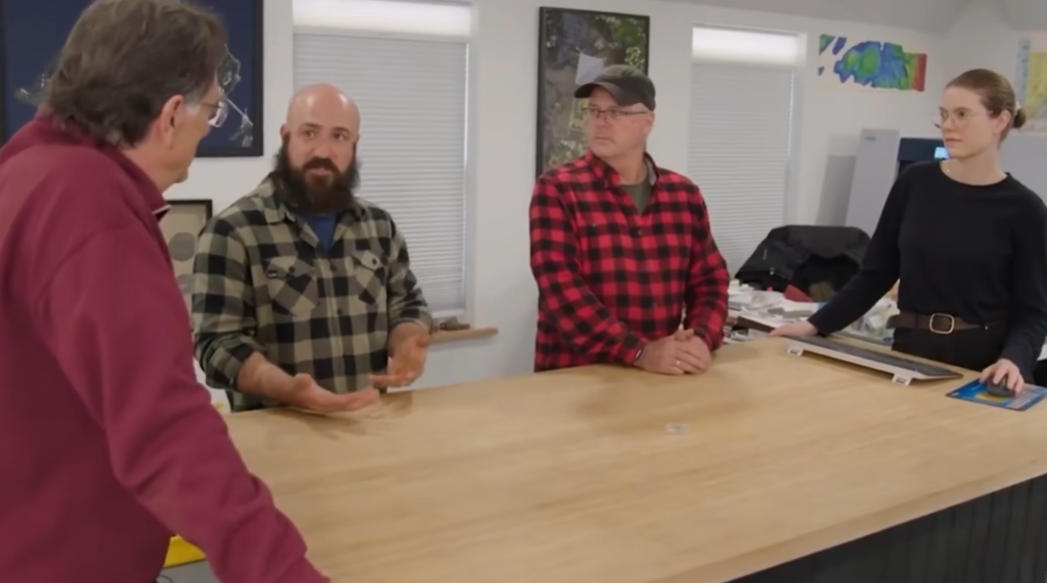
[Image: Emma Culligan pointing to a digital overlay of the $85M shaft and the original Money Pit]
A Unified Underground Network
Culligan’s mapping has revealed an “impossible” coincidence: the $85 million shaft shares identical depth markers and resistance layers with the original 1795 Money Pit. The data suggests that the two structures are not separate holes, but parts of a single, integrated hydraulic system.
The shaft appears to function as an “engineered shield.” Rather than leading directly to treasure, it was designed to absorb the weight of the ocean and the earth, sacrificing itself to inward collapses to protect a more critical, deeper chamber. This “pressure relief” system allowed the builders to redirect water through concealed sideways pathways, keeping specific zones consistently dry—a necessity for protecting parchment, wood, or delicate artifacts.
The “Gasket” of Clay
Corroborating the engineering theory is a dense, uniform layer of clay found deep in the pit. Lab results indicate this clay was manually compressed while still pliable, effectively creating an underground gasket. This layer regulates moisture and isolates the lower depths from the volatile water shifts common on the island’s surface.

“This kind of foresight only exists when something beneath requires permanent protection,” Culligan stated. “They weren’t just digging a hole; they were building a barrier designed to last centuries without maintenance.”
What Lies Beneath?
The precision of the construction has reignited theories regarding the Knights Templar or high-level colonial military engineers. The resources required to execute such a plan—involving stage-collapse design and hydrology control—suggest that whatever the shaft is shielding is singular in human history.
As the team prepares to follow the data deeper, the consensus on the island has shifted: the $85 million shaft is not the prize, but the lock. And for the first time in three centuries, the fellowship may finally have the key.