Oak Island’s Golden Clues: How a Set of Ancient Finds Is Rewriting Theories About the Island’s Mysterious Past
For more than two centuries, Oak Island has stirred the imagination of explorers and scholars alike. Each season brings new discoveries that add layers to one of North America’s most enduring archaeological puzzles. But recent findings—ranging from gold-plated jewelry to possible 18th-century infrastructure—have intensified both the excitement and the mystery surrounding the island. As the Lagina brothers and their team dig deeper, they continue to uncover artifacts that may reshape our understanding of who was here, what they were doing, and why.
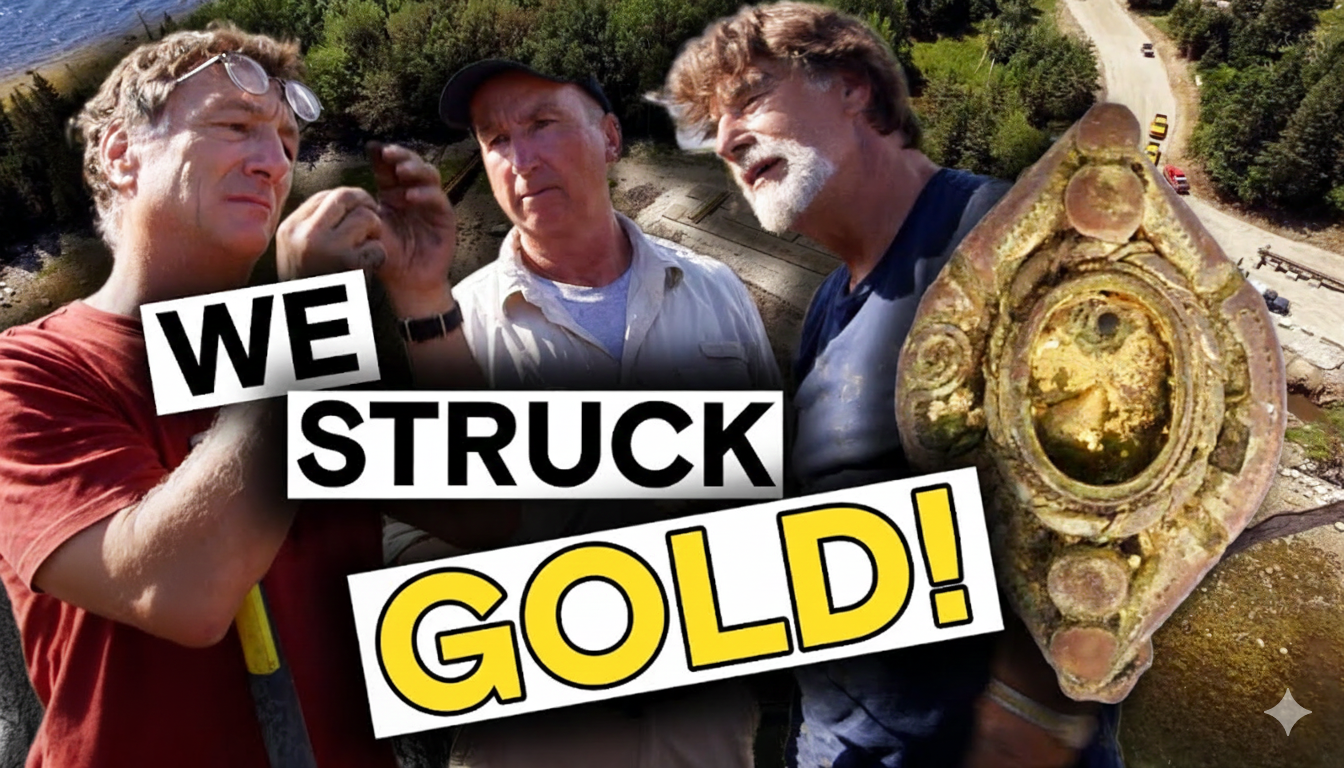
One of the most iconic discoveries in recent years is the now-famous “bobby dazzler” brooch, unearthed in 2018 on Lot 21 by Gary Drayton and Rick Lagina. The term “bobby dazzler,” as Drayton explained, comes from his home region of Lincolnshire, England—an old expression used to describe something brilliantly shiny, often linked in folklore to stolen jewelry used to distract London policemen, or “bobbies,” centuries ago. When he brought the phrase to Oak Island, it became part of the show’s vocabulary—and part of the island’s modern legend.
When the brooch was examined at St. Mary’s University in Halifax, lab analysts confirmed it was not merely decorative—it bore actual gold plating, making it one of the first verified pieces of treasure ever recovered on Oak Island. To Drayton, the brooch was more than a lost ornament; it was a connection to a much older European past. “These pieces could be 600 or 700 years old,” he said. “You can find paintings in castles in Europe with people wearing designs just like these.”
Whether the object belonged to early depositors or later visitors remains unknown, but the discovery has reinforced the belief that Oak Island’s mystery may stretch far earlier than the commonly cited late 18th-century timeline.
Unearthing New Clues at Smith’s Cove
Momentum continued as large-scale excavations at Smith’s Cove resumed. Encased within a massive 525-foot steel cofferdam, the cove became the focus of one of the team’s most significant undertakings: revealing the enigmatic U-shaped structure first partially uncovered by the late Dan Blankenship in 1971.
For Rick and Marty Lagina, the excavation was not merely an engineering feat but an emotional milestone. “It feels like childhood excitement,” Rick said. “We’re finally seeing with our own eyes what we’ve only seen in old photographs.”
While digging through spoil piles near the structure, Gary Drayton’s metal detector signaled another promising target. Moments later, the team lifted a small, heavy object with a distinctly gold color. Though early examinations suggested it might be gold-plated rather than solid gold, the absence of milled edges raised an important point: the object could be older than 1795, potentially predating the Money Pit discovery itself.
If confirmed, it would support the idea that significant activity occurred along Smith’s Cove long before the island entered public record.

A Trail of Ox Shoes and a Possible Transport Route
Meanwhile, archaeologists working on Lot 15 uncovered fire-cracked rock and other evidence of early human activity. Not far away, Drayton and crew member Jack Begley made another intriguing discovery: a series of ox shoes, buried in alignment, pointing toward the swamp.
In isolation, ox shoes offer limited information. But when found in sequence—and in an area without known agricultural history—they can indicate the former presence of a transportation route. Begley noted that the alignment ran toward both the paved swamp structure and the Lot 15 stone feature, suggesting that heavy materials may once have been hauled along this path.
Further investigation produced a metal fitting believed to be part of an old harness. Taken together, these finds hint at coordinated movement of cargo between the swamp and upland areas—perhaps supporting theories that the swamp once functioned as a maritime worksite or landing zone.
The Historical Debate Widens
Amid these archaeological advances, discussions among the team and visiting experts have explored broader historical possibilities. One theory gaining renewed attention focuses on the 1760s–1770s, a period of political tension in Nova Scotia and the American colonies.
Some suggest that the U-shaped structure at Smith’s Cove, dated to around 1769, may not be an original depositor feature but rather part of a later recovery attempt. With the American Revolution looming and finances strained, the idea that colonial or French agents might have sought hidden wealth—real or rumored—has become a subject of serious debate among the team.
Rick Lagina, however, emphasizes a deeper motivation: “I do not believe this is simply temporal wealth,” he said. “Understanding why something was done is the key to discovering who did it.”
His brother Marty remains the voice of cautious skepticism, arguing that belief must be balanced with scientific evidence. Yet even he concedes that the timing of historical settlement and geopolitical tensions makes the landscape of the late 18th century unusually compelling.

Where the Mystery Stands Today
As each new artifact is unearthed—be it a gold-plated brooch, a centuries-old coin, or an ox shoe buried along a forgotten trail—the historical picture becomes both clearer and more complex. Oak Island continues to defy simple explanations. Evidence of multiple occupations, diverse origins, and layered engineering projects suggests that the island’s mystery is not the story of a single group or a single era.
Instead, it may be a palimpsest—a centuries-long accumulation of intentions, attempts, and legends, all converging in a place where history and myth have become inseparable.
For the Lagina brothers and their team, the work is far from over. But with every season, every dig, and every unexpected artifact, Oak Island edges closer to revealing the truth behind one of the world’s most enduring enigmas.