The 17th-Century Smoking Gun? New Finds at Oak Island Point to Pre-Discovery Treasure Deposit

The long-standing mystery of Oak Island has taken a sophisticated turn as a series of 17th-century artifacts and the discovery of a previously unknown tunnel have the Lagina brothers and their team convinced they are on the “precipice” of a breakthrough. Scientific analysis of small finds—a tunic button, a lead weight, and a hand-forged spike—is providing a digital roadmap to what may lie within the elusive “Aladdin’s Cave.”
Evidence on the Surface: Lot 5’s Secrets
On the western side of the island, metal detection expert Gary Drayton and Craig Tester have been meticulously sifting through ten tons of spoils from a mysterious rounded stone feature on Lot 5. The area has already yielded fragments of a 17th-century English silver coin and a 14th-century lead barter token, the latter sparking renewed interest in the island’s potential connection to the medieval Knights Templar.
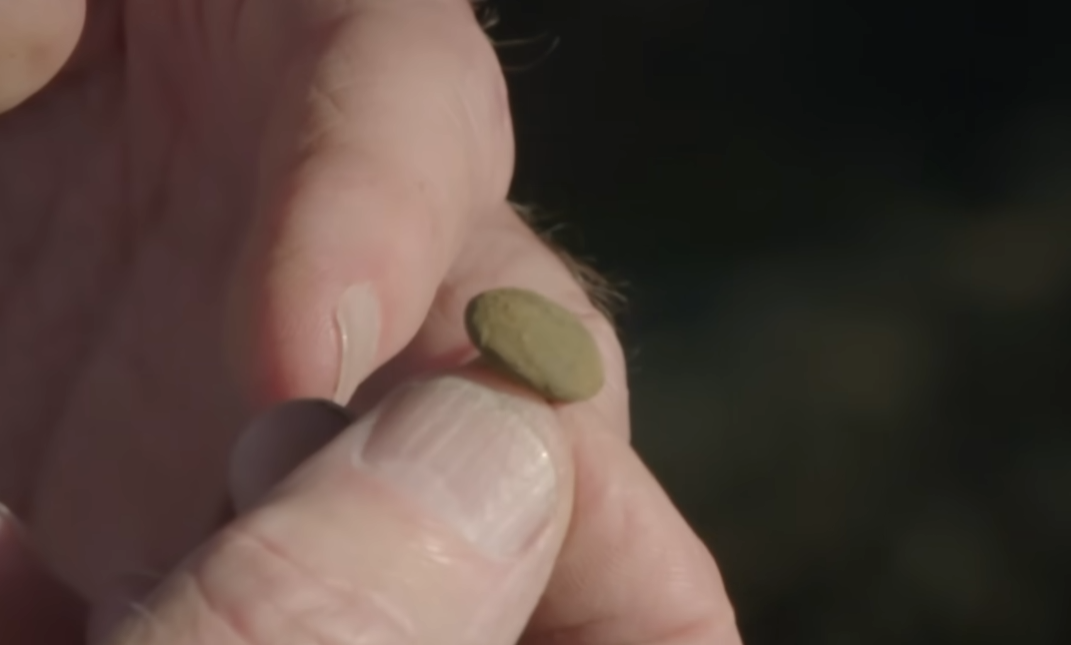
The latest discovery in the spoils is a small, rounded copper-iron alloy button. Archaeometallurgist Emma Culligan, using a SkyScan 1273 CT scanner and X-ray fluorescence (XRF), confirmed the composition aligns with English manufacturing from the late 1600s to early 1800s. Drayton suggests the “fancy” nature of the button points toward a gentleman or a military officer rather than a local farmer, reinforcing the theory of a significant British military presence on the island long before the Money Pit was famously “discovered” in 1795.
The Lead Weight Conundrum
Tensions between traditional archaeology and modern science emerged in the Oak Island lab over a shaped lead object weighing 26.2 grams. While Drayton identified it as an ancient coin weight—a tool used by high-ranking merchants or payroll officers to verify the value of gold coins—Culligan’s chemical analysis revealed high levels of phosphorus, a marker typically associated with mid-20th-century lead production.
To resolve the discrepancy, the team is turning to laser ablation. This high-powered testing method removes microscopic samples to determine specific isotope values, which could pinpoint the lead’s geographic origin and its true age, potentially linking it to the high concentrations of precious metals recently detected in the Money Pit’s water.
The Deep Reveal: Shaft AC1 and the Rose-Head Spike
While the lab work continues, the heavy machinery at Shaft AC1 has struck what Rick Lagina describes as a “jackpot.” At a depth of 96 to 110 feet, the team intercepted a man-made tunnel. Unlike searcher tunnels from the 1800s, these timbers lacked iron fasteners, suggesting an older, more primitive construction.
However, a massive iron spike was recovered from the associated spoils. Emma Culligan’s analysis confirmed the spike is hand-forged rot iron, charcoal-smelted, and features a “rose-head” design—characteristic of 17th-century craftsmanship. “This is your typical 1600s spike,” Drayton noted. “You find these in cabinets, doors, and treasure chests.”
The Fipps Connection
The 1600s timeline aligns perfectly with a theory championed by researcher Scott Clark involving Sir William Fipps. In 1687, Fipps recovered a massive fortune from the Spanish wreck Concepcion. While he officially reported a portion of the find to the English Crown, a 1688 letter suggests his associate, Andrew Belchure, was spotted in Mahone Bay at the exact time Fipps was returning from his second salvage mission.

The team now believes Fipps and Belchure may have utilized an existing Templar vault to hide “missing” Spanish silver. “That spike indicates somebody was down deep in the Money Pit well before its discovery,” Marty Lagina concluded.
With the team now aiming for “Aladdin’s Cave” at the 145-foot mark, the spirit in the War Room is one of cautious triumph. The artifacts are no longer just curiosities; they are the keys to a 300-year-old heist.