THE ANCHOR OF HISTORY: Secret Multi-Chamber Complex Uncovered Beneath Oak Island

In what is being described as the most significant turning point in the 225-year history of the Oak Island mystery, the Lagina brothers and their team have reportedly located a massive, architecturally sophisticated underground complex. Revealed in the latest stage of the Season 13 investigation, the discovery transcends previous “anomalies,” providing the first three-dimensional map of a physical structure engineered to remain hidden forever.
The find was not a stroke of luck but the result of a “multi-technology” offensive. By overlaying data from ground-penetrating radar, seismic tomography, and electromagnetic conductivity mapping, the team rendered a geometrically coherent model that defies any natural geological explanation.
“That is Not Natural”
The scanning results revealed a sprawling installation significantly larger than any previously identified feature on the island. The model shows a network of multiple connected spaces, straight walls, and right-angled corners—the unmistakable signatures of human construction.
“Someone built that,” the team’s scanning specialist remarked, pointing to the rendered image. Unlike the narrow search shafts of the 19th century, this structure appears to be a permanent, institutional-scale installation. It features heavy outer walls consistent with medieval European stone masonry and interior voids that suggest rooms or chambers that have maintained their structural integrity for centuries.
The Convergence of Evidence

Perhaps most staggering is the structure’s location. It sits precisely at the convergence point of three independent lines of evidence identified earlier this season:
-
The Stone Road: The cobblestone path, believed to be of Portuguese origin, aligns directly with the structure’s roof.
-
The Flood Tunnels: The complex sits at the geometric “hub” of the island’s notorious booby-trap system, with the tunnels radiating outward to protect this specific coordinate.
-
Historical Documentation: The coordinates match a 16th-century map brought to the site by the research team, pinpointing this exact underground location.
“Everything this season was telling us this was here,” Rick Lagina said, visibly moved by the 3D model. “The road wasn’t built for a shaft; it was built for this. The tunnels weren’t protecting a chest; they were protecting this.”
Not a Treasure, but an Archive?
The scale of the complex—multiple rooms connected by passages designed for human movement—has led experts to shift their theories. While previous searchers hunted for a single “Money Pit” chest, the current evidence suggests a state-level or religious institutional operation.
Architects on the team suggest that the different chambers were likely used for different purposes, potentially housing a vast archive rather than a single hoard. This would explain the massive resources required to build a fortress at such a depth—a project far beyond the reach of pirates or colonial settlers.
“There It Is”
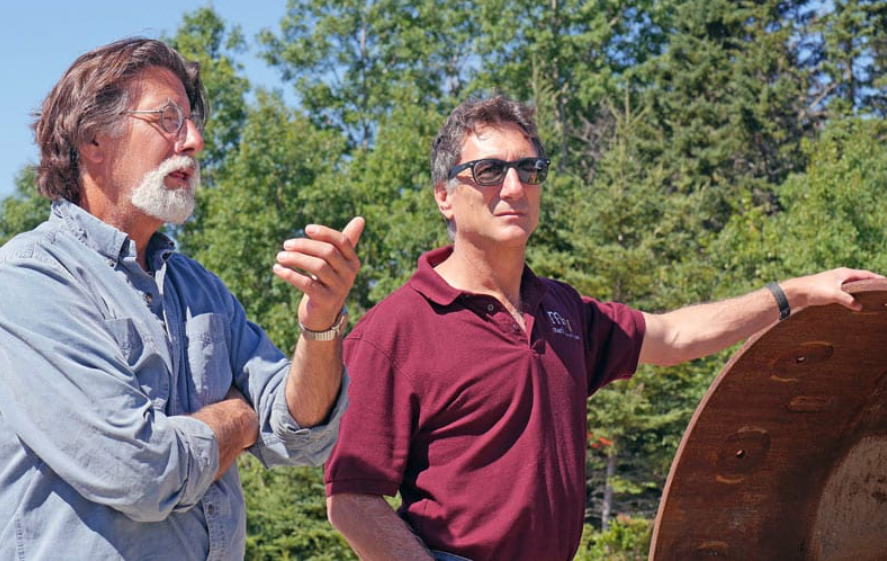
The discovery has silenced even the most skeptical members of the “War Room.” Marty Lagina, often the voice of pragmatic doubt, stood in silent affirmation as the full dimensions of the complex were revealed.
The structure’s depth appears to have been a deliberate choice. It was built just below the threshold of early detection technology, successfully evading discovery for over two centuries. It was only through the integrated scanning used in Episode 19 that the technology finally caught up to the engineering of the past.
As the team prepares for what is described as the “most important excavation in treasure hunting history,” the focus has shifted from “if” to “how.” The team must now approach the complex with archaeological precision, mindful that they are no longer just digging for gold, but breaching a vault that was never meant to see the light of day.