What a Medieval Jade Bracelet Could Mean for Rick Lagina and the Oak Island Investigation
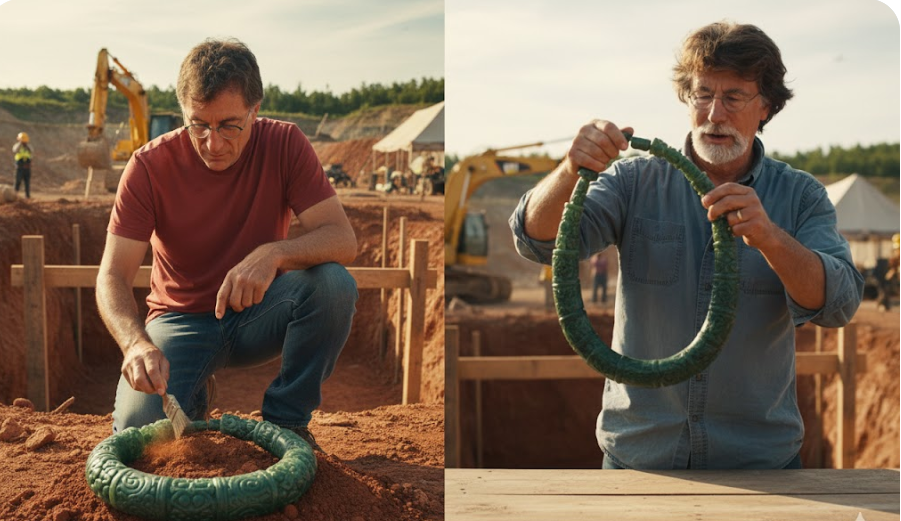
For more than a decade, The Curse of Oak Island has pursued one central question: who came to Oak Island before modern settlement, and why? Now, the reported discovery of a medieval jade bracelet by Rick Lagina and his team may represent one of the most consequential artefacts uncovered to date—provided its origin and context withstand scrutiny.
Jade is not a material commonly associated with medieval North America. Its presence immediately raises questions about long-distance trade, cultural exchange, and pre-Columbian contact. In Europe, jade objects were typically associated with status, ceremonial use, or elite adornment, particularly during the High Middle Ages. If authenticated as medieval and genuinely recovered from Oak Island soil, the bracelet could suggest a far more complex historical narrative than previously documented.
From an analytical standpoint, the most important factor is not the object itself, but its provenance. Oak Island’s history is layered with disturbances—from treasure hunts dating back to the 18th century to modern industrial excavation. For the bracelet to alter the investigation’s trajectory, the team must establish that it was found in an undisturbed stratigraphic layer consistent with medieval dating. Without that context, sceptics will argue that the artefact could have been introduced during later activity.
Assuming provenance can be verified, the implications expand rapidly. Jade in medieval Europe was rare and valuable, often imported through long trade networks that extended into Asia. This raises two immediate possibilities. The first is indirect transfer: the bracelet could have passed through multiple hands, arriving in the North Atlantic via Norse, merchant, or religious routes. The second is more controversial but increasingly discussed within Oak Island scholarship—that medieval Europeans, possibly linked to religious or military orders, reached the island intentionally.
Such a theory would align with earlier finds on Oak Island that hint at structured activity rather than accidental presence. Stone roads, wharf-like formations, and European-style artefacts have repeatedly challenged the idea that the island was untouched prior to modern settlement. A jade bracelet, particularly if stylistically linked to known medieval craftsmanship, would reinforce the argument that Oak Island functioned as a purposeful site rather than a transient stop.
From a programme analysis perspective, this discovery could reshape the team’s investigative priorities. Rick Lagina has increasingly emphasised evidence-driven archaeology over speculative treasure hunting. A verified medieval artefact would likely shift focus toward identifying habitation zones, storage areas, or ritual sites rather than exclusively pursuing deep-shaft targets like the Money Pit. We may see increased collaboration with European historians, gemologists, and medieval material-culture experts in upcoming episodes.
There is also the question of intent. Why would a valuable personal item such as a jade bracelet be left behind? One possibility is accidental loss during a prolonged stay. Another is deliberate deposition—perhaps as a religious offering or symbolic marker. The latter theory gains traction if additional personal or ceremonial items are recovered nearby. A single artefact raises questions; a cluster begins to suggest purpose.
Critically, the discovery could also help anchor Oak Island’s timeline. One of the series’ longstanding challenges has been connecting disparate finds across centuries into a coherent chronology. A medieval bracelet, accurately dated, would serve as a fixed reference point, potentially aligning other artefacts, wood samples, and structural remains within the same period. That alignment could clarify whether Oak Island activity was continuous or episodic.

Looking ahead, several developments seem likely if the bracelet proves authentic. First, expect expanded testing—not only of the jade itself, but of surrounding soil, associated metals, and organic material. Second, the team may redirect exploration toward shallower, wider excavation areas rather than deep drilling. Third, the discovery will likely prompt renewed debate over which historical groups could plausibly have reached Nova Scotia during the medieval period.
However, caution remains essential. Oak Island history is littered with promising finds that failed to withstand peer review. Rick Lagina has shown increasing awareness of this risk, often tempering on-screen reactions until expert confirmation is secured. If the bracelet’s dating or origin proves ambiguous, its impact may be narrative rather than historical.
Even so, from a programme analysis standpoint, the significance lies in momentum. The series has gradually moved away from singular “treasure” expectations toward a broader investigation of human activity and intent. A medieval jade bracelet fits squarely within that evolution. It suggests people with resources, knowledge, and purpose once stood on Oak Island—whether as explorers, traders, or custodians of something they deemed worth protecting.
If verified, this artefact may not answer Oak Island’s ultimate mystery. But it could redefine the questions being asked—and in doing so, mark a turning point in how the investigation proceeds from here.