New clues prove that Europeans were the first to arrive on Oak Island.
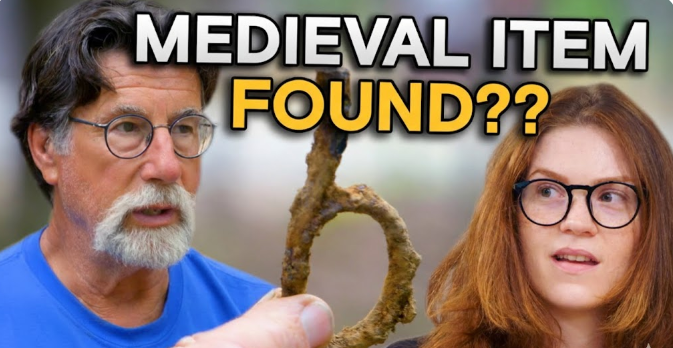
For decades, the mystery of Oak Island was anchored to a single year: 1795. The story we all knew began with three boys, a block and tackle, and a strange depression in the ground. However, as an analyst following the team’s progress on the ground, it is becoming increasingly clear that the “Money Pit” discovery was not the beginning of the story, but perhaps its final chapter. Recent activities on Lot 5 have provided a series of artifacts that do more than just hint at a pre-1795 presence—they effectively prove that Europeans were active on the island centuries earlier than previously believed.
The Roman Connection: A Puzzle in the North Atlantic
One of the most staggering revelations from Lot 5 involves the recovery of six ancient Roman coins. According to coin expert Sandy Campbell, these artifacts could be between 1,500 and 2,000 years old. While the presence of Roman currency on a Canadian island seems like an impossibility, the historical context provides a bridge. Experts suggest these coins remained in everyday circulation throughout Europe as late as the 1400s.
This discovery places a definitive European “footprint” on the island long before the age of discovery. It suggests that whoever visited Oak Island—be it Templars, Norse explorers, or unknown European voyagers—brought with them the currency of the old world. The team is now focusing their search east of these coin finds, eager to find the structures or encampments that might have housed these early visitors.
The Alchemy of the Lead Finds
The search led by Rick Lagina and Gary Drayton has unearthed another elongated piece of lead. For those of us who have analyzed the “Medieval Lead Cross” found in Smith’s Cove, this find is electric. The team is investigating whether this new lead artifact shares a chemical signature with the cross, which has already been linked to the 13th century.
The fact that these lead artifacts are surfacing on Lot 5—an area already rich with evidence of European visitation—suggests a concentrated effort by an organized group. This isn’t just a random shipwreck; it is a pattern of activity that points toward a specific, potentially medieval, European mission.
Deconstructing the “Horse Tack” Mystery
Perhaps the most intriguing sequence in recent days was the recovery of two wrought iron fragments. Initially, there was a divide in the team’s interpretation. Archaeologist Laird Niven hypothesized that the objects were horse tack, specifically a bridal cheek piece. This was a tantalizing theory because historical records show no evidence of Lot 5 being used for farming or grazing prior to 1795. If horses were on the lot, they weren’t there for farming—they were there for a major construction project.
However, the scientific intervention by metallurgist Emma Culligan provided a more precise, though equally significant, answer:
-
Scientific Dating: Lab analysis revealed the metal was produced via a pre-blast furnace method, indicating a date in the 1700s or potentially the late 1600s.
-
Metallurgy: The fragments showed sodium and chlorine values, proving they had been in prolonged contact with salt water.
-
Identification: Stylistic comparisons confirmed the items were handles to British shears from the mid-17th century.
Analysis: Why These Shears Matter
As an analyst, I find the identification of 17th-century British shears to be a “smoking gun” for pre-discovery activity. If these tools were dropped on Lot 5 in the 1600s, it proves that Europeans—specifically the British—were occupied on the island over a century before the Money Pit was discovered.
This aligns with the team’s broader theory: Oak Island was the site of a massive, clandestine military or industrial operation conducted by European powers. The “crudely made” nature of the wrought iron suggests these were working tools, not decorative items, indicating that real labor was being performed on Lot 5 long ago.
Predictions for Future Discoveries
Based on the current trajectory of the Lot 5 excavations, here is what I predict we will see in the coming months:
-
Subsurface Structures: With the discovery of tools (shears) and possible horse equipment, the team is likely to find the foundations of a temporary workshop or habitation site on Lot 5.
-
The Lead Scan Results: I expect Emma Culligan’s scan of the elongated lead piece to confirm a match with the medieval lead cross. This will solidify the 13th-century European connection and potentially link Lot 5 directly to the events at Smith’s Cove.
-
Expanded Metal Detecting: As Gary Drayton noted, the area “needs metal detecting,” and the team is moving with renewed urgency. We can expect a “surge” of finds near the center of the lot as they hunt for the missing pieces of the shears and further coinage.
Conclusion
The mystery of Oak Island is no longer just about a hidden treasure; it is about a hidden history. Lot 5 has become the primary stage for this revelation. By moving the timeline from 1795 back to the 1600s, and potentially the 1300s, the team isn’t just looking for gold—they are uncovering the lost records of European exploration in North America. As Rick Lagina aptly put it, the story goes “further back in time than we had even thought”.