A Boulder, a Void, and an Unusual Lead Signal: Why Lot 8 Could Mark a Turning Point on Oak Island
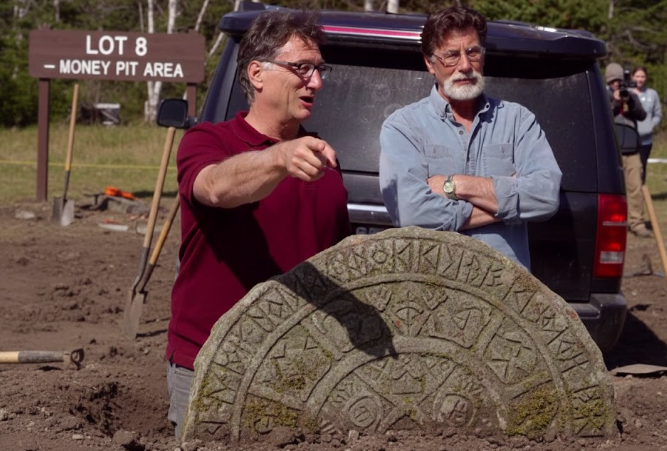
For viewers of The Curse of Oak Island, patience has always been part of the experience. Discoveries rarely arrive fully formed. Instead, meaning is built layer by layer — through context, testing, and careful interpretation. The recent developments surrounding a massive boulder on Lot 8 may represent one of the clearest examples of that slow-burn process paying off.
At first glance, the stone itself appeared unremarkable: several tons of rock resting among smaller, deliberately placed stones. But it was the arrangement, not the size, that raised eyebrows. The evenly spaced support stones suggested human intervention rather than natural deposition. When the archaeological team exposed the ground beneath, what they found immediately challenged assumptions.
Beneath the boulder was disturbed soil — not compacted earth, but loose, back-filled material. More striking still was a void beneath the rock, large enough to suggest deliberate excavation. Snake camera footage hinted at objects within the cavity, including what appeared to be an iron stake and reflective material that caught the team’s attention.
From a programme-analysis standpoint, this moment matters because Oak Island rarely presents a single anomaly in isolation. Features that persist through multiple investigative methods — visual inspection, subsurface imaging, and now chemical analysis — tend to become central storylines.
That is where Dr. Ian Spooner enters the picture.
The Lead That Shouldn’t Be There
Dr. Spooner’s soil core analysis delivered one of the most compelling data points of the season. Beneath the boulder, organic material showed lead concentrations as high as 140 parts per million, compared with background levels closer to 12 parts per million elsewhere on the island.
This disparity is significant. Lead does not accumulate naturally in organic forest soil at those levels without an external process. As Spooner explained, such concentrations are consistent with burning activity, particularly prolonged fires involving wood or coal.
Historically, fire has been used to ventilate underground spaces. From ancient mining practices in Europe to early tunnel systems, controlled burning at shaft openings created airflow, drawing smoke upward and fresh air downward. The implication is not simply heat or habitation, but purposeful underground work.
Equally important was what Spooner did not find. Nearby soils lacked similar lead enrichment, ruling out a broad environmental source. The signal appears localized — directly tied to activity beneath the boulder.
For analysts of the show, this is the moment when a feature crosses from curiosity to consequence.
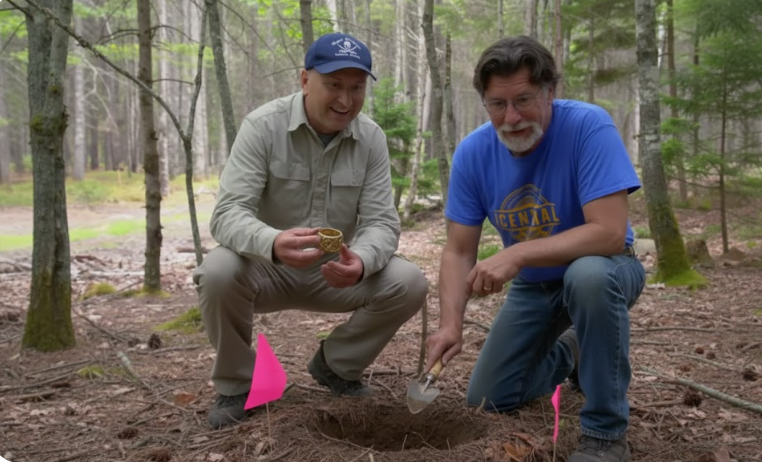
Voids, Structure, and Intent
When archaeologists reinserted cameras after further excavation, the imagery suggested not a single hollow space, but a network of voids, described by team members as a “matrix.” That language matters. Oak Island history is defined by engineered complexity: shafts, tunnels, drains, and back-fill designed to conceal and protect.
The presence of multiple voids beneath a stabilized boulder suggests more than a random cavity. It points toward intentional construction, followed by concealment. If something lay beneath — or passed through — this area, the boulder may have served as both protection and marker.
As Rick Lagina noted during the investigation, significant effort appears to have gone into placing and stabilizing the stone. That level of labour implies that what lay beneath was considered valuable enough to justify the work.
The Gold-Coloured Mystery
The most visually arresting moment came when camera footage revealed rock-like material with golden, vein-like coloration embedded within it. While caution remains essential — mineral staining and subsoil can produce misleading appearances — several experienced team members remarked on its luster and definition.
From an editorial standpoint, the show wisely resisted immediate conclusions. Archaeologists raised valid concerns about context and formation. Yet the fact remains: if this coloration represents mineralization or processed material, its position beneath an untouched boulder raises urgent questions.
Why place such material there? Why protect it so carefully? And why was it never retrieved?
Why Lot 8 Now Matters More Than Ever
Oak Island investigations often pivot on moments where multiple lines of evidence converge. Lot 8 now presents:
-
Engineered stone placement
-
Disturbed and back-filled soil
-
Subsurface voids
-
Anomalously high lead concentrations
-
Visual indications of unusual material
Taken together, these elements form a compelling case for human activity tied to underground construction, rather than surface-level occupation.
From a series-analysis perspective, this positions Lot 8 as a potential secondary access point — perhaps linked indirectly to larger systems elsewhere on the island. It also aligns with long-standing theories that valuables were not simply buried, but engineered into a broader network of concealment.
What Happens Next
The decision to lift the boulder is not just a dramatic escalation; it is a logical next step following exhaustive non-invasive work. Archaeologists have documented the feature, tested the soils, and explored accessible voids. Moving the stone now becomes a controlled transition rather than a leap.
If further artifacts emerge — particularly items that can be dated or culturally identified — Lot 8 could help anchor Oak Island’s mystery to a specific period or group. Even structural elements alone would deepen understanding of how underground systems were constructed and ventilated.
For viewers, this development represents one of the most cohesive investigative arcs in recent seasons. It is not a single object driving speculation, but evidence layered with method and restraint.
Whether or not treasure ultimately lies beneath the boulder, Lot 8 has already delivered something crucial: clarity. It reinforces the idea that Oak Island’s story is not about chance loss, but about deliberate action — carefully planned, carefully hidden, and waiting to be understood.