A Personal Treasure, Not Loose Gold: Why This Single Gold Ring May Be the Most Important Find in Oak Island History
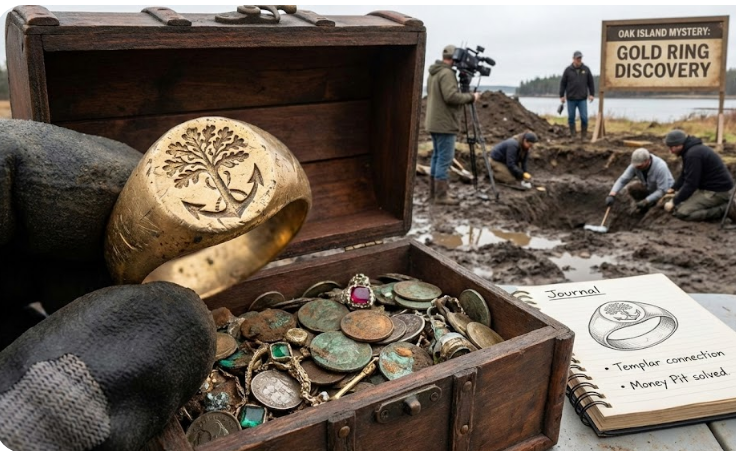
For more than a decade, The Curse of Oak Island has trained its audience to treat every artifact as a clue rather than a conclusion. If the team were to uncover a valuable gold ring inside a treasure chest, the significance would extend far beyond the object itself. From a programme-analysis perspective, such a find would represent one of the clearest narrative pivots the series has seen — not proof of treasure, but evidence of intent.
A gold ring immediately changes the conversation. Unlike coins, tools, or fragments of metal that can be explained away through trade, loss, or later occupation, a ring implies personal ownership. It suggests that whoever placed it there expected to retrieve it. In the logic of Oak Island, that distinction matters enormously.
Why a Ring Is Different From Previous Finds
Over the years, the team led by Rick Lagina and Marty Lagina has uncovered a wide range of artifacts — coins, buttons, tools, and decorative items. Most have pointed to European activity predating official settlement, but none have definitively proven a deliberate cache of personal wealth.
A gold ring, particularly one recovered from a sealed or structured container, crosses a threshold. Rings are not utilitarian objects. They carry symbolic, financial, and sometimes institutional meaning. Depending on its design, metallurgy, and craftsmanship, such a piece could be associated with status, rank, or affiliation — whether mercantile, military, or religious.
From a production standpoint, this is the kind of discovery that would likely be framed not as an endpoint, but as a gateway. The show’s editorial pattern suggests that the ring would immediately trigger a cascade of expert consultations, laboratory testing, and historical comparisons.

Likely Analytical Steps the Show Would Take
The first phase would almost certainly focus on authentication and dating. Specialists in metallurgy and historical jewellery would be brought in to determine composition, manufacturing techniques, and wear patterns. Is the gold alloy consistent with medieval European standards? Does the design align with known periods — 14th century, 16th century, or later?
Next would come contextual analysis. Where exactly was the chest found? Was it associated with a shaft, tunnel, or engineered structure? Oak Island’s narrative strength lies in its insistence that placement matters as much as the artifact itself. A ring found loose in soil tells one story. A ring found inside a chest, within a controlled environment, tells another entirely.
If the chest were linked to known features — the Money Pit area, Smith’s Cove, or a solution channel — the discovery would almost certainly redirect excavation priorities.
How This Could Shift the Season’s Direction
From an analyst’s viewpoint, a gold ring inside a chest would likely become a season-defining anchor. The show has historically structured its episodes around escalating credibility: early finds suggest activity; later finds suggest planning; rare finds suggest purpose.
A ring fits squarely into the final category.
Expect the narrative to pivot toward who rather than what. The focus may move away from abstract treasure theories and toward identifying potential owners: European nobility, high-ranking merchants, or organized groups with the means to transport and conceal valuables across the Atlantic.
This would also strengthen long-standing theories involving organized expeditions rather than isolated individuals. Whether the show leans toward medieval trade networks, military operations, or religious orders, the emphasis would be on deliberate concealment by people with resources.

Predictions for What Comes Next
If this discovery were real within the show’s framework, several developments are likely:
-
Expanded Excavation Around the Find Site
The area surrounding the chest would become a focal point. Additional structural elements — woodwork, fasteners, or secondary containers — could emerge, reinforcing the idea of a broader cache. -
Parallel Historical Investigation
Expect archival research to intensify. Old maps, shipping records, and European records would be re-examined to identify groups known to use rings of similar design or value. -
Heightened Technical Caution
The team has become increasingly careful in recent seasons. A find of this magnitude would likely slow excavation rather than accelerate it, prioritising documentation and preservation. -
Narrative Reframing
Editorially, the show would likely frame the ring not as “the treasure,” but as confirmation that treasure was meant to be there. This distinction preserves the long-term arc while raising credibility.
What This Means for the Long-Term Mystery
Crucially, a gold ring does not solve Oak Island — it narrows it. It strengthens the argument that the island was used intentionally, by people who understood value, secrecy, and recovery. For viewers, that shift matters. It moves the series away from coincidence and closer to purpose.
From a programme analysis perspective, this kind of find would justify continued exploration without overpromising resolution. It supports the show’s central thesis: that Oak Island is not a random accumulation of objects, but a constructed puzzle layered over time.
If handled carefully, a gold ring in a treasure chest could become one of the most consequential moments in the series — not because it ends the search, but because it finally explains why the search exists at all.