“I Have to Tell the Truth”: Marty Lagina Finally Reveals Oak Island’s Biggest Secret After 220 Years

For over two centuries, Oak Island in Nova Scotia has been shrouded in mystery. Countless treasure hunters, historians, and explorers have attempted to uncover its secrets, but the elusive Money Pit and surrounding tunnels have long defied discovery. In a groundbreaking turn of events, Marty Lagina, long regarded as the methodical and skeptical mind behind the Oak Island expeditions, has finally revealed what may be the island’s most significant secret. This revelation has the potential to rewrite centuries of speculation and may mark a new chapter in understanding one of history’s longest-running treasure mysteries.
Marty’s approach has always distinguished him from others chasing the island’s legends. While his brother Rick is captivated by stories of pirates, treasure, and buried riches, Marty has consistently focused on evidence, engineering, and logic. For years, he emphasized that any worthwhile discovery must be backed by solid data, rather than legend. This analytical perspective, combined with meticulous study of historical maps, soil surveys, and ground-penetrating radar, ultimately led him to a discovery that defies the expectations of both skeptics and believers. Rather than digging blindly at the Money Pit, Marty examined overlooked areas, paying close attention to patterns in the terrain and engineered drainage systems. His hypothesis: the true secret would be concealed in a location designed to avoid attention, protected by practical measures rather than spectacle.
The breakthrough emerged from a modest rise on the eastern side of Oak Island, previously dismissed by many as unremarkable. By analyzing drainage patterns, Marty noted that water was being redirected around this area rather than flowing through it—a deliberate engineering solution. This suggested the presence of a man-made structure below, designed to remain dry for centuries. A careful excavation revealed a stone platform and, beneath it, a sealed chamber. The construction was sophisticated, with channels carved into rock to prevent water intrusion, indicating that whoever built the structure had both engineering knowledge and the foresight to preserve its contents for generations.
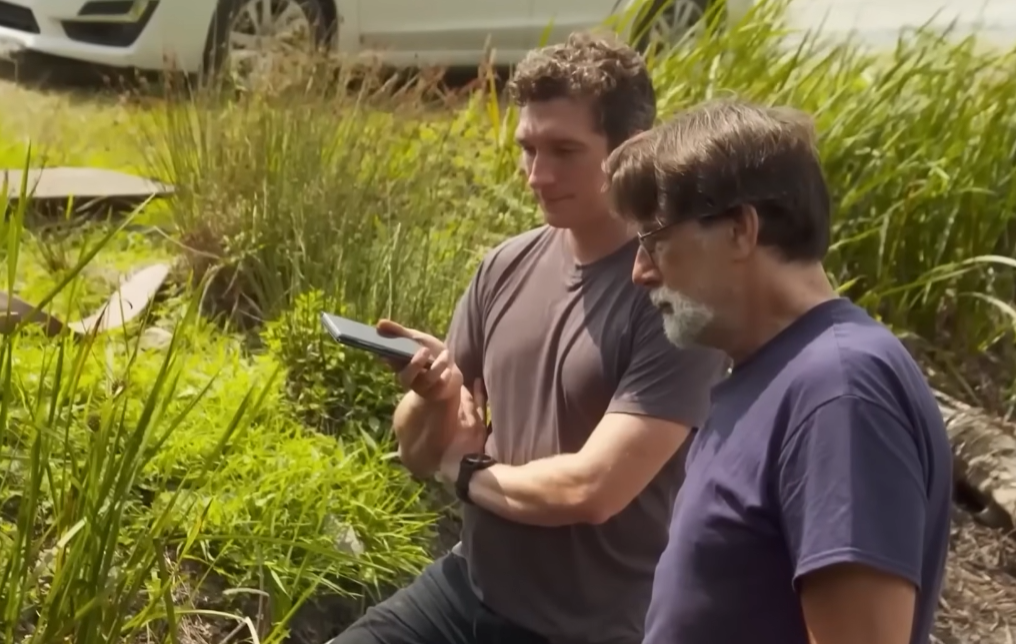
Inside the chamber, the Lagina team found a remarkable collection of artifacts. The first was a stone slab engraved with precise engineering drawings, detailing a network of underground tunnels and chambers, including a bypass for Oak Island’s infamous flood tunnels. This level of planning indicated that the creators were not merely hiding treasure—they were designing a defensive system to protect something of significant value. A lead container sealed with wax contained handwritten French documents outlining labor, materials, and costs, dated 1762 and prepared by an engineer under the French crown. These documents corroborated the existence of a highly organized vault, constructed during a period when France controlled parts of North America and faced mounting pressure from Britain.
Perhaps most astonishing was a copper cylinder containing a parchment inventory of the vault’s contents. The documents listed gold, religious relics, confidential government records, and valuable possessions of French aristocrats fleeing political upheaval. Financial historians estimate the value of these items at over $240 million in today’s currency. This discovery suggests that Oak Island was not merely a playground for folklore but a deliberately engineered storage site for assets of extraordinary historical and monetary value. The engineering sophistication of the chamber, coupled with the precise documentation, supports Marty’s long-standing hypothesis that the island’s mysteries are rooted in calculated design rather than coincidence.
From an analytical perspective, this revelation changes the narrative of Oak Island. For generations, explorers focused on the Money Pit, often risking life and fortune to uncover what they believed was the main treasure. Marty’s discovery indicates that the Money Pit may have been a distraction, engineered to divert attention from the true vault. This reinforces the idea that Oak Island was a site of strategic planning, intended to protect valuable assets through misdirection and robust engineering rather than relying solely on concealment or legend.
Looking forward, several developments are likely. First, the vault itself remains largely unexplored. Following the original blueprint, the team could create a precise access tunnel that bypasses the flood system entirely. This would allow for careful extraction of the items while preserving the integrity of the structure. The operation will likely require sophisticated engineering, substantial funding, and careful planning to avoid damage, suggesting that Oak Island will remain a focus of intensive exploration for years to come.

Second, the implications for historical research are profound. The artifacts provide insight into French colonial strategy, resource allocation, and engineering in the mid-18th century. Scholars may now be able to study these materials to better understand political, military, and economic decisions of the era. The combination of architectural innovation and documented inventory demonstrates a level of sophistication that challenges previous assumptions about colonial activity in Nova Scotia.
Finally, the personal and public impact of Marty’s revelation cannot be overstated. For decades, skeptics doubted the existence of anything significant on Oak Island, while believers questioned the patience and rigor of modern explorers. Marty’s evidence-based approach validates years of careful observation and methodical investigation, demonstrating that patience, scientific inquiry, and engineering analysis can yield results even in seemingly intractable historical mysteries.
In conclusion, Marty Lagina’s disclosure of Oak Island’s long-hidden vault represents a turning point in one of the world’s most enduring treasure hunts. From the perspective of a show analyst, the discovery highlights the value of evidence-driven exploration, the ingenuity of 18th-century engineers, and the enduring human fascination with uncovering hidden knowledge. As excavation and analysis continue, viewers and historians alike can anticipate a wealth of discoveries that may finally illuminate the full scope of Oak Island’s secrets, solving a mystery that has captivated generations for over 220 years.